
Loading, please wait...
_900x900.jpg "Roman 'Consular' Lead Slingshot")
_200x200.jpg "Roman 'Consular' Lead Slingshot")
.jpg "Roman 'Consular' Lead Slingshot")
LOT 1465
Roman 'Consular' Lead Slingshot
1ST CENTURY B.C.
1 3/8 in. (38 grams, 36 mm).
Fusiform shot with casting nipple at each end, low-relief legend 'COS' to one face and traces of letters on the other. [No Reserve]
ProvenanceFrom the collection of a London antiquarian, formed since the 1980s.
LiteratureCf. D'Amato, R. and Sumner, G., Arms and Armour of the Imperial Roman Soldier: From Marius to Commodus, 112 BC-AD 192, London, 2009, fig.32, p.45, for a similar glandes from Zaragoza Museum, from Munda battlefield.
FootnotesThe shot (Völling type 1C) is marked with the abbreviation COS, meaning CO(N)S(UL), the highest military magistrate of the Roman Res Publica. The projectiles were made of different materials: lead (glandes) or pottery or stone (lapides missiles).
CONDITIONTimeLine Auctions follows a vetting process to ensure the authenticity and legality of all items, reinforcing our commitment to integrity and responsible trading. Each antiquity, antique, and coin lot undergoes thorough examination by a vetting committee of at least ten external specialists, professional trade association members, scientists, and archaeologists: Our Vetting Process
AUCTIONS:
TimeLine is a leading auction house specialising in antiquities, ancient art, collectables, natural history, coins, medals, and books. Our auctions offer museums, collectors, historians, and enthusiasts the opportunity to acquire unique and historically significant pieces.
-
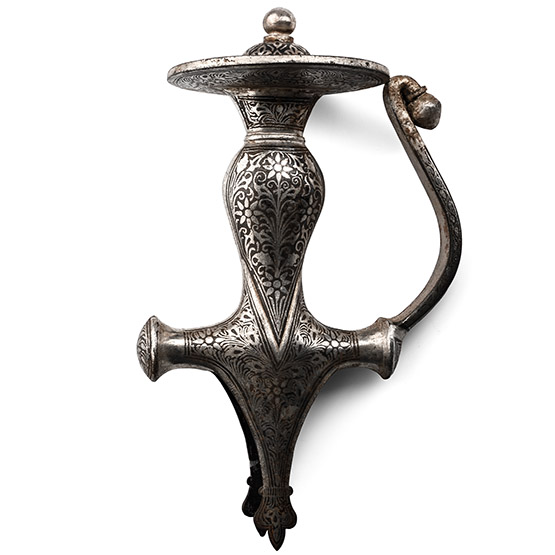
Indian Silvered Bronze Sabre Handle
20th century A.D.Sold for (Inc. bp): £195
Comprising a lentoid-section bulbous grip with lateral stub quilloons and carinated spur to both faces ending in a trefoil, dished disc pommel with dome and knop; curved knuckle-guard with returned knop finial; reserved panels of arabesque foliage ornament, rosettes and linear detailing. 447 grams, 19.1 cm
Private collection, UK. -
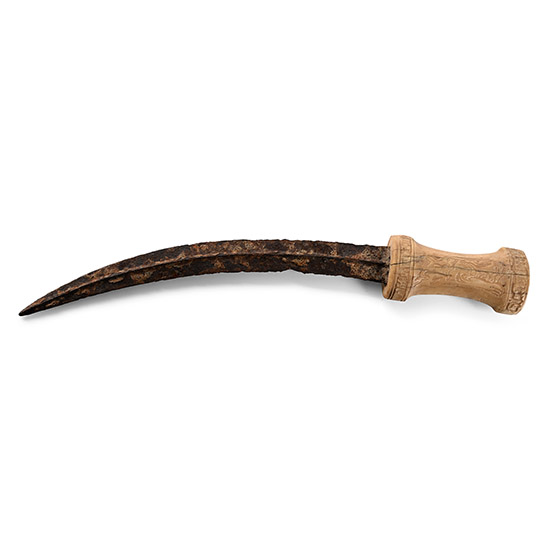
Western Asiatic Iron Dagger with Bone Hilt
19th-early 20th century A.D.Sold for (Inc. bp): £52
Comprising a curved iron blade with midrib, waisted bone hilt with carved scene to each face, band of text above and below. 550 grams, 46 cm
Private collection, UK. -
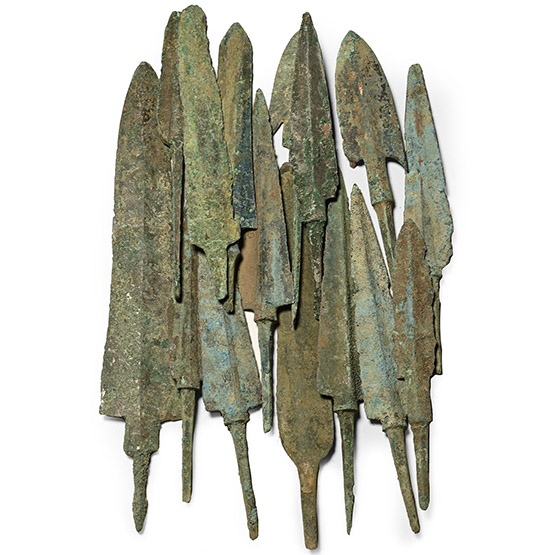
Luristan Bronze Arrowhead Group
13th-6th century B.C.Sold for (Inc. bp): £234
Including barbed, triangular, heater-shaped and other tanged types. 442 grams total, 11.3-19.5 cm
Acquired 1980-2015. Ex Abelita family collection.
