
Loading, please wait...
LOT 0157
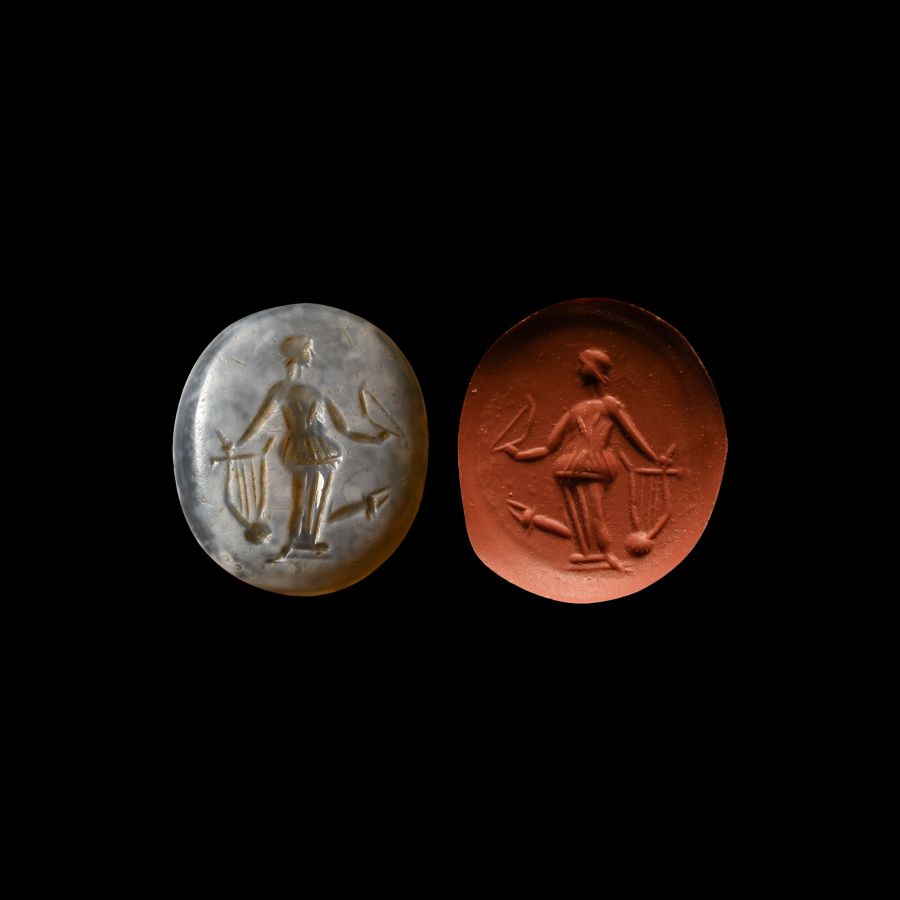
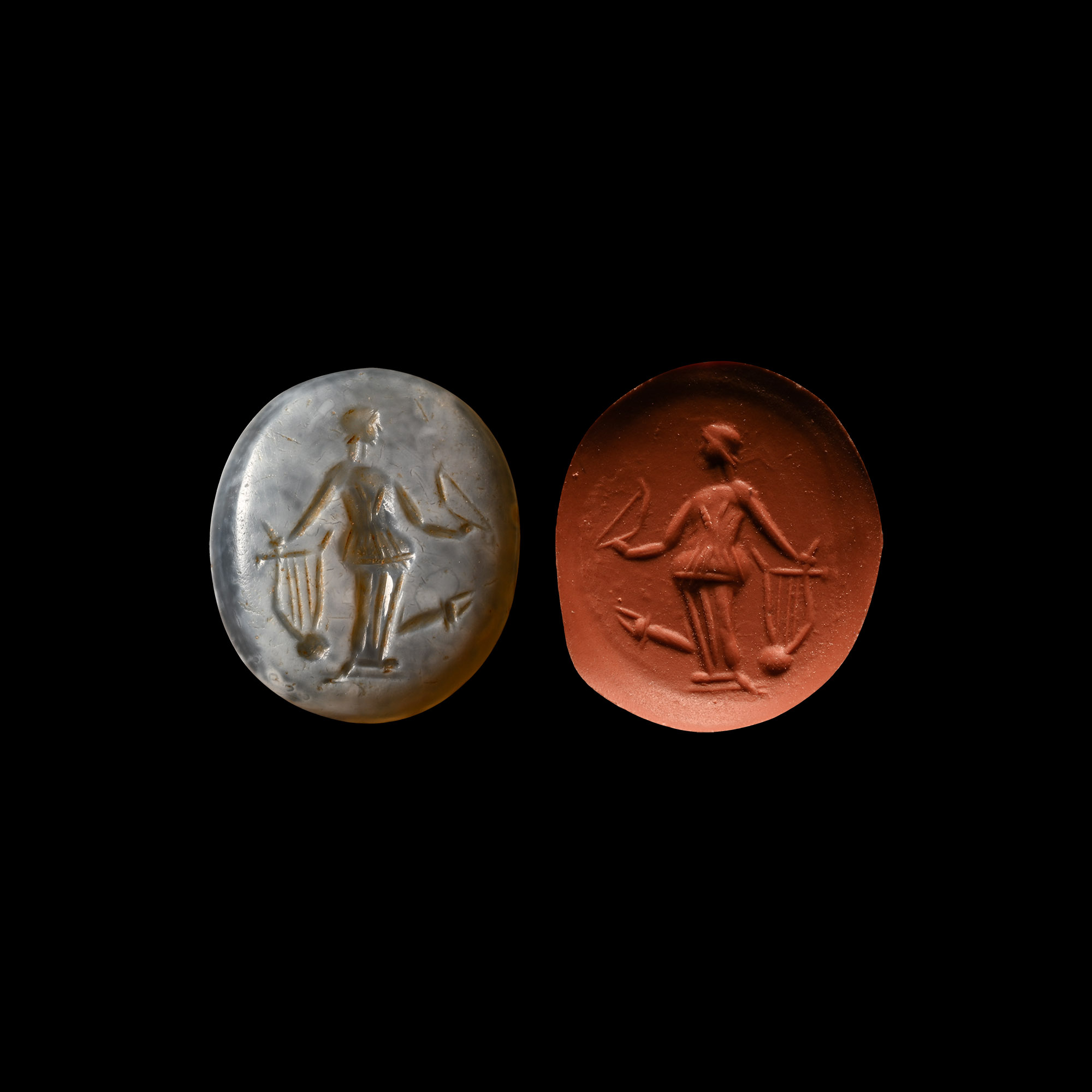
Roman Chalcedony Gemstone with Muse Euterpes
1ST CENTURY A.D.
5/8 in. (0.77 grams, 14 mm).
The muse standing on a baseline with her head in profile, resting her left arm on a cithara, carrying a laurel branch in her extended right hand, the weight of the body resting on the right leg.
ProvenanceAcquired in the late 1980s-early 1990s.
Important North West London collection.
Cf. similar images of Apollo in Behemerid, A.G., ‘La coleccion Cluniense de Gliptica’, in BSAA arqueologia, LXXI, 2005, pp.185-208, pl.I, no.6.
FootnotesThe muse is Euterpe, the muse of music as well as lyrical poetry. The motif can be related to numerous representations of Apollo, in which he appears leaning on a column on which the lyre or tripod is placed. It is a serial representation, based on statuary prototypes, which were widely copied by Hellenistic-Roman artisans, where the figure of Apollo, here, is transformed in that of the muse of music.
CONDITIONTimeLine Auctions follows a vetting process to ensure the authenticity and legality of all items, reinforcing our commitment to integrity and responsible trading. Each antiquity, antique, and coin lot undergoes thorough examination by a vetting committee of at least ten external specialists, professional trade association members, scientists, and archaeologists: Our Vetting Process
AUCTIONS:
TimeLine is a leading auction house specialising in antiquities, ancient art, collectables, natural history, coins, medals, and books. Our auctions offer museums, collectors, historians, and enthusiasts the opportunity to acquire unique and historically significant pieces.
LOT 0157
Roman Chalcedony Gemstone with Muse Euterpes
Estimate £800 - 1,000€930 - 1,160 (for guidance only)$1,080 - 1,350 (for guidance only)
-
.jpg)
Roman Bronze-Handled Key with Panther
1st-4th century A.D.Estimate: £600 - 800 (+bp*)
Opening Bid: £300
The bronze handle modelled as the forequarters of a panther leaping from a crown of fronds, with stylised facial detailing; iron stem, bit and wards. 74 grams, 77 mm
Acquired on the German art market around 2000s. From the collection of an EU gentleman living in the UK. -
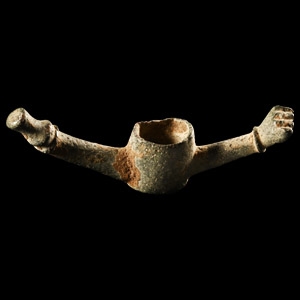
Roman Bronze Phallic and Fist Fitting
1st-4th century A.D.Estimate: £150 - 200 (+bp*)
Opening Bid: £75
The central circular socket flanked by a stylised phallus on one side and an extended arm with clenched fist on the other. 12.8 grams, 57 mm
From the collection of a Cambridge lady, 1990s. -
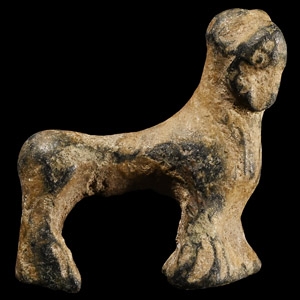
Roman Bronze Standing Lion Statuette
1st-4th century A.D.Sold for (Inc. bp): £169
Modelled in the round with naturalistic detailing, standing with head turned to the right. 12.3 grams, 26 mm wide
‘The Ancient Menagerie Collection’ formerly the property of a Cambridgeshire lady, collected since the 1990s and acquired from auctions and dealers throughout Europe and the USA, now ex London collection.
