
Loading, please wait...
LOT 0160
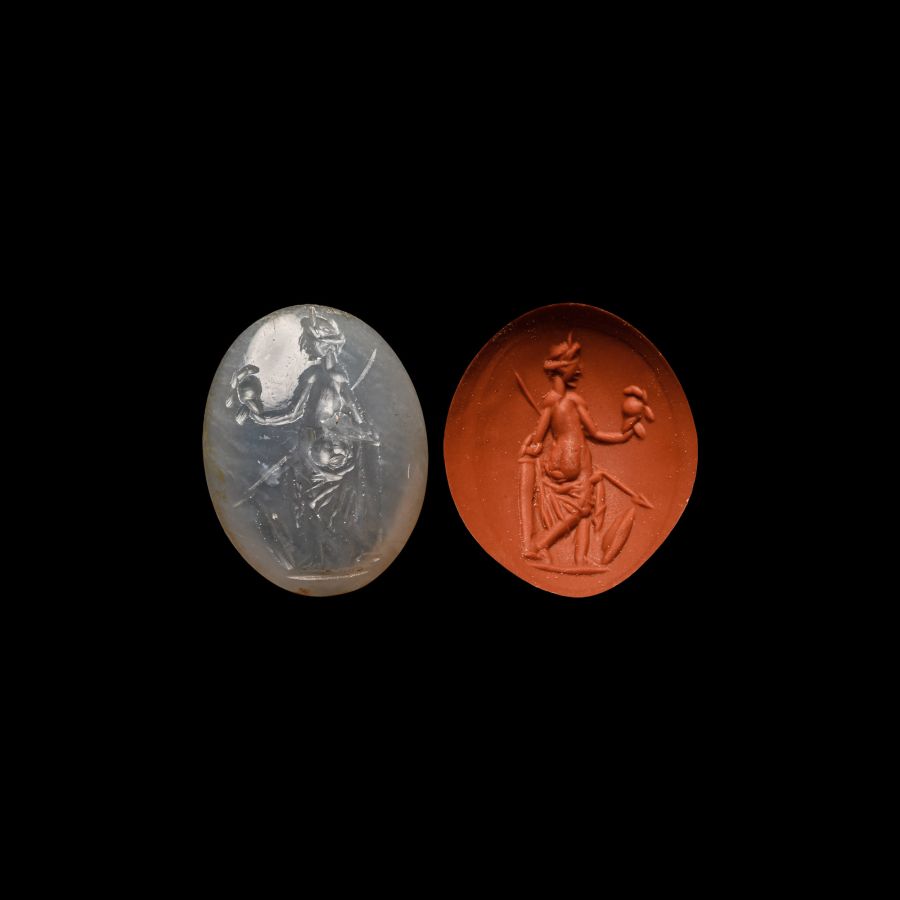
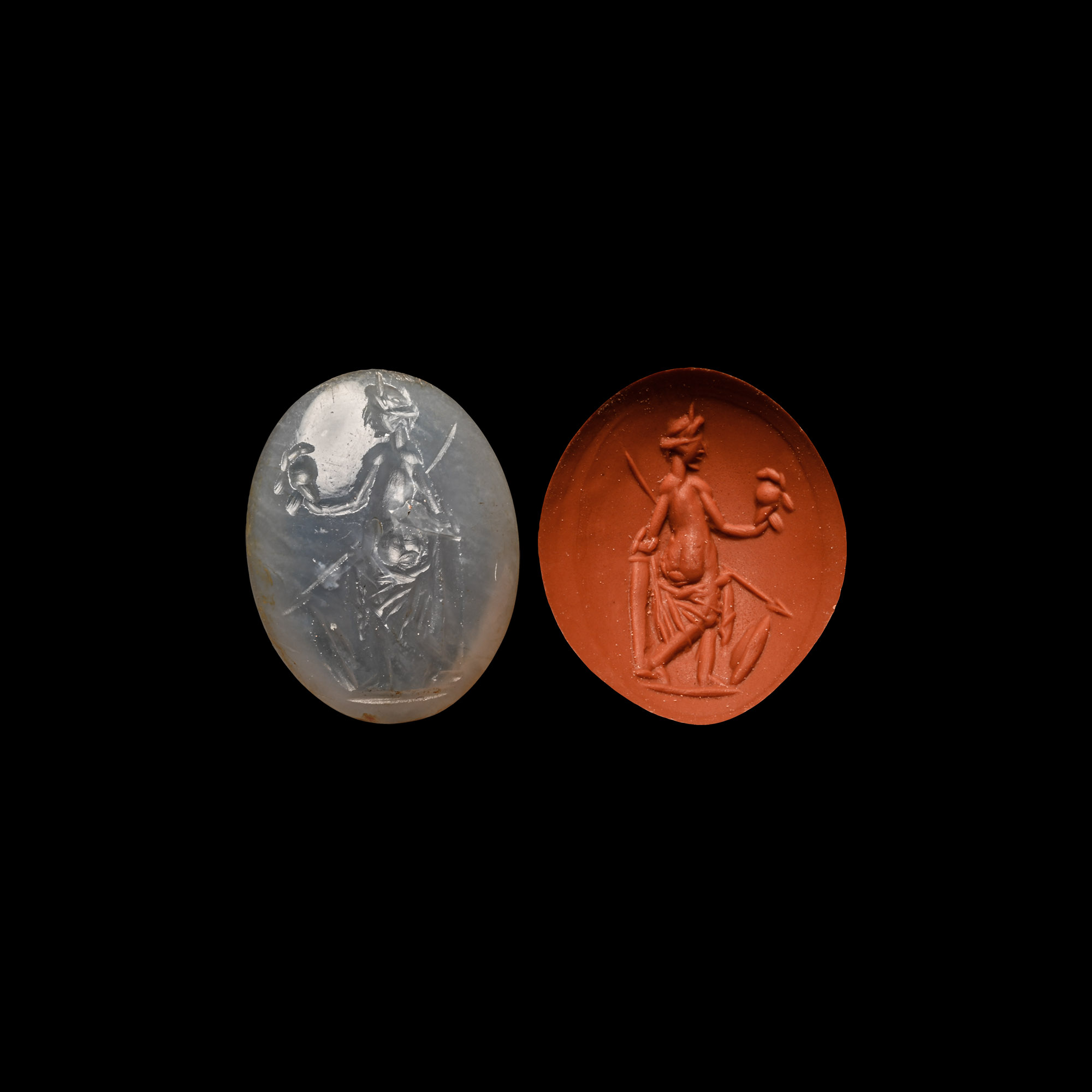
Roman Chalcedony Gemstone with Aphrodite Kallipygos
1ST CENTURY A.D.
1/2 in. (0.84 grams, 12 mm).
The goddess seen from behind, drapery around her legs, resting her left hand on a column and holding up an object in her right hand.
ProvenanceAcquired in the late 1980s-early 1990s.
Important North West London collection.
Cf. Walters, H.B., Catalogue of Engraved Gems & Cameos, Greek, Etruscan & Roman in the British Museum, London, 1926, no.3859.
FootnotesThe famous statue of Aphrodite Kallipygos, the model for this gemstone, recalls a story reported in the Deipnosophists of Athenaeus regarding the foundation of a temple to her in ancient Syracuse. According to Athenaeus, two beautiful sisters from a farm near Syracuse quarrelled over which of them had the most shapely buttocks, and approached a young passer-by to judge. They showed themselves to the traveller, the son of a rich man, and he voted for the older sister. Later, he fell in love with her and fell ill with lovesickness. Upon learning of what had happened, the man's younger brother went to see the girls and fell in love with the younger sister. Consequently the brothers refused to consider any other brides forcing the father to arrange for the sisters to come and marry them. The townspeople nicknamed the sisters ‘Kallipygoi’ (‘Women with Beautiful Behinds’) and the young men, with their newfound prosperity, dedicated a temple to Aphrodite, naming her ‘Kallipygos’.
CONDITIONTimeLine Auctions follows a vetting process to ensure the authenticity and legality of all items, reinforcing our commitment to integrity and responsible trading. Each antiquity, antique, and coin lot undergoes thorough examination by a vetting committee of at least ten external specialists, professional trade association members, scientists, and archaeologists: Our Vetting Process
AUCTIONS:
TimeLine is a leading auction house specialising in antiquities, ancient art, collectables, natural history, coins, medals, and books. Our auctions offer museums, collectors, historians, and enthusiasts the opportunity to acquire unique and historically significant pieces.
-
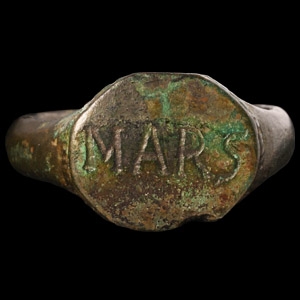
Roman Bronze Ring with Inscription
1st-4th century A.D.Sold for (Inc. bp): £494
The hoop with convex outer face and rounded octagonal bezel, later inscribed 'MARS'. 4.54 grams, 23.00 mm overall, 16.93 mm internal diameter (approximate size British N, USA 6 1/2, Europe 13.72, Japan 13)
Acquired on the German art market around 2000s. From the collection of an EU gentleman living in the UK. -
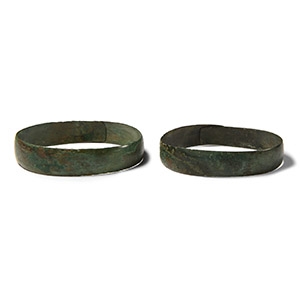
Roman Bronze Bracelet Group
1st-4th century A.D.Sold for (Inc. bp): £59
Comprising two flat-section bracelets with overlapping rounded terminals. 28.7 grams total, 61-63 mm
From the family collection of a Surrey gentleman since before 1960.
Bracelets were worn in Rome by ladies of rank, but it was considered a mark of effeminacy for civilian men to use such female ornaments (Suetonius, Caligula, 52; Nero, 30). The armillae (or psellia in Greek) were rings and bracelets worn by women in the Graeco-Roman world on both legs and arms. Homer mentions them (elikas) as being part of the hairstyle of the divine Aphrodite, thus giving an almost sacred character to these objects. There were different types, the most common consisting of a more or less thick metal wire, or a flat or cylindrical circle, like our examples. -
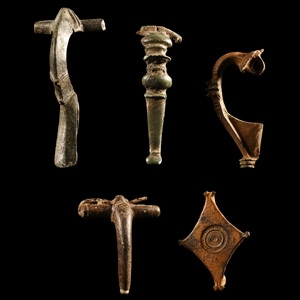
Roman Bronze Brooch Group
1st-3rd century A.D.Sold for (Inc. bp): £91
Comprising: lozengiform plate brooch; Colchester-type bow brooch; trumpet-headed bow brooch; and other types. 37.5 grams total, 32-52 mm
Acquired on the UK market, 1990s. Property of a retired academic.
