
Loading, please wait...
LOT 0141
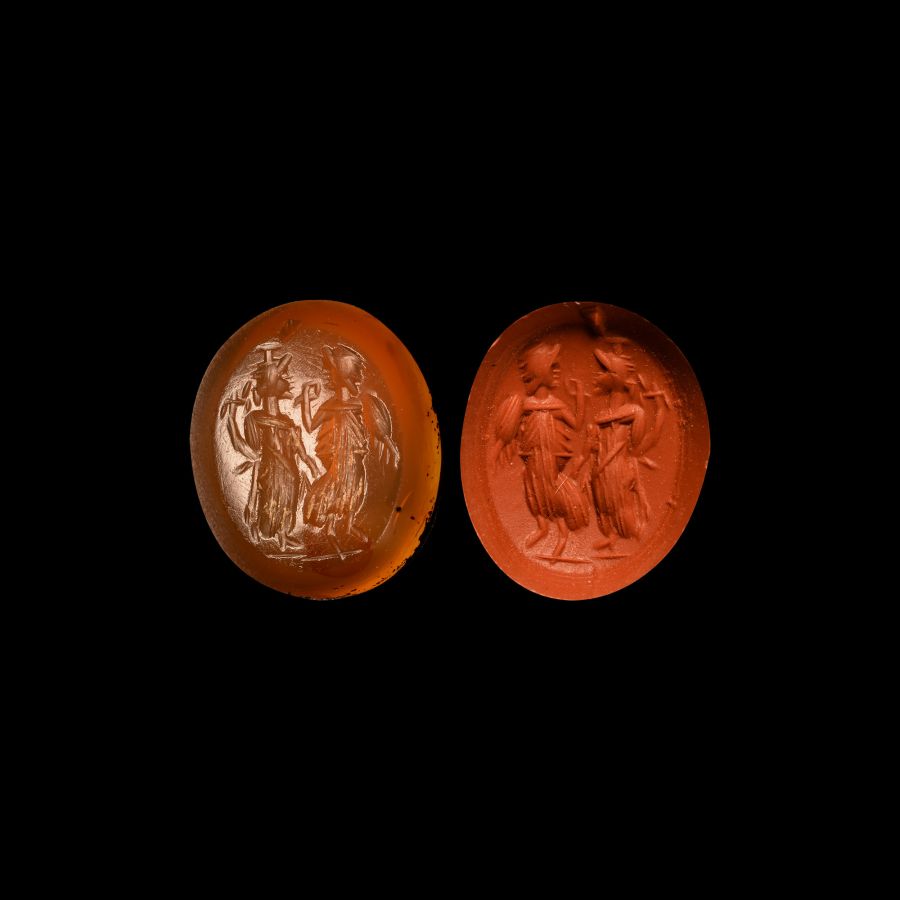
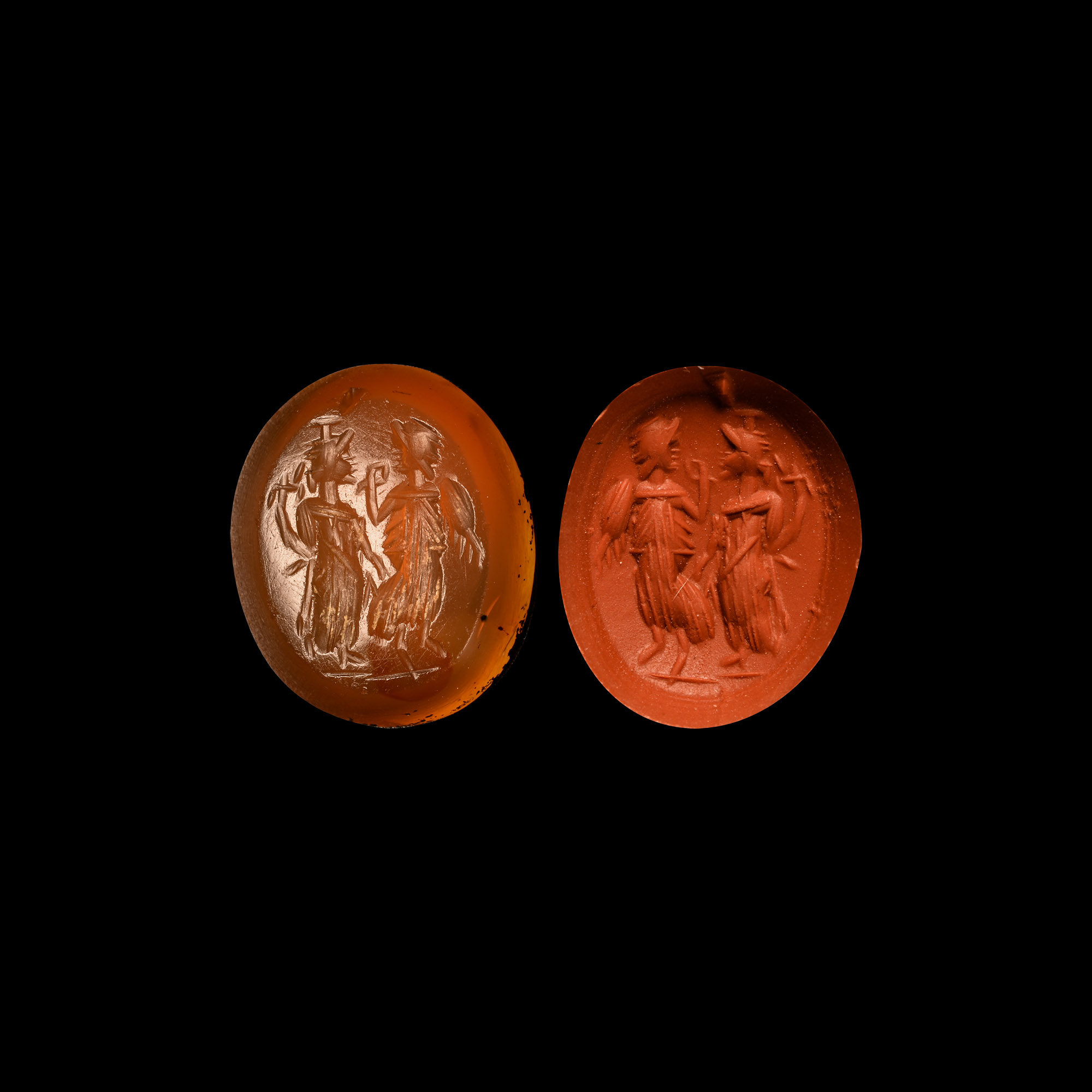
Roman Carnelian Gemstone with Serapis and Isis
2ND-3RD CENTURY A.D.
3/4 in. (2.51 grams, 18 mm).
The oval intaglio showing Serapis holding a sceptre and wearing a modius upon his head; Isis, wearing a feather(?) headdress and holding a sistrum.
ProvenanceAcquired in the late 1980s-early 1990s.
Important North West London collection.
Cf. Walters, H.B., Catalogue of Engraved Gems & Cameos, Greek, Etruscan & Roman in the British Museum, London, 1926, no.1030, for the type.
FootnotesSerapis was known to the Greek and Roman world already in the 3rd century B.C. in Alexandria, where Ptolemy I built a serapeum in honour of the god. The name of the god is considered to be composed from the names Osiris and Apis bull and means 'Osiris the bull' since after his death he became the ruler of the outer world, while it was also believed that Osiris lived in the world through Apis. Isis, his spouse, was worshipped in the Roman Empire as a powerful divinity, mother of the gods.
CONDITIONTimeLine Auctions follows a vetting process to ensure the authenticity and legality of all items, reinforcing our commitment to integrity and responsible trading. Each antiquity, antique, and coin lot undergoes thorough examination by a vetting committee of at least ten external specialists, professional trade association members, scientists, and archaeologists: Our Vetting Process
AUCTIONS:
TimeLine is a leading auction house specialising in antiquities, ancient art, collectables, natural history, coins, medals, and books. Our auctions offer museums, collectors, historians, and enthusiasts the opportunity to acquire unique and historically significant pieces.
-
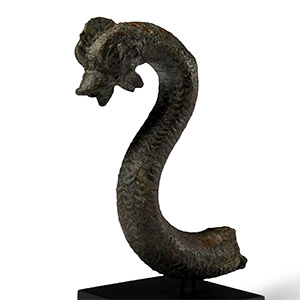
Large Roman Bronze Mythical Cockerel-Headed Snake
4th century A.D.Estimate: £500 - 700 (+bp*)
Opening Bid: £278
The upper body, neck and head of a mythical basilisk, modelled in the round with the body of a serpent and head of a cockerel, the body with a tapering round-section profile, stylised detailing to the head. 260 grams, 88 mm
‘The Ancient Menagerie Collection’ formerly the property of a Cambridgeshire lady, collected since the 1990s and acquired from auctions and dealers throughout Europe and the USA, now ex London collection.
The basilisk was a Graeco-Roman mythical two-legged dragon or serpent-like creature with a cock's head. It had the reputed ability to kill people by either looking at them, touching them, or sometimes breathing on them. According to legend a basilisk would die instantly upon hearing a rooster crow or looking at itself in a mirror. -
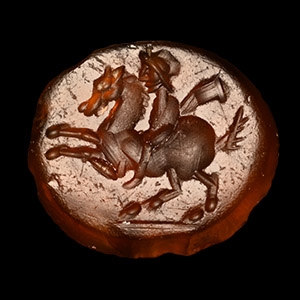
Roman Carnelian Gemstone with Horse and Cavalry Man
3rd-2nd century B.C.Estimate: £600 - 800 (+bp*)
Opening Bid: £333
The rounded intaglio with a horseman, helmetted or wearing a causia, with flying cloak, riding towards left. 0.27 grams, 9 mm
Acquired in the late 1980s-early 1990s. Important North West London collection.
The cap (kausia) was typical of Hellenistic military dress and had been worn by cavalrymen since Alexander’s campaigns of the 4th century BC. The gemstone could represent an Italic cavalrymen, a socius (ally) of the Roman army. Another possibility is that the gemstone follows Etruscan influence, like the example in the British Museum, accession no. 1872,0604.156. The kausia cap had also its metallic counterpart, worn by the Tarentine cavalrymen of the Hellenistic period. -
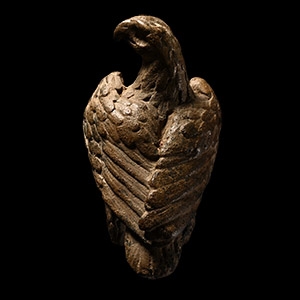
Roman Bronze Figure of an Eagle
Circa 2nd century A.D.Estimate: £4,000 - 6,000 (‡+bp*)
Opening Bid: £2,000
Naturalistically modelled in the round, standing with wings folded against the body, head turned left, feather detailing and recessed circular eyes; feet absent. 111 grams, 62 mm
Acquired in Europe before 2001. This lot has been checked against the Interpol Database of stolen works of art and is accompanied by search certificate number no.11857-206794.
