
Loading, please wait...
LOT 0140
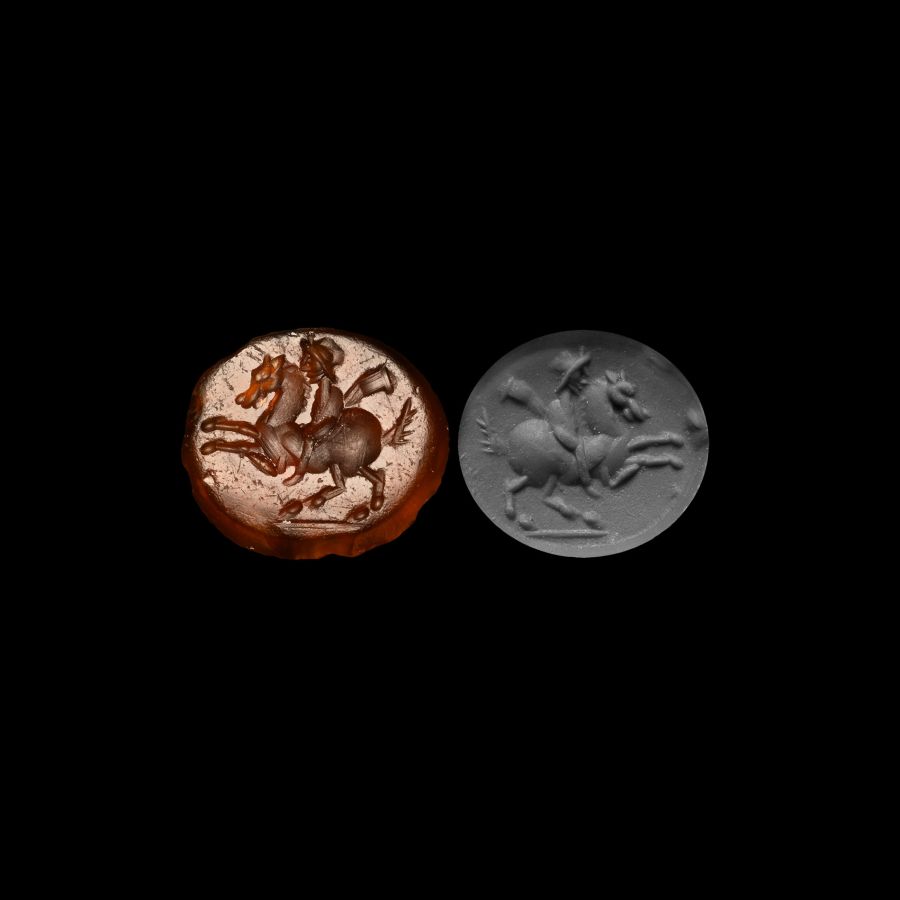
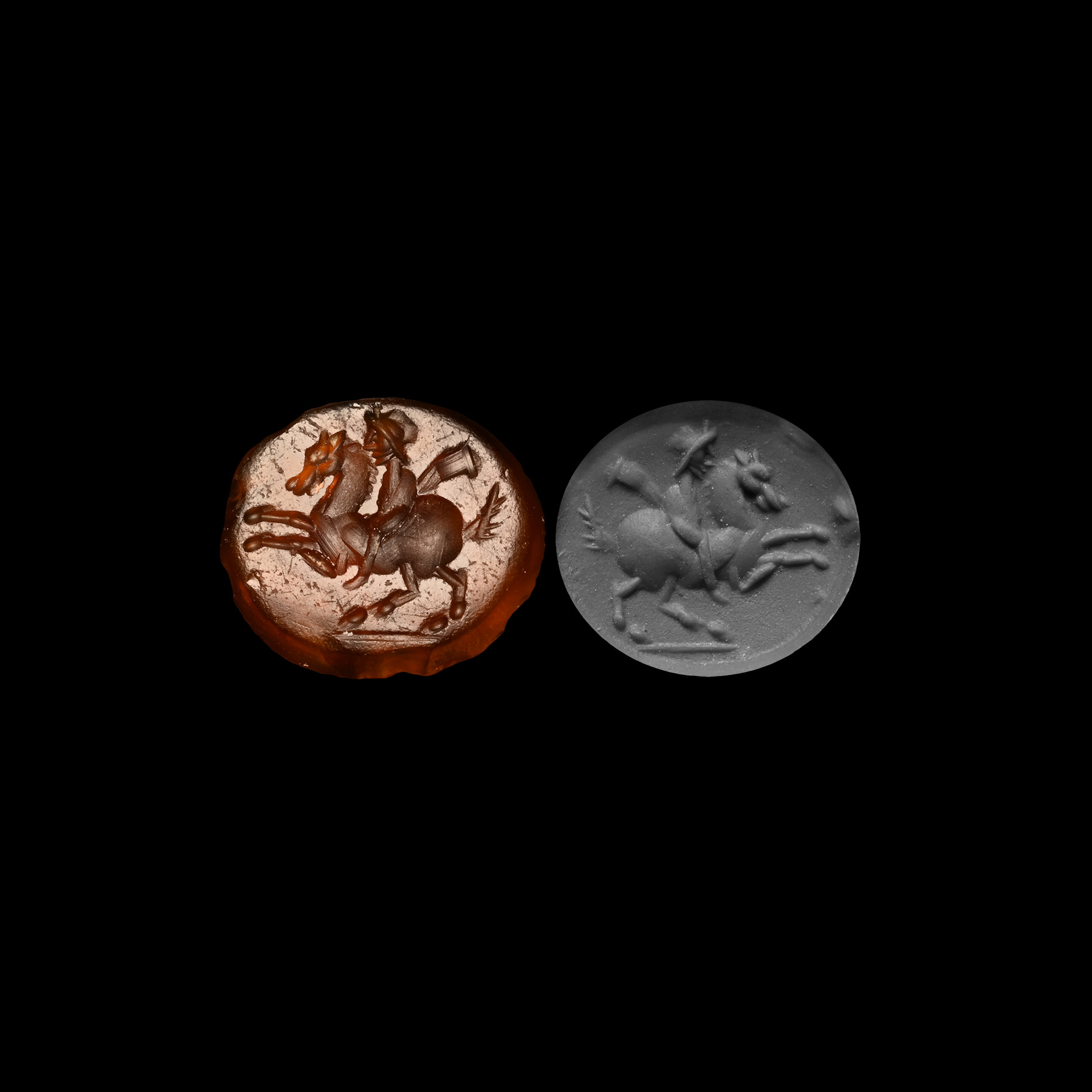
Roman Carnelian Gemstone with Horse and Cavalry Man
3RD-2ND CENTURY B.C.
3/8 in. (0.27 grams, 9 mm).
The rounded intaglio with a horseman, helmetted or wearing a causia, with flying cloak, riding towards left.
ProvenanceAcquired in the late 1980s-early 1990s.
Important North West London collection.
Cf. Walters, H.B., Catalogue of Engraved Gems & Cameos, Greek, Etruscan & Roman in the British Museum, London, 1926, no.1010, for similar.
FootnotesThe cap (kausia) was typical of Hellenistic military dress and had been worn by cavalrymen since Alexander’s campaigns of the 4th century BC. The gemstone could represent an Italic cavalrymen, a socius (ally) of the Roman army. Another possibility is that the gemstone follows Etruscan influence, like the example in the British Museum, accession no. 1872,0604.156. The kausia cap had also its metallic counterpart, worn by the Tarentine cavalrymen of the Hellenistic period.
CONDITIONTimeLine Auctions follows a vetting process to ensure the authenticity and legality of all items, reinforcing our commitment to integrity and responsible trading. Each antiquity, antique, and coin lot undergoes thorough examination by a vetting committee of at least ten external specialists, professional trade association members, scientists, and archaeologists: Our Vetting Process
AUCTIONS:
TimeLine is a leading auction house specialising in antiquities, ancient art, collectables, natural history, coins, medals, and books. Our auctions offer museums, collectors, historians, and enthusiasts the opportunity to acquire unique and historically significant pieces.
LOT 0140
Roman Carnelian Gemstone with Horse and Cavalry Man
Estimate £600 - 800€700 - 930 (for guidance only)$810 - 1,080 (for guidance only)
-
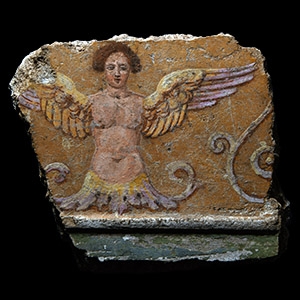
Roman Polychrome Wall Painting Fragment with Winged Siren
Late 1st century B.C.-early 2nd century A.D.Sold for (Inc. bp): £20,800
Decorated with a frieze of partially preserved acanthus volutes from which emerges a figure of a winged female, possibly a siren, the body and the head of a woman with brown hair, the outstretched wings in pink and yellow; ochre background, cream-coloured line border with a green raised edge (part of the wall) below; mounted on a custom-made display stand. 979 grams total, 16 cm high including stand
From a European collection formed in the 19th century or earlier, based on the custom-made tooled leather box similar to another fragment kept in a case of similar manufacture with a label reading 'Fragment de Pompéi provenant de la vente Préat 1868' sold at Sotheby's New York, 12 December 2013, lot 84. Mitsukoshi department store, Nihonbashi, Tokyo, by 1974. Japanese art market, 1974-1978. Accompanied by an academic report by Dr Raffaele D'Amato. This lot has been checked against the Interpol Database of stolen works of art and is accompanied by search certificate number no 11828-207723.
This painted stucco was probably part of a decorative frame. Such decorations can be seen on the famous Villa of Oplontis, where the painted walls of the Triclinium nr. 14 have been divided thrice by columns with a sphinx as ornament on the top of the pillar, decorated with acanthus scrolls and sirens beneath the sphinxes. -
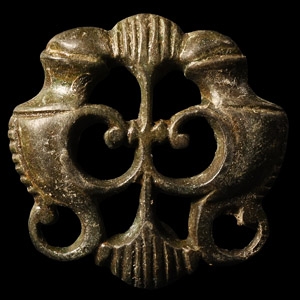
Roman Bronze Military Belt Mount
2nd-3rd century A.D.Sold for (Inc. bp): £72
Composing two opposed dragonesque figures with tail and lowered head, sitting on a peltate style cut out. 19.7 grams, 35 mm
Acquired on the UK art market. Property of a Ruislip, UK, gentleman, by inheritance.
Belt appliques and decorations change notably during the centuries of the Roman Empire. In around 2nd-3rd centuries A.D., particularly in Pannonia and in Britain, show many very Celtic orientated fittings, maybe as the result of provincial influences within the army or production systems. -
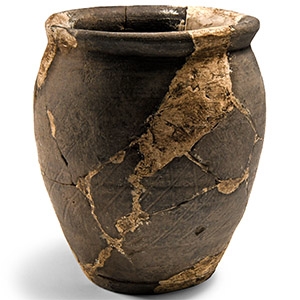
Roman 'Newark' Burnished Greyware Vessel
3rd century A.D.Sold for (Inc. bp): £156
A piriform jar with everted rim, shallow cross-hatching around the lower body, foot delineated with an incised ring; reconstructed with the use of plasticine. 491 grams, 13.3 cm high
Found Cotham, Newark, Nottinghamshire, UK, in September 2021.
