
Loading, please wait...
LOT 0138
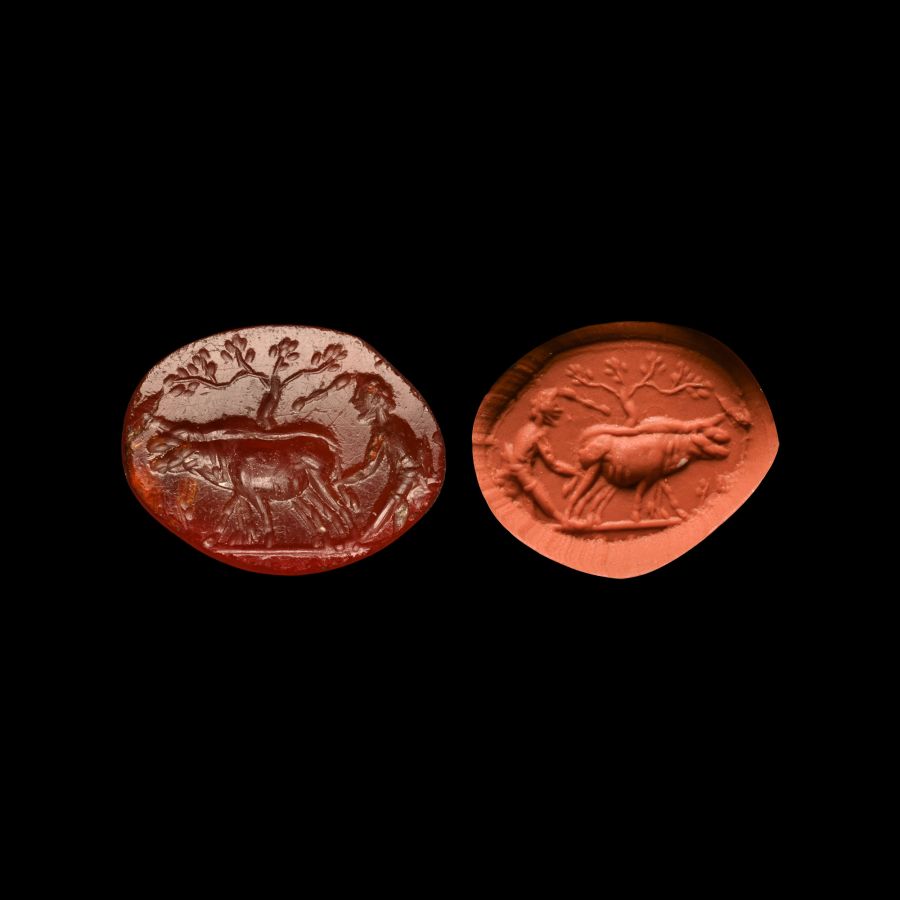
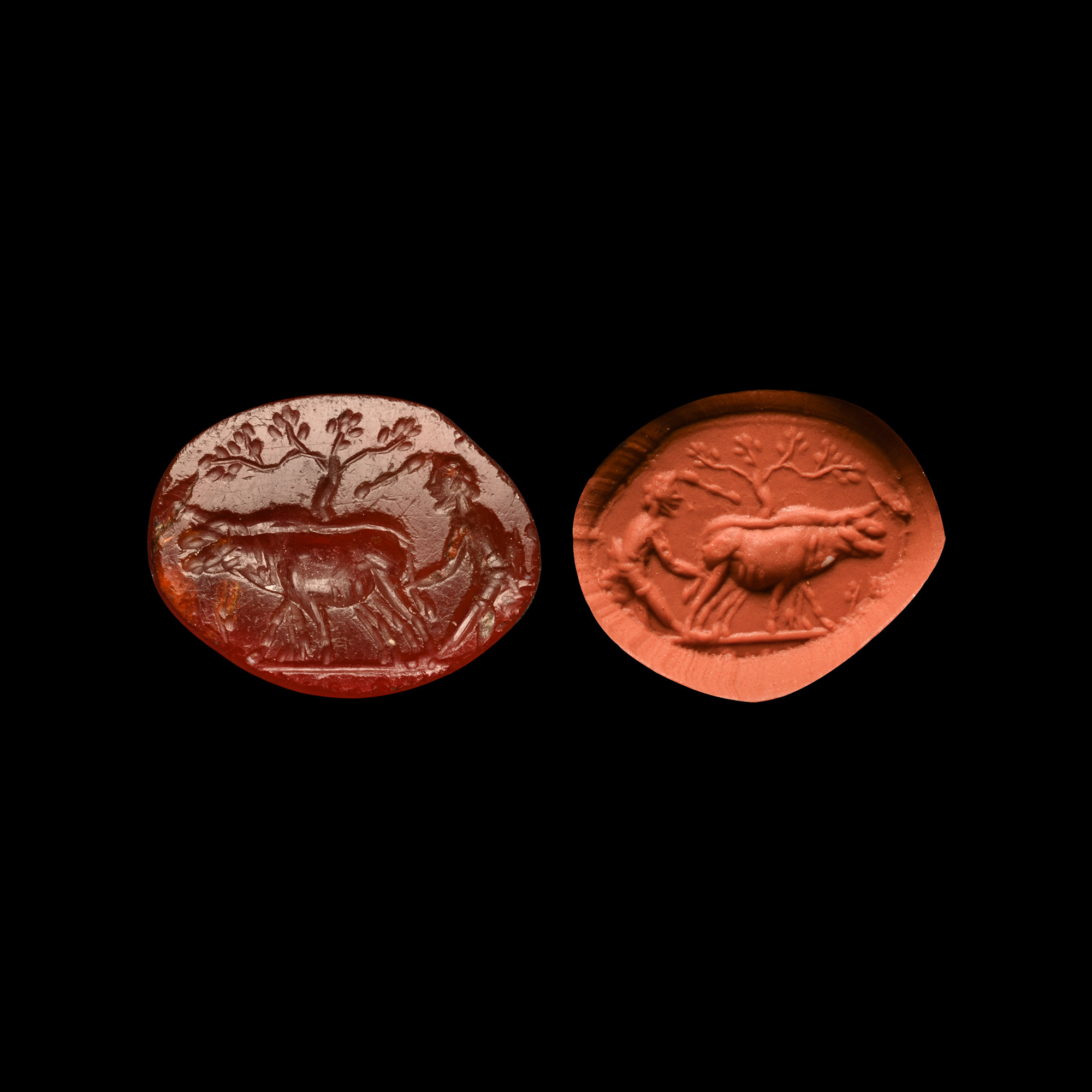
Roman Carnelian Gemstone with Farmer and Oxen
1ST-2ND CENTURY A.D.
3/8 in. (0.38 grams, 10 mm).
The oval intaglio engraved with a man driving a pair of oxen with plough to left, a detailed tree with branches in the background, ground line under the oxen.
ProvenanceAcquired in the late 1980s-early 1990s.
Important North West London collection.
Cf. no.633 of the Lost Gems of the Malborough collection, for a similar scene, in Boardman, J., The Malborough Gems. Formerly at Blenheim Palace, Oxfordshire, Oxford, 2009; cf. also Various, Catalogue of the Malborough Gems, being a collection of Works in Cameo and Intaglio formed by George, Third Duke of Malborough, Oxford, 1875, no.633.
FootnotesThe gem could refer to the Augustan program of restoration of peace and security in the empire, after the agitated period of civil wars, with the possibility for men to return peacefully to their lands in a now peaceful empire. However, we cannot exclude that the image also refers to the well-known episode of Greek mythology, when Odysseus, to escape the call to arms in Troy, feigned madness by ploughing the fields without interruption, until he was unmasked by Palamedes, cousin of Agamemnon, who placed Odysseus' infant son Telemachus in front of the plough, forcing Odysseus to stop and reveal feigned insanity.
CONDITIONTimeLine Auctions follows a vetting process to ensure the authenticity and legality of all items, reinforcing our commitment to integrity and responsible trading. Each antiquity, antique, and coin lot undergoes thorough examination by a vetting committee of at least ten external specialists, professional trade association members, scientists, and archaeologists: Our Vetting Process
AUCTIONS:
TimeLine is a leading auction house specialising in antiquities, ancient art, collectables, natural history, coins, medals, and books. Our auctions offer museums, collectors, historians, and enthusiasts the opportunity to acquire unique and historically significant pieces.
-
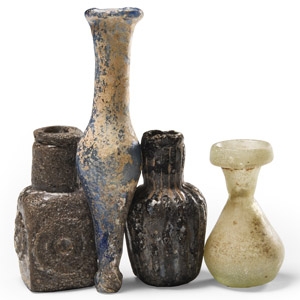
Roman Glass Vessel Collection
1st-4th century A.D.Sold for (Inc. bp): £182
Miniature vessels including unguentaria in various colours. 56 grams total, 42-83 mm
Acquired 1970s-1996. Property of a North American collector. London collection, 2016. -
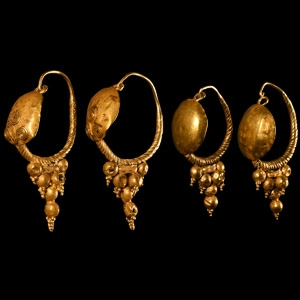
Roman Gold Earring Pairs
2nd-3rd century A.D. or earlierEstimate: £1,500 - 2,000 (‡+bp*)
Opening Bid: £750
Two pairs of earrings with decoratively twisted hoops, domed plaques and pyramid bulbs embellished with granule clusters; one pair with gold wire spirals to the plaques. 16.97 grams total, 42-50 mm
Acquired between 1950-1970s. Ex Swiss private collection. -
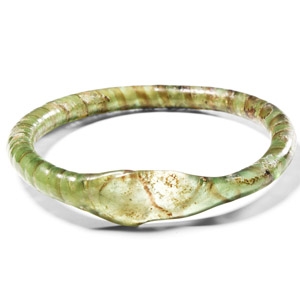
Roman Glass Bracelet
1st-4th century A.D.Sold for (Inc. bp): £208
Twisted in dark green colour with a black spiral band within, flattened plaque. 23.8 grams, 78 mm wide
Acquired 1980-2015. Ex Abelita family collection.
