
Loading, please wait...
_900x900.jpg "Roman Carnelian Gemstone with Eros, the Greek God of Love Holding a Theatrical Mask")
_200x200.jpg "Roman Carnelian Gemstone with Eros, the Greek God of Love Holding a Theatrical Mask")
.jpg "Roman Carnelian Gemstone with Eros, the Greek God of Love Holding a Theatrical Mask")
LOT 0140
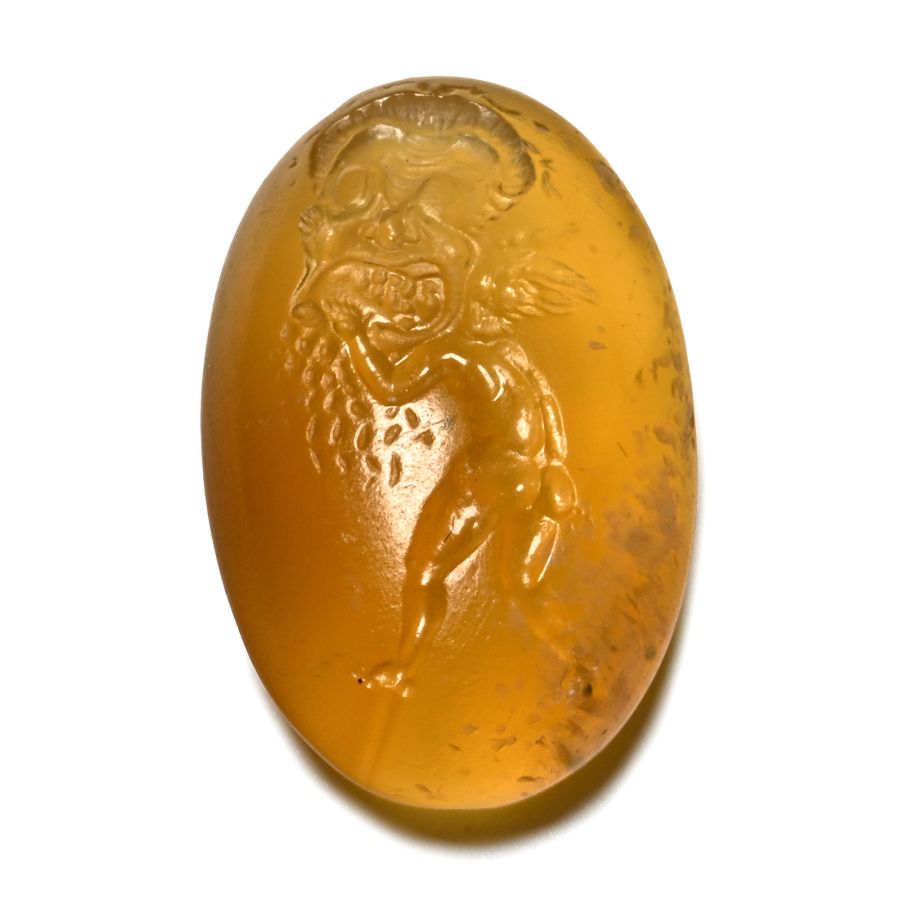
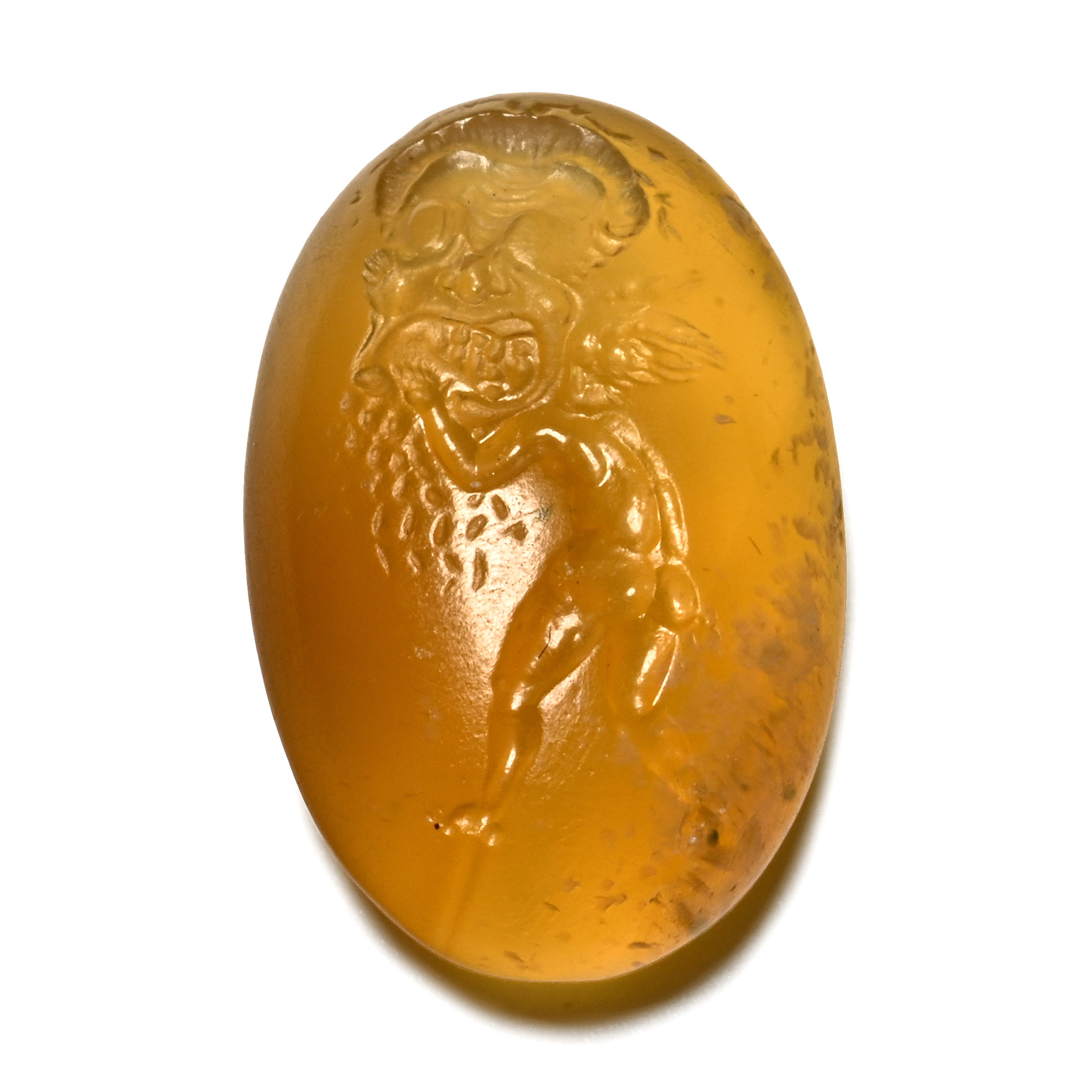
Roman Carnelian Gemstone with Eros, the Greek God of Love Holding a Theatrical Mask
1ST CENTURY A.D.
5/8 in. (1.8 grams, 17 mm).
Plano-convex in section with intaglio scene: a small winged character stands beneath a large theatrical mask, supporting it on his shoulders; supplied with a museum-quality impression.
ProvenanceAcquired on the UK art market.
Private collection, England.
This lot has been checked against the Interpol Database of stolen works of art and is accompanied by search certificate number no.13118-249633.
Cf. Neverov, O.I.: Antichnie Kamei v Sobranii Ermitazha, 1988, item 62.
FootnotesThe young Eros appears with his face inside the wide-open mouth of the mask, looking out as a spectator. The mask is held in his small hands and is characterised by a thick beard, large orbital cavities, and short hair with ribbons. He is depicted in three-quarters seen from behind, engraved and polished with great skill.
The stone has a convex surface with traces of ancient burning at the bottom and slight wear marks.
TimeLine Auctions follows a vetting process to ensure the authenticity and legality of all items, reinforcing our commitment to integrity and responsible trading. Each antiquity, antique, and coin lot undergoes thorough examination by a vetting committee of at least ten external specialists, professional trade association members, scientists, and archaeologists: Our Vetting Process
AUCTIONS:
TimeLine is a leading auction house specialising in antiquities, ancient art, collectables, natural history, coins, medals, and books. Our auctions offer museums, collectors, historians, and enthusiasts the opportunity to acquire unique and historically significant pieces.
LOT 0140
Roman Carnelian Gemstone with Eros, the Greek God of Love Holding a Theatrical Mask
Estimate £4,000 - 5,000€4,640 - 5,800 (for guidance only)$5,400 - 6,750 (for guidance only)
-
.jpg)
Roman Silver Ring with Gemstone of Cupid Riding a Dolphin
2nd-3rd century A.D.Sold for (Inc. bp): £715
With an inset onyx gemstone, intaglio of a boy riding on the back of a dolphin and wielding a whip; supplied with a museum-quality impression. 9.29 grams, 27.65 mm overall, 20.67 mm internal diameter (approximate size British O, USA 7, Europe 14.98, Japan14
Private collection, before 1975. Private collection, England. -
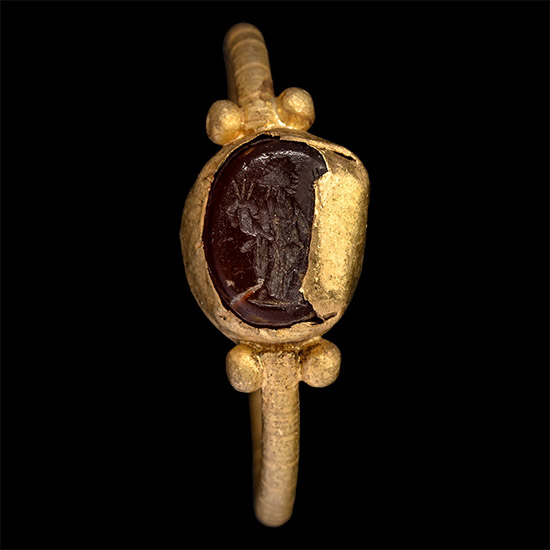
Roman Gold Ring with Fortuna Gemstone
2nd-3rd century A.D.Sold for (Inc. bp): £598
Slender hoop with notches to the shoulders, pairs of granules at the junction with the rectangular cell with inset carnelian intaglio Fortuna with a cornucopia; supplied with a museum-quality impression. 3.17 grams, 23.57 mm overall, 18.42 mm internal diameter (approximate size British Q, USA 8, Europe 17.49, Japan 16)
Ex German art market, 2000s. Acquired from an EU collector living in London. From the collection of a Surrey, UK, gentleman. -
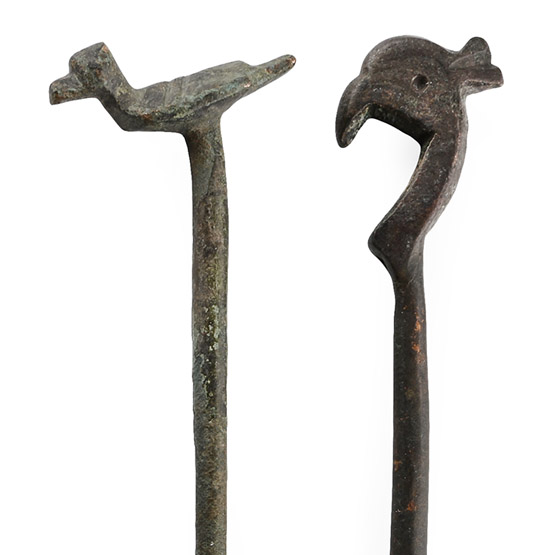
Roman Bronze Dress Pin Collection
1st-4th century A.D.Sold for (Inc. bp): £65
Each comprising of round-section tapering body with zoomorphic head; one with profile of a peacock's head, one formed as a water bird with folded wings and ribbed tail. 29.6 grams total, 10.8-12 cm
Ex property of an Essex, UK, gentleman collector. From the private collection of a Colchester, UK, gentleman.
