
Loading, please wait...
_900x900.jpg "Roman Carnelian Gemstone of the God Serapis")
_200x200.jpg "Roman Carnelian Gemstone of the God Serapis")
.jpg "Roman Carnelian Gemstone of the God Serapis")
LOT 0001
Roman Carnelian Gemstone of the God Serapis
1ST-2ND CENTURY A.D.
1/2 in. (0.47 grams, 14 mm).
Orangey-red intaglio with a concave front and flat back, depicting the three-quarter bust of Serapis; displaying a tightly curled beard, shoulder-length wavy hair with a central parting brushed up from the forehead, wearing the characteristic calathus (woven basket or corn-measure) headgear, symbolising fertility; supplied with a museum-quality impression.
ProvenancePrivate English collection, formed between the late 1970s and early 1990s.
Private collection, London, UK.
Cf. Spier, J., Ancient Gems and Finger Rings, J. Paul Getty Museum Catalogue, Malibu, 1992, p.108, no.276, for a similar three-quarter depiction in agate; Museum of Fine Arts, Boston inv. no.13.243, for a similar carnelian example.
FootnotesSerapis was a Graeco-Egyptian god combining the Egyptian gods Osiris and Apis, but with a decidedly Greek appearance. He was promoted by Ptolemy I in the 3rd century BC to help unite the Greek and Egyptian people. Later, Ptolemaic rulers spread his worship, and Serapis became popular across the Roman Empire. Outside Egypt, he was often identified as Isis's partner, replacing Osiris. Over time, he also adopted traits associated with the Greek gods, Hades and Dionysus.
CONDITIONTimeLine Auctions follows a vetting process to ensure the authenticity and legality of all items, reinforcing our commitment to integrity and responsible trading. Each antiquity, antique, and coin lot undergoes thorough examination by a vetting committee of at least ten external specialists, professional trade association members, scientists, and archaeologists: Our Vetting Process
AUCTIONS:
TimeLine is a leading auction house specialising in antiquities, ancient art, collectables, natural history, coins, medals, and books. Our auctions offer museums, collectors, historians, and enthusiasts the opportunity to acquire unique and historically significant pieces.
-
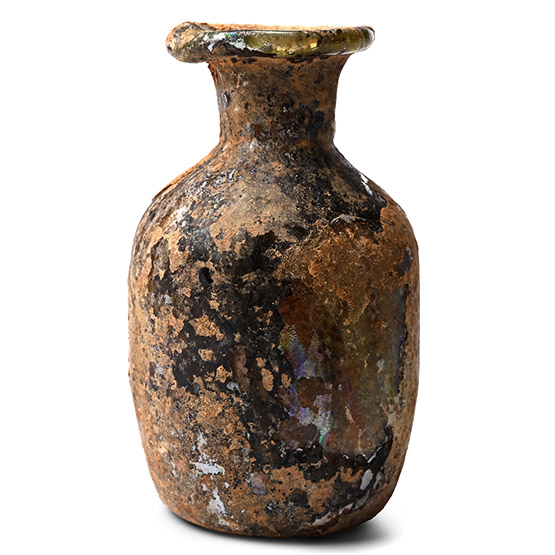
Roman Glass Flask
Circa 1st-4th century A.D.Estimate: £100 - 140 (+bp*)
Opening Bid: £50
Comprising a barrel-shaped body with a dimpled base, short tubular neck and an everted rim. 33 grams, 72 mm
From a London, UK, collection of glass, 1970-2000s. -
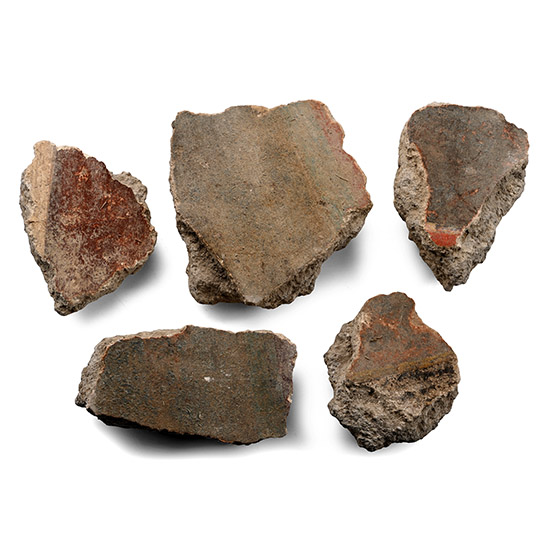
Roman Fresco Wall Plaster Collection
1st century A.D.Sold for (Inc. bp): £48
Fragments of wall plaster with rendered surface painted with mainly Pompeii red, pale blue and white detailing; some with impression of timber laths to the reverse. 690 grams total, 7.9-10.5 cm
Acquired in the 19th century. Ex Jeger collection, Switzerland. UK gallery, early 2000s.
These small fragments, for analogies with the fragments of Pompeii, seem to belong to the second style of Roman painting, red panels representing highlight and shadow, decorated with vegetal interlaces. Some panels were probably framed by a red grenade fillet. A fragment shows alternate blue and red colour over a cream background, maybe pertinent to a socle -
.jpg)
Roman Gold Ring with Green Chalcedony Gemstone with Pantheistic Deity
1st century A.D.Sold for (Inc. bp): £2,340
Cabochon with intaglio standing male deity, possibly Asclepius, surrounded by attributes including a wreath, caduceus, ant, sistrum and others; supplied with a museum-quality impression. 9.91 grams, 23.93 mm overall, 19.33 mm internal diameter (approximate size British L 1/2, USA 6, Europe 11.87, Japan 11)
Private collection, England.
