
Loading, please wait...
LOT 0201
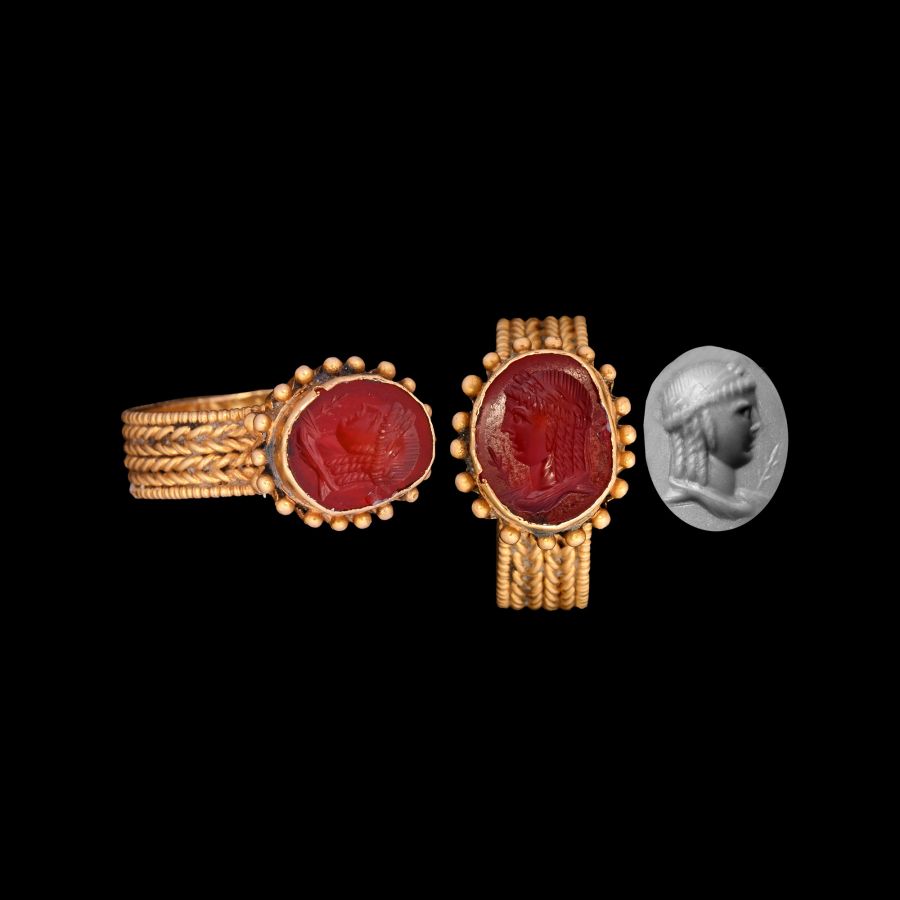
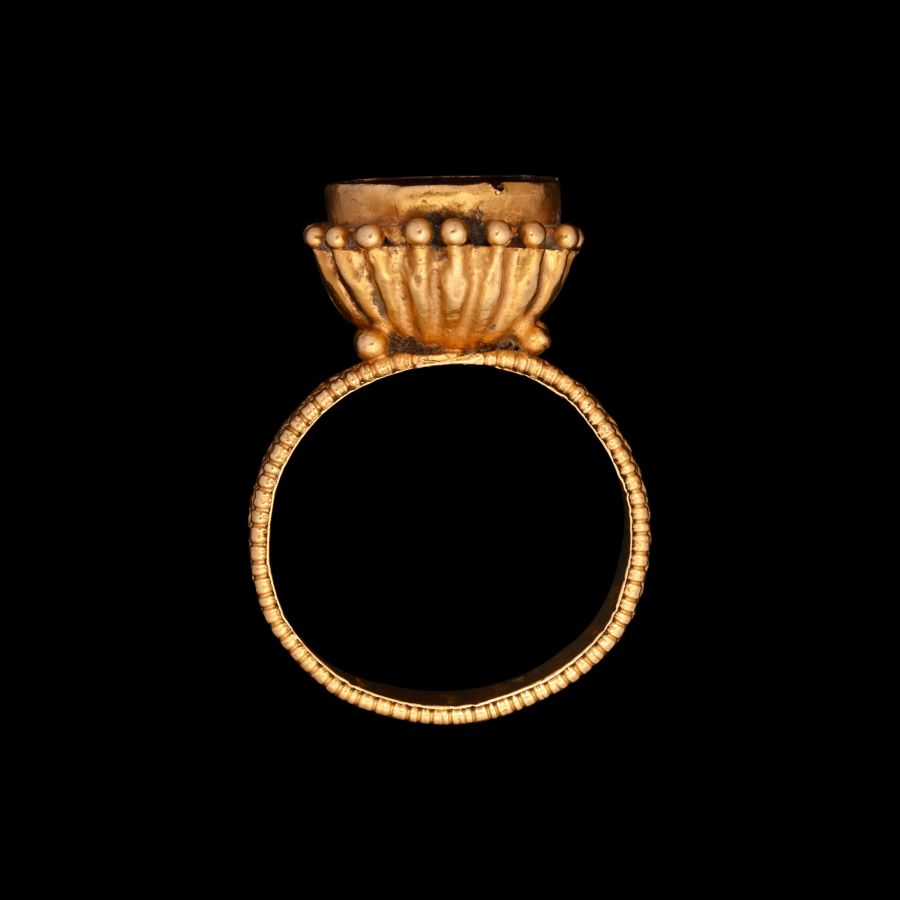
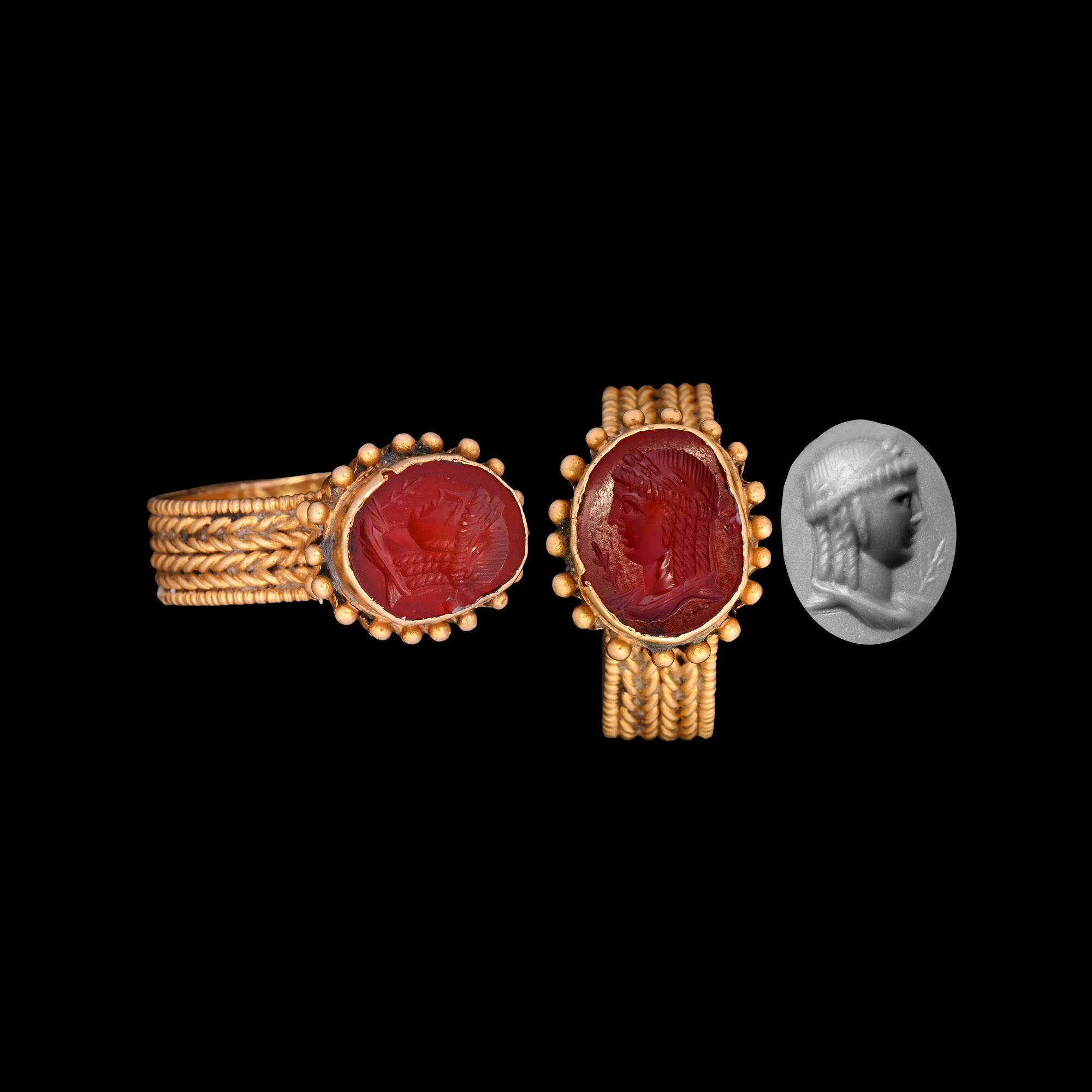
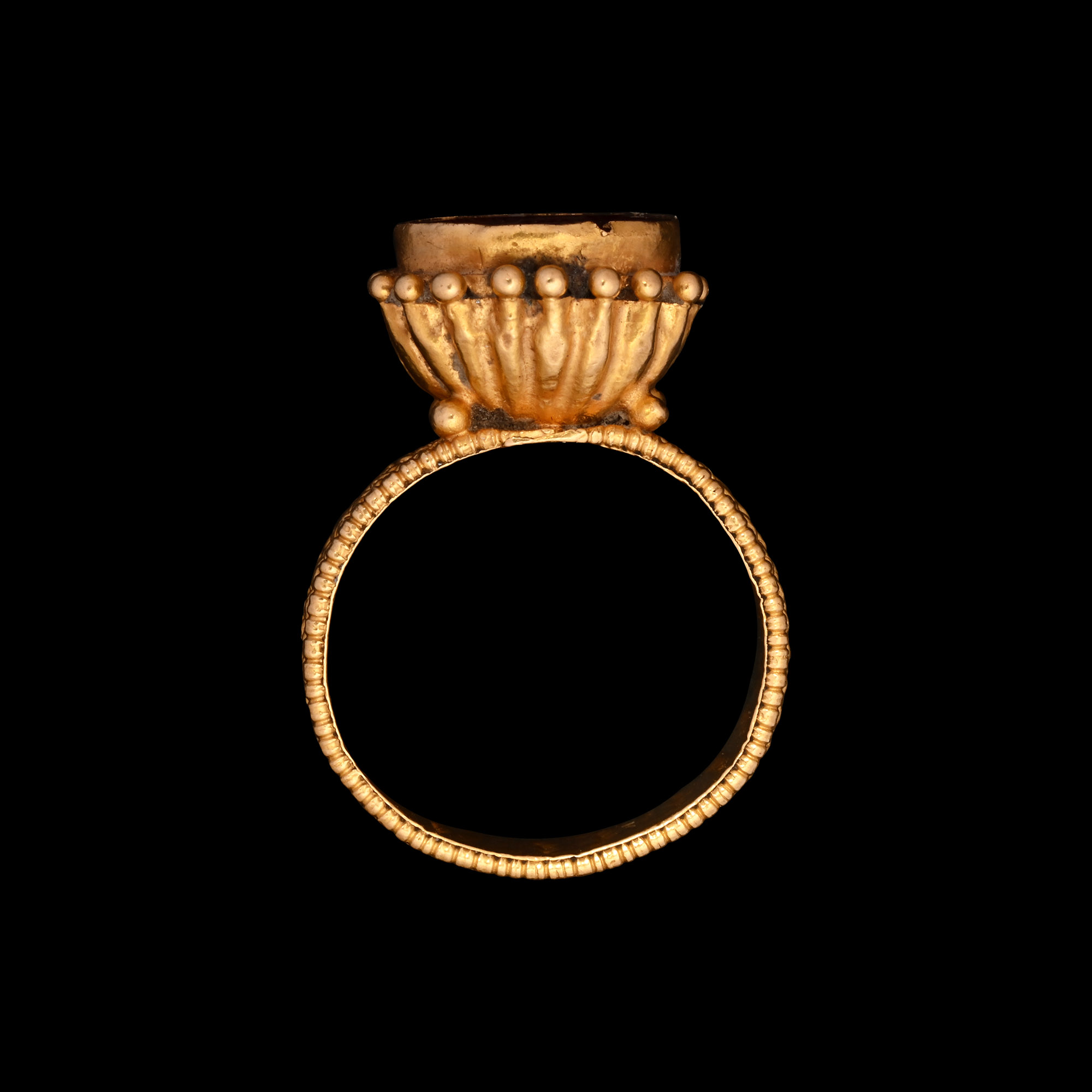
Roman Carnelian Gemstone of the God Apollo in Byzantine Gold Ring
1ST CENTURY B.C.-1ST CENTURY A.D. AND LATER
1 in. (6.46 grams, 26.66 mm overall, 17.29 x 16.50 mm internal diameter (approximate size British M 1/2, USA 6 1/4, Europe 13.09, Japan 12)).
Roman intaglio depicting youthful god Apollo in profile, set into a 5th-7th century A.D. Byzantine ring with flat-section hoop with roped bands and pelleted border, fluted hemispherical bezel with ribbed underside; supplied with a museum-quality impression.
ProvenancePrivate collection, 1950s.
Private collection, M.G., South Germany, 2000.
with Gorny and Mosch, 14 December 2016, no.259.
Private collection, England.
This lot has been checked against the Interpol Database of stolen works of art and is accompanied by search certificate number no.13135-249517.
Cf. Chadour, A.B., Rings. The Alice and Louis Koch Collection, volume I, Leeds, 1994, items 485-6, for intaglio see item 222.
CONDITIONTimeLine Auctions follows a vetting process to ensure the authenticity and legality of all items, reinforcing our commitment to integrity and responsible trading. Each antiquity, antique, and coin lot undergoes thorough examination by a vetting committee of at least ten external specialists, professional trade association members, scientists, and archaeologists: Our Vetting Process
AUCTIONS:
TimeLine is a leading auction house specialising in antiquities, ancient art, collectables, natural history, coins, medals, and books. Our auctions offer museums, collectors, historians, and enthusiasts the opportunity to acquire unique and historically significant pieces.
LOT 0201
Roman Carnelian Gemstone of the God Apollo in Byzantine Gold Ring
Estimate £3,000 - 4,000€3,480 - 4,640 (for guidance only)$4,050 - 5,400 (for guidance only)
-
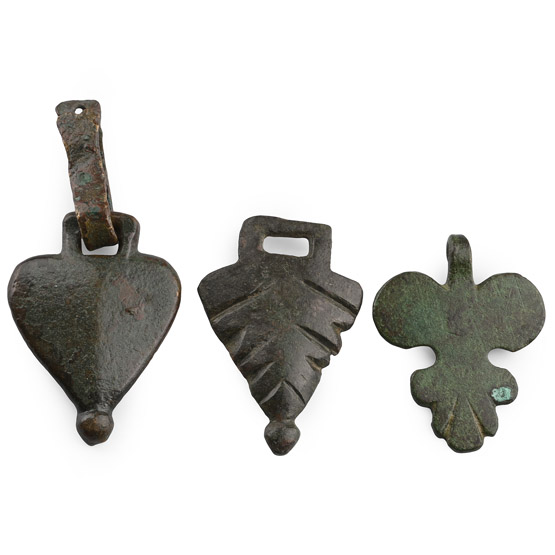
Roman Bronze Military Horse Harness Pendant Group
1st-4th century A.D.Sold for (Inc. bp): £52
Including ivy-lead and other types, one with attachment strap. 37 grams total, 41-65 mm
Ex German art market, 2000s. Acquired from an EU collector living in London. From the collection of a Surrey, UK, gentleman. -
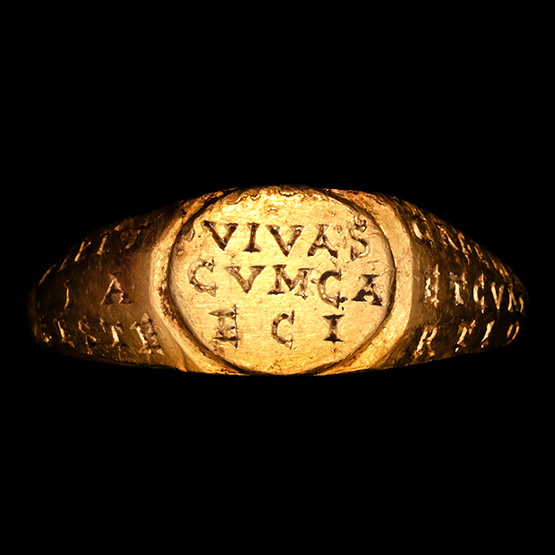
Roman Gold 'Talismanic' Ring with Inscriptions
3rd-4th century A.D.Sold for (Inc. bp): £5,200
Comprising chamfered sloped shoulders and ellipsoid bezel; engraved with later blundered Latin legends in capitals: left shoulder - ‘REBET ?IA SESTE’ (It is rebated), bezel - ‘VIVAS CVM CAECI’ (Live with Caecus), right shoulder - ‘CAFELIX ET CVM RTIO’ (Safe and comfortable). 3.80 grams, 18.19 mm overall, 14.94 mm internal diameter (approximate size British F, USA 2 3/4, Europe 3.67, Japan 3)
Private collection, Europe. Acquired on the English art market. This lot has been checked against the Interpol Database of stolen works of art and is accompanied by search certificate number no.13044-248372.
The ring is extensively engraved with the following Latin words and approximate translations: Left shoulder - ‘REBET ?IA SESTE’ - It is rebated. Bezel - ‘VIVAS CVM CAECI’ - Live with Caecus. Right shoulder - ‘CAFELIX ET CVM RTIO’ - Safe and comfortable. The Latin expression can be understood as part of a personal protective message. -
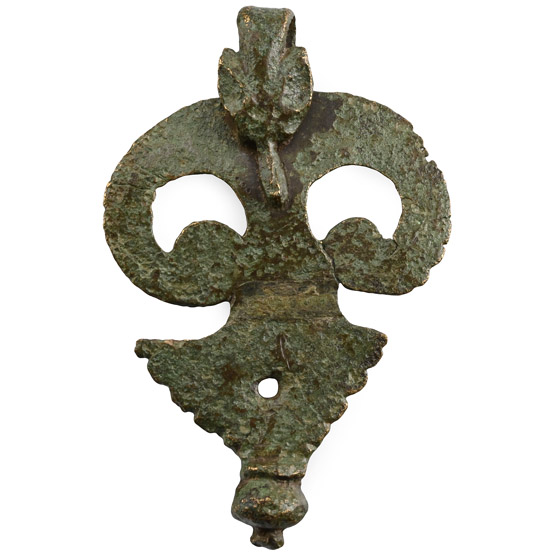
Roman Bronze Military Pendant
Circa 2nd-3rd century A.D.Sold for (Inc. bp): £33
Formed as a leaf with lobed scrolls above, looped suspension point with wolf-head detailing; knop finial below. 4.66 grams, 46.6 mm
Ex German art market, 2000s. Acquired from an EU collector living in London. From the collection of a Surrey, UK, gentleman.
