
Loading, please wait...
LOT 0652
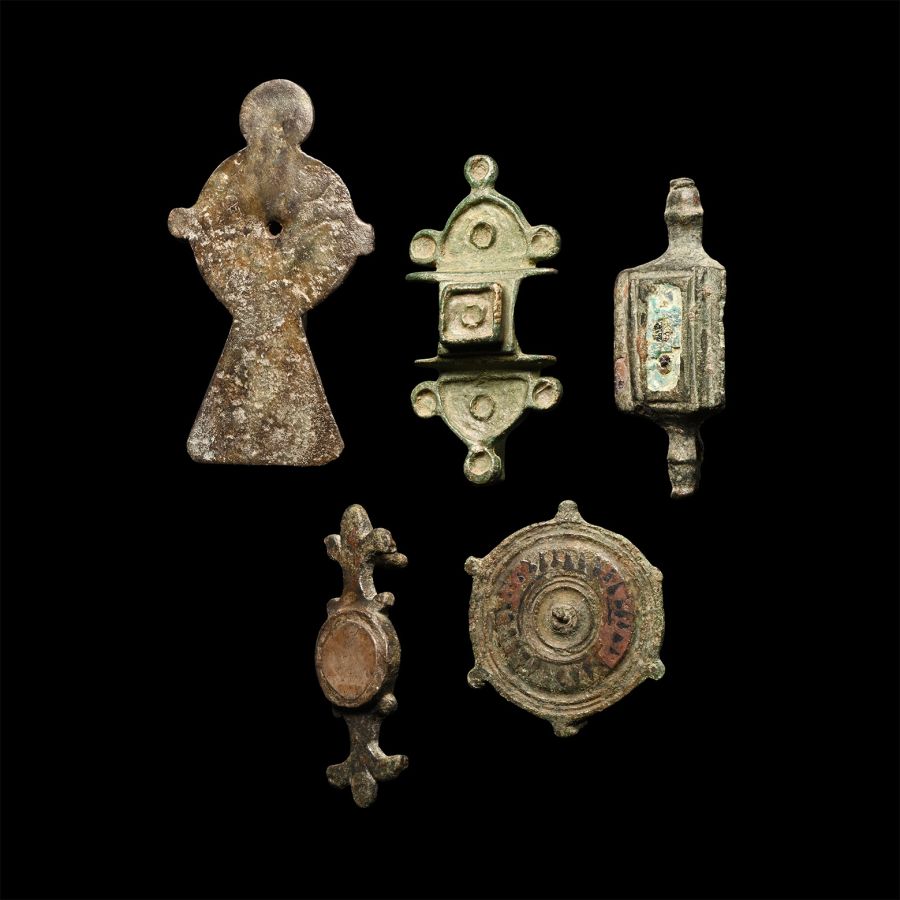
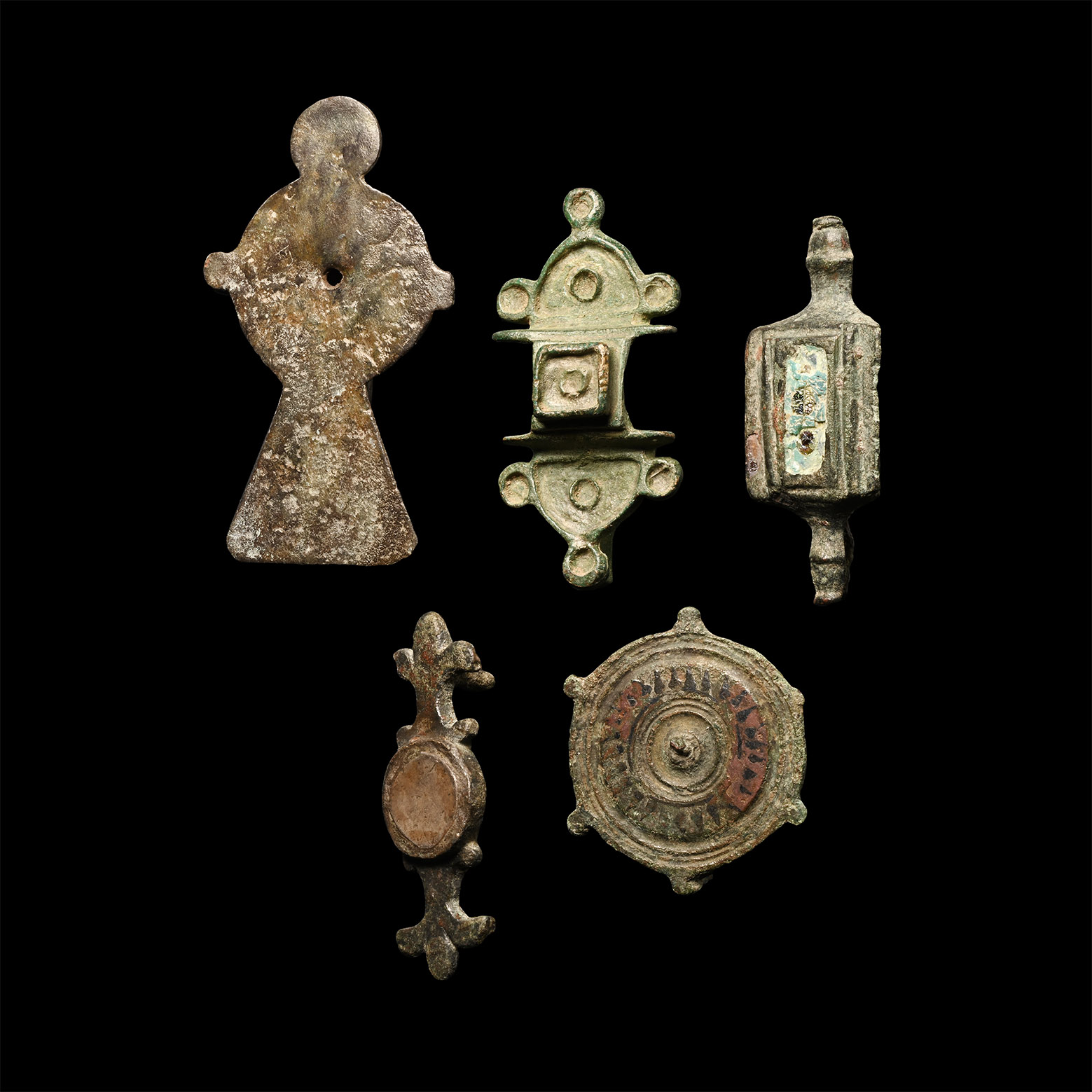
Roman Brooch Collection
MAINLY 2ND CENTURY A.D.
1 1/8 - 1 3/4 in. (25 grams total, 28-46 mm).
A mixed group of bronze plate brooches including disc-with-lugs, equal-ended and other types. [5]
ProvenanceAcquired in the late 1990s-2000.
Property of an East London gentleman.
TimeLine Auctions follows a vetting process to ensure the authenticity and legality of all items, reinforcing our commitment to integrity and responsible trading. Each antiquity, antique, and coin lot undergoes thorough examination by a vetting committee of at least ten external specialists, professional trade association members, scientists, and archaeologists: Our Vetting Process
AUCTIONS:
TimeLine is a leading auction house specialising in antiquities, ancient art, collectables, natural history, coins, medals, and books. Our auctions offer museums, collectors, historians, and enthusiasts the opportunity to acquire unique and historically significant pieces.
LOT 0652
Roman Brooch Collection
Estimate £150 - 200€170 - 230 (for guidance only)$200 - 270 (for guidance only)
-

Roman Tragic Mask Applique
1st century A.D. or laterSold for (Inc. bp): £130
A rectangular slate mount showing the head of a tragic mask with angular eyes, straight nose and a clownish, down-turned mouth. 3 grams, 16.2 mm
Very fine condition.
Acquired from Galerie Jean Phillipe Mariaud de Serres, 1990-2000. Property of a French collector.
Small appliqués like this one were common in Roman furniture. In the Graeco-Roman world, comic and tragic masks played an important role in Greek drama, commonly performed in the Roman Empire. The actors had the ability to easily play more than one character in succession with a simple change of masks, and the characters of the masks became popular objects in the material culture. -
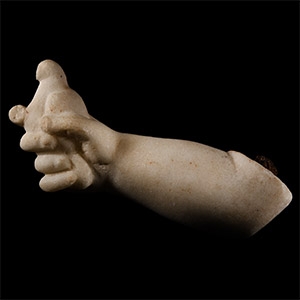
Roman Marble Hand Holding Bird
1st-2nd century A.D. or laterSold for (Inc. bp): £845
A white marble right forearm and hand, modelled in the round gripping a bird; simple detailing to the bird's head and to the folds of the skin on the palm of the hand and the nail beds; remains of iron rod inserted into the limb. 531 grams, 17 cm
New York art market, 1992. -
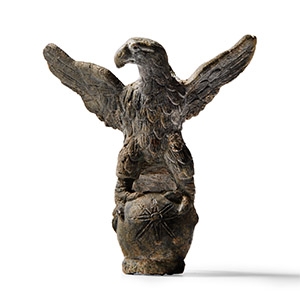
Roman Military Eagle Staff Terminal
2nd-3rd century A.D.Sold for (Inc. bp): £11,050
A free-standing bronze imperial or military eagle terminal from a staff or a sceptre, modelled in the round in a dynamic pose standing on a globe, wings spread, head turned to the right, semi-naturalistic anatomical and feather detailing; the globe bearing an incised eight-armed stylised Macedonian star; sub-triangular lug to back of the neck; collar to globe with hollow underside. 166 grams, 88 mm high
with Bonham's, London, Knightsbridge, UK, 16 May 2002, lot 301. Accompanied by a copy of the relevant Bonhams catalogue pages. Accompanied by an academic report by Dr Raffaele D'Amato. This lot has been checked against the Interpol Database of stolen works of art and is accompanied by search certificate number no.11582-198947
In the Roman world, the eagle was associated with the god Jupiter or Zeus, king of the Olympian gods, and was seen as ‘the symbol and agent of apotheosis after death’. An eagle was released from the top of an emperor’s funeral pyre to signal the journey of the soul towards heaven. A sacred attribute of Jupiter, this eagle terminal may have been attached to a sceptre of the statue of the god. Eagles were also the principal standard of the legions, and became the military symbol for excellence.
