
Loading, please wait...


LOT 0131
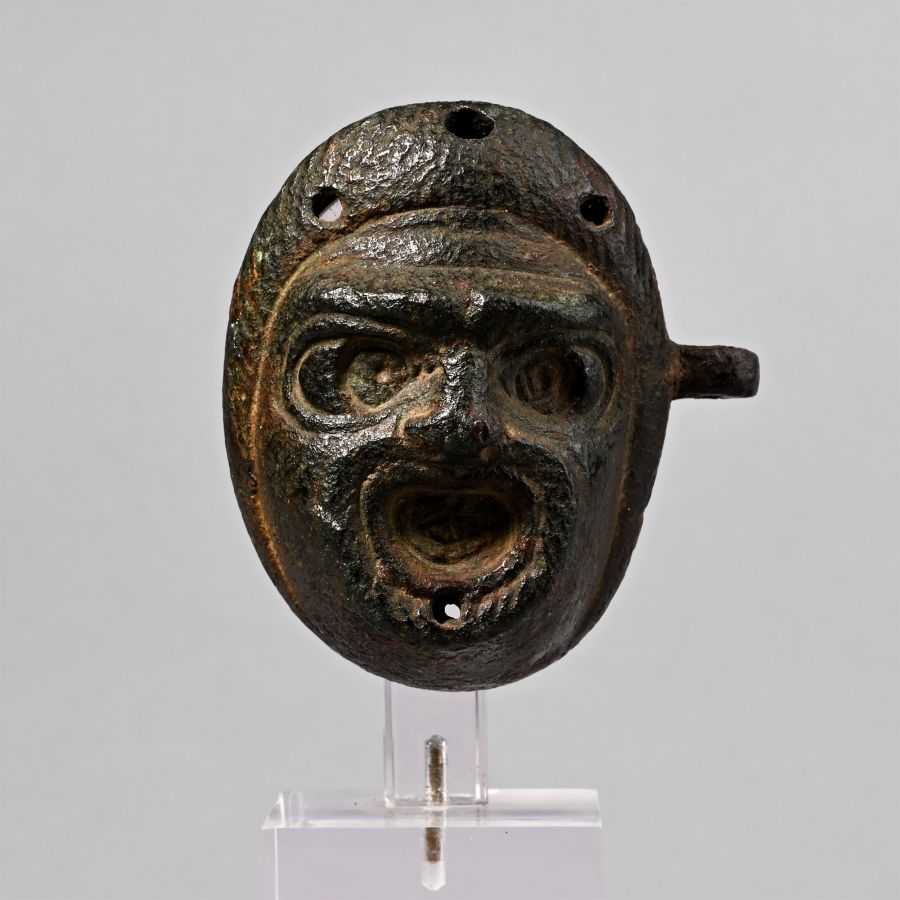
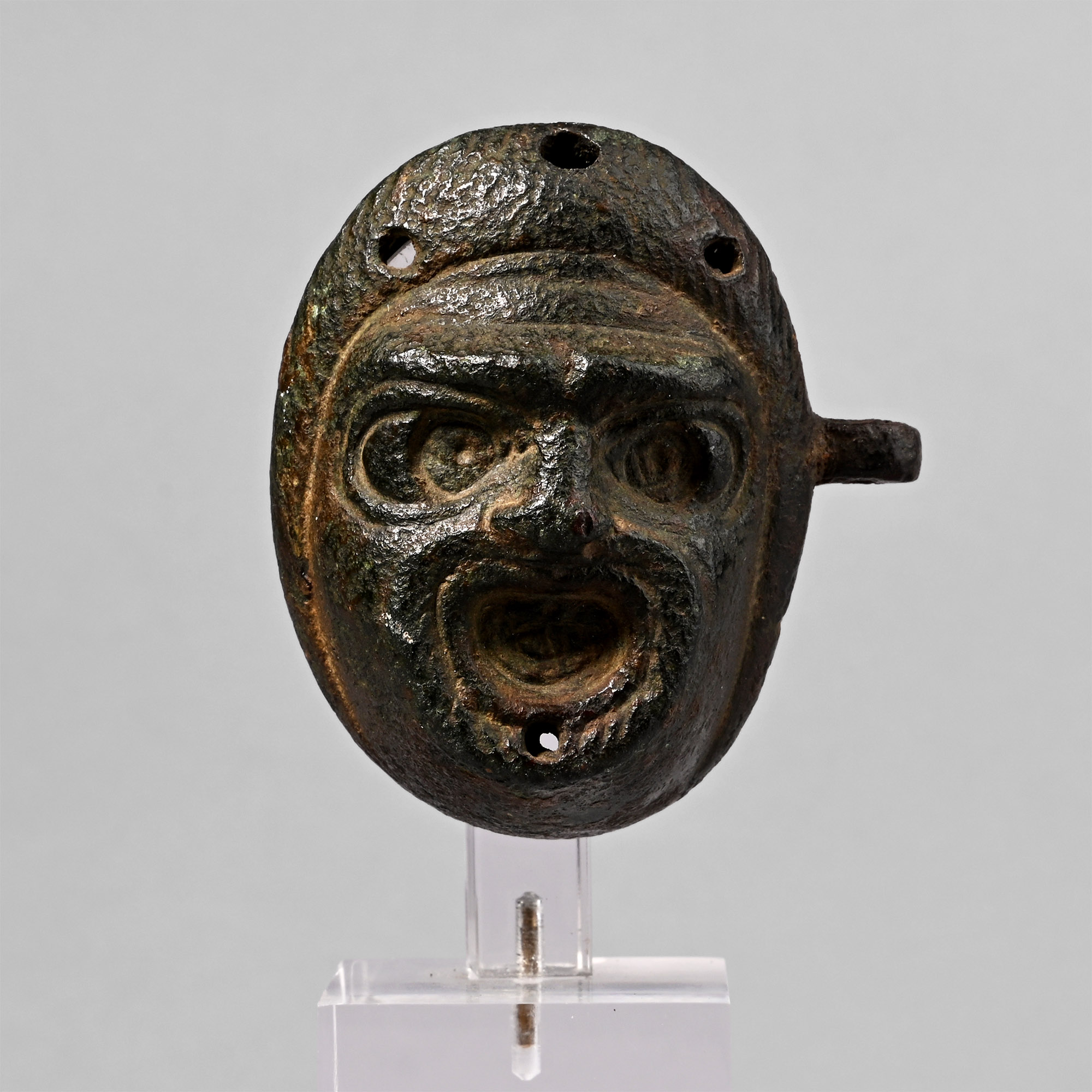
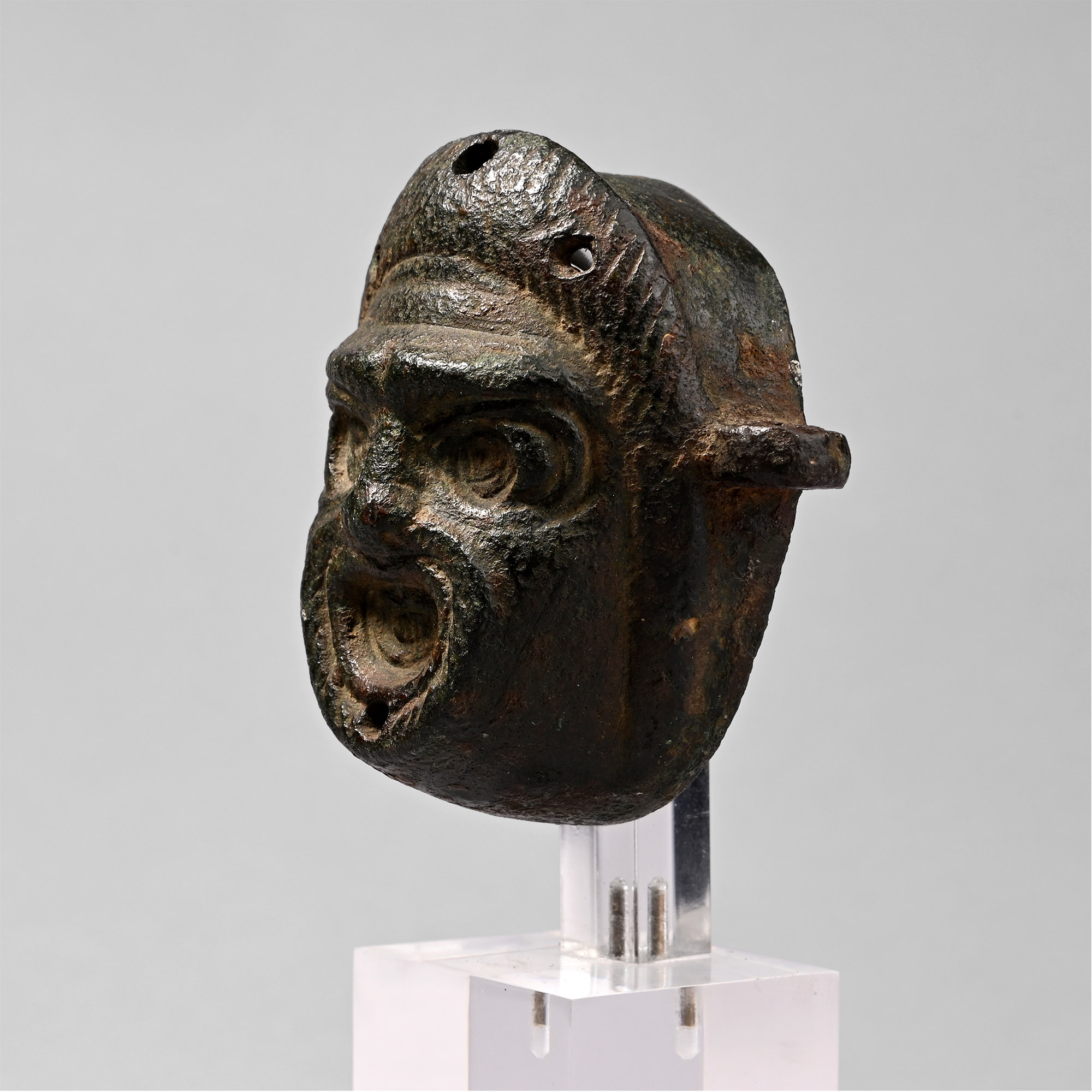
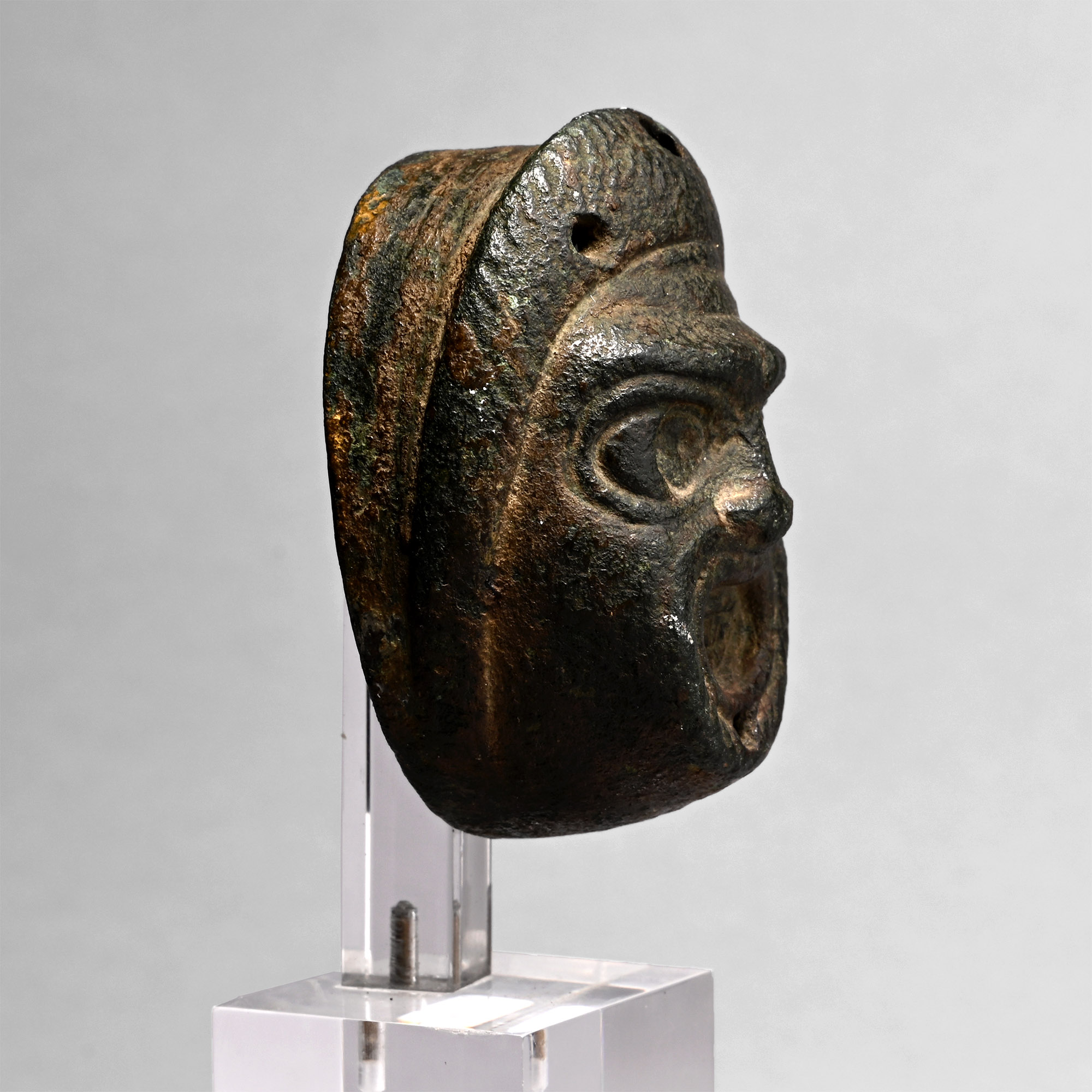
Roman Bronze Theatre Mask Mount
1ST-2ND CENTURY A.D.
2 1/2 in. (5 1/4 in.) (207 grams total, mask: 62 mm, 13.3 cm high including stand).
Comic theatre mask in the form of a bearded man with a furrowed forehead, bulging brows and flat nose; within the mouth opening of the mask, the actor’s mouth visible as if an actor were wearing the mask, likewise the actor’s eyes with drilled pupils seem to peer through the eye openings that are framed by bulges, hair brushed back from the forehead; on the right, a hinge eyelet, and small holes at the top and bottom probably for the air supply; possibly the lid of a lamp; accompanied by a custom-made display stand.
ProvenanceEx Prof. Hans Dahn (1919-2019), Lausanne, acquired July 1959 from Donati.
LiteratureCf. similar dramatic masks in stone at the BM, inv.no.1805,0703.146; cf. similar applique in Rolland, H., Bronzes Antiques de Haute Provence, Paris, 1965, item 408.
FootnotesDespite the moralising of certain elements of society and the bad reputation they suffered, the actors and their dramatic spectacles remained hugely popular with ordinary Romans. Theatre was important in the life of commoners and had a powerful impact on moulding public opinion. This piece, likely a decorative element, reflects the popularity and prominent place of theatre in Roman culture.
CONDITIONTimeLine Auctions follows a vetting process to ensure the authenticity and legality of all items, reinforcing our commitment to integrity and responsible trading. Each antiquity, antique, and coin lot undergoes thorough examination by a vetting committee of at least ten external specialists, professional trade association members, scientists, and archaeologists: Our Vetting Process
AUCTIONS:
TimeLine is a leading auction house specialising in antiquities, ancient art, collectables, natural history, coins, medals, and books. Our auctions offer museums, collectors, historians, and enthusiasts the opportunity to acquire unique and historically significant pieces.
LOT 0131
Roman Bronze Theatre Mask Mount
Estimate £1,500 - 2,000€1,740 - 2,320 (for guidance only)$2,030 - 2,700 (for guidance only)
Opening Bid
£825 (EUR 957; USD 1,114) ‡+BP*
-
Roman Terracotta Bullae, Tesserae or Token Group
3rd century B.C.-1st century A.D.Estimate: £100 - 140 (+bp*)
Opening Bid: £5
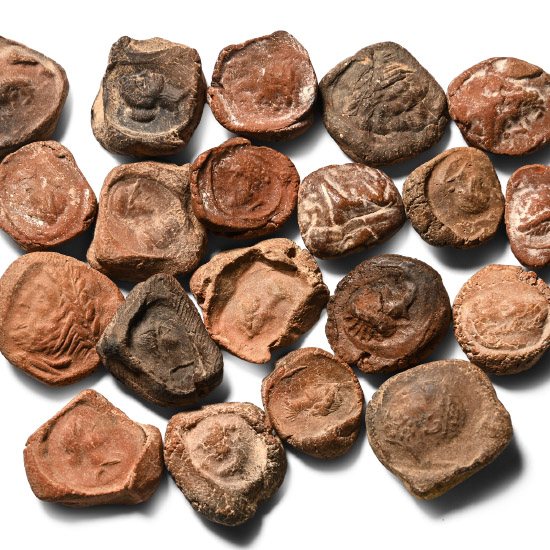
A mixed group of ceramic bullae, tesserae or theatre tokens bearing low-relief motifs, mainly consisting of profile busts of deities. 28.4 grams total, 14-20 mm
From the private collection of a European gentleman (1942-2024), formed since the 1970s.
The term 'tessera' was used in Roman times to convey the Greek term σύμβολον (token). Small tiles are known as tokens, often shaped like coins, made of metal (copper, lead, iron), clay, bone, wood, or glass, stamped as well as engraved. The tokens, however, are not exclusively coin-shaped, as the Latin term 'tessera' suggests by etymologically referring to a square or at least a four-sided shape and confirmed in several cases by material remains of the past. Tokens and tesserae seem to have been used both in Athens and Rome for the distribution of goods. According to written sources, the term token is identified with credentials of the official authorities. They have also been interpreted as tokens of identity, as entrance tickets to theatre performances, tribunals or assemblies of citizens, archival material of seal engraving, as pawns in games, Charon’s obols and even as amulets. -
Roman Iridescent Aubergine Glass Dimpled Jar
Circa 1st-2nd century A.D.Estimate: £600 - 800 (+bp*)
Opening Bid: £300
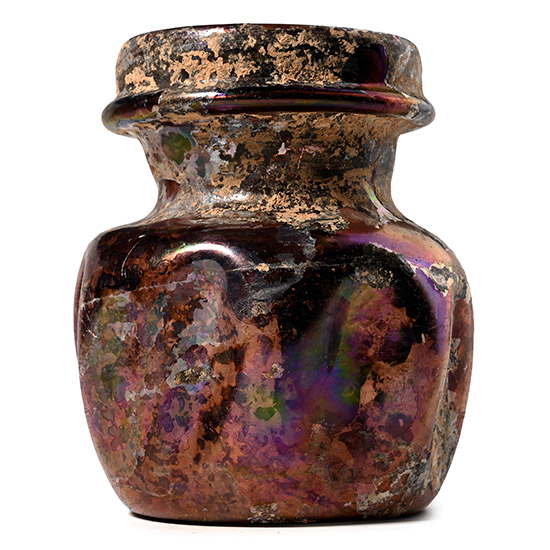
Of squat profile with dimples to the equator, short neck, broad mouth and dimple to the underside; remains of iridescence. 74 grams, 96 mm high
Acquired Jerusalem, Israel, June 1974. From the private collection of Dr Stanley I. Batkin (1914-2015), Scarsdale, New York, USA. From a private USA collection, acquired from the estate of the above. Ex Ancient Glass from the Dr Stanley Batkin (2014-2015) collection, Bonhams, London, 6 July 2017, no.177 (part). -
Roman Marble Head of Cupid on Georgian Pedestal
1st-2nd century A.D.Estimate: £15,000 - 20,000 (‡+bp*)
Opening Bid: £7,000
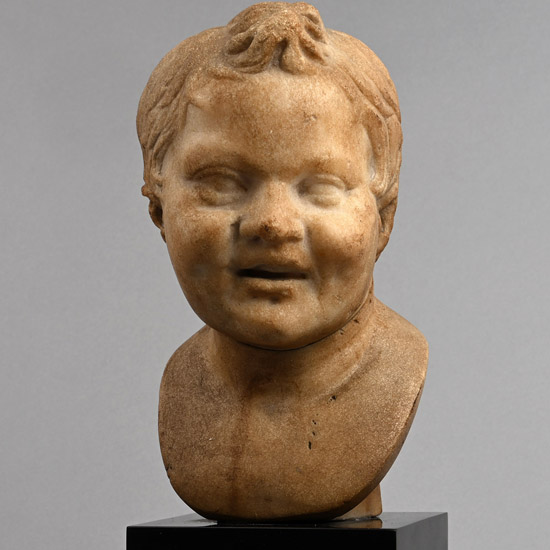
Carved in the round as a bust of a child with short hair combed into a peak, fleshy features, lips slightly parted in a smile, fitted to an 18th-century marble pedestal; mounted on a display stand with collection note 'Buste d'Enfant / Epoque Romaine / 1er Siècle'. 6.12 kg total, 30 cm including stand
Collection of B. Poindessault (1935-2014), France, acquired before October 1975. Oger & Blanchet Enchères, Paris, 2014. German private collection, Cologne. Private collection, acquired in 2015. Accompanied by an academic report by Dr Marina Mattei. Accompanied by a copy of an Art Loss Register certificate, no.S000104583. Accompanied by a copy of French passport no.167453. This lot has been checked against the Interpol Database of stolen works of art and is accompanied by search certificate no.12931-246329.
The finely sculpted head represents a young child, probably intended as Eros (Cupid). Such depictions were produced in numerous variations to illustrate the stages of childhood and the capacity of children to undertake meaningful or symbolic actions. The softly modelled features and gentle expression recall the celebrated work of Boethos, The Boy Strangling the Goose, as well as the widespread images of Eros and the Erotes found throughout Graeco-Roman sculpture and painting. In Graeco-Roman art, representations of children occupied an important and evolving role. Initially, youthful figures were portrayed as miniature adults, but from the 4th century BC onwards - particularly during the Hellenistic and Roman periods - artists began to study children’s anatomy more closely, reproducing their characteristic proportions and expressions with naturalistic sensitivity. The figure of Eros, the constant companion of Aphrodite, became the quintessential model of the child in ancient art, identifiable by his traditional attributes of wings and bow. As evidenced by numerous statuettes and wall paintings unearthed at Pompeii, scenes of childhood were among the most popular subjects for adorning the gardens and interiors of wealthy Roman villas. These figures appear in lively and varied activities - playing, working, performing, or interacting with animals such as birds, hares, and dolphins - celebrating both the charm and vitality of early life within an idealised artistic vision.
