
Loading, please wait...
_900x900.jpg "Roman Bronze Statuette of Resting Hercules")
_200x200.jpg "Roman Bronze Statuette of Resting Hercules")
.jpg "Roman Bronze Statuette of Resting Hercules")
LOT 0108
Roman Bronze Statuette of Resting Hercules
3RD CENTURY A.D.
6 1/8 in. (715 grams, 15.5 cm).
Depicted as lar and modelled nude in a standing pose with the right hand resting on the handle of his club, left arms supporting the lionskin mantle; hair cut short and beard textured.
ProvenanceAcquired on the UK art market, 1990s.
Private collection, New York, USA.
Accompanied by an academic report by Dr Raffaele D'Amato.
This lot has been checked against the Interpol Database of stolen works of art and is accompanied by search certificate number no.13295-255447.
Cf. for similar typologies Reinach, S., Répertoire de la statuaire grecque et romaine, Paris, 1897, p.211, 7 and 9; 212 nos.1,2,7; 214,2 and 5; Rolland, H., Bronzes Antiques de Haute Provence, Paris, 1965, items 98,101; Salskov Roberts, H., ‘types of Herakles statuettes in Copenhagen that reflects large classical sculptures’ in Mattusch, C.C., Brauer, A., Knudsen, S.E., From the parts to the whole, volume 2, Acts of the 13th International Bronze Congress, held at Cambridge, Massachusetts, May 28-June 1, 1996, Cambridge, 1996, pp.83-88, figs.6,8.
FootnotesThe position of the statuette, belonging to the typology of ‘resting’ Hercules, is unconventional, probably belonging to a more archaic period prototype (Reinach, 1897, p.211,7). By the late 300s or early 200s B.C., the depiction of Hercules wearing the lion's skin over his head had fallen out of favour in Greek art. A worshipper probably placed this statuette in a sanctuary as an offering to the deity, or in his house as a symbol of protection. The majority of small Hercules statuettes are ex-votos, and the donors were possibly herdsmen, considering his function as protector of the flocks. Statuettes of the god found in provinces like Gallia, Britannia, or Pannonia might have appealed to Italic soldiers serving further north and could easily have been carried with them on campaign.
CONDITIONTimeLine Auctions follows a vetting process to ensure the authenticity and legality of all items, reinforcing our commitment to integrity and responsible trading. Each antiquity, antique, and coin lot undergoes thorough examination by a vetting committee of at least ten external specialists, professional trade association members, scientists, and archaeologists: Our Vetting Process
AUCTIONS:
TimeLine is a leading auction house specialising in antiquities, ancient art, collectables, natural history, coins, medals, and books. Our auctions offer museums, collectors, historians, and enthusiasts the opportunity to acquire unique and historically significant pieces.
LOT 0108
Roman Bronze Statuette of Resting Hercules
Estimate £4,000 - 6,000€4,640 - 6,960 (for guidance only)$5,400 - 8,100 (for guidance only)
-
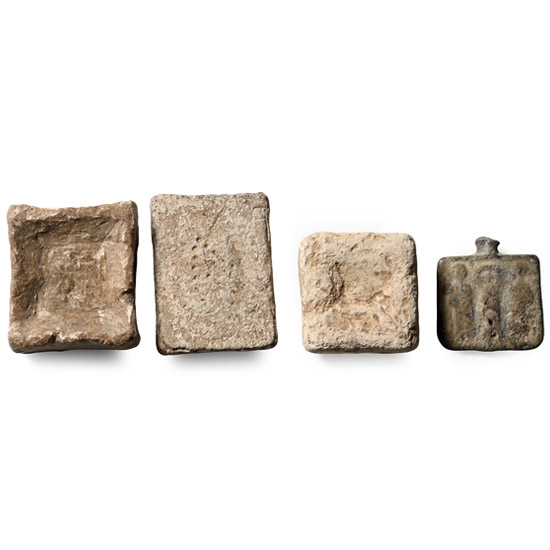
Roman Lead and Bronze Trade Weight Collection
Circa 2nd-4th century A.D.Sold for (Inc. bp): £39
Comprising: three rectangular weights, one barrel-shaped with two symbols on one end, and a tabular bifacial plaque with four standing figures on one side and the other with three figures. 72 grams total, 14-22 mm
Acquired on UK art market. Property of a Middlesex gentleman. -
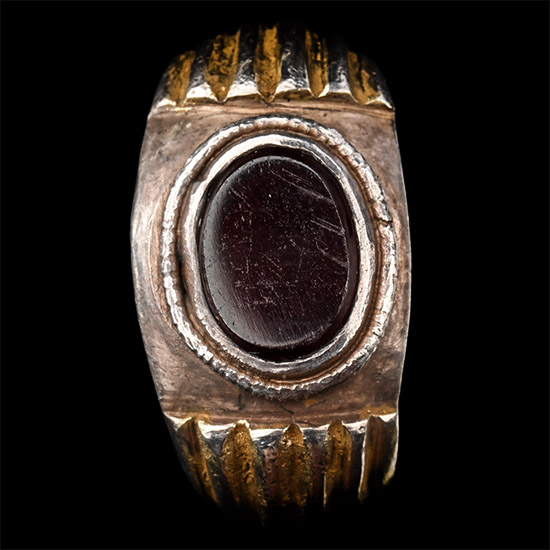
Roman Silver-Gilt Ring with Gemstone
2nd-3rd century A.D. or laterSold for (Inc. bp): £182
With a ribbed hoop, rectangular bezel with central cell and beaded wire collar, inset with later garnet cloison. 15.33 grams, 27.34 mm overall, 20.41 x 16.53 mm internal diameter (approximate size British N 1/2, USA 6 3/4, Europe 14.35, Japan 13)
From the collection of a European gentleman living in South London; acquired 1970-1980. Private collection, Suffolk, UK. -
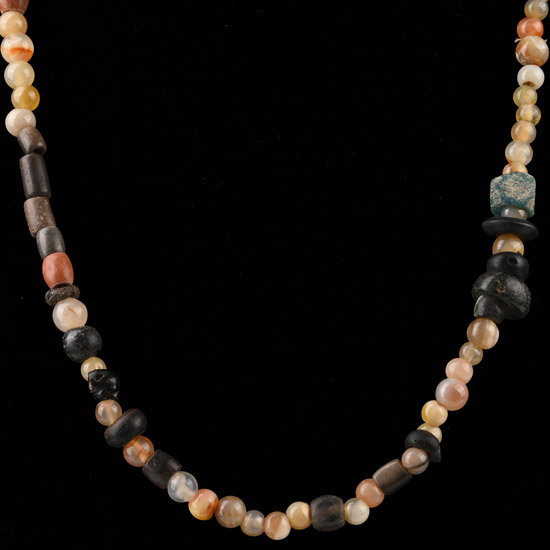
Roman Glass and Polished Stone Bead Necklace String
1st-4th century A.D. and laterSold for (Inc. bp): £78
Restrung group of mainly glass beads of oblate, spherical, cylindrical, polyhedral and other types. 72.9 grams, 66 cm
From the private collection of Mr Brian Edwards, New Malden, Surrey, UK, formed from the late 1970s-early 1980s; thence by descent. Accompanied by the original collector's data sheet(s) with reference no.A101.
