
Loading, please wait...
LOT 0659
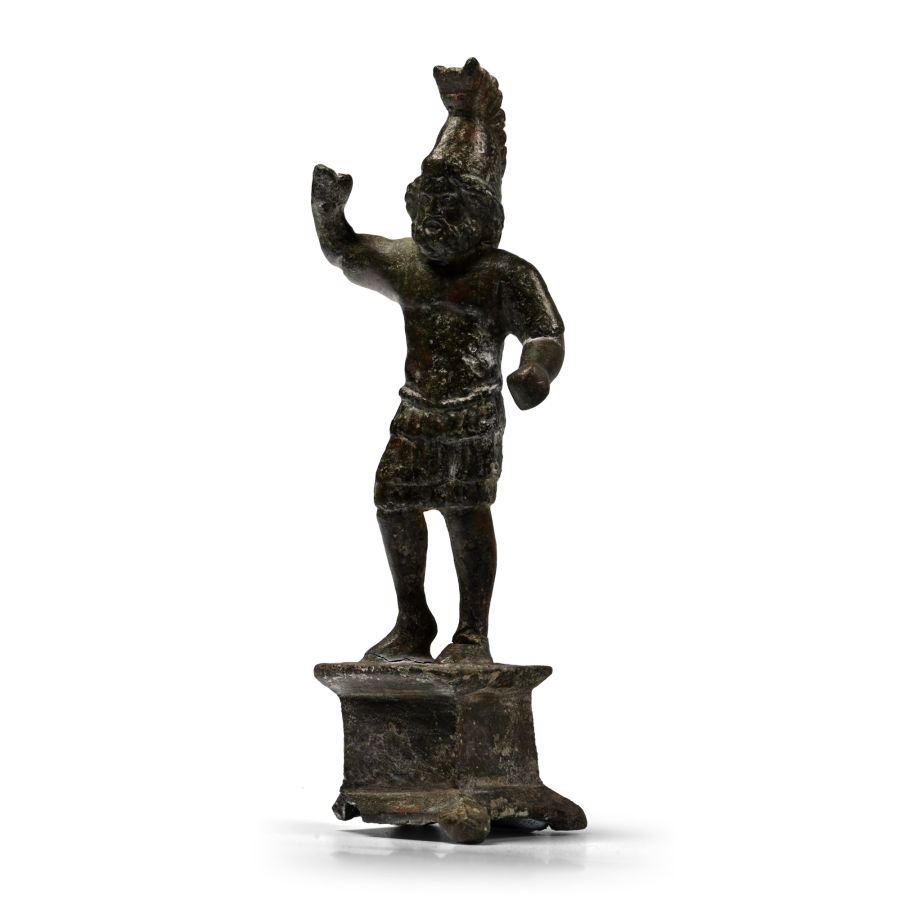
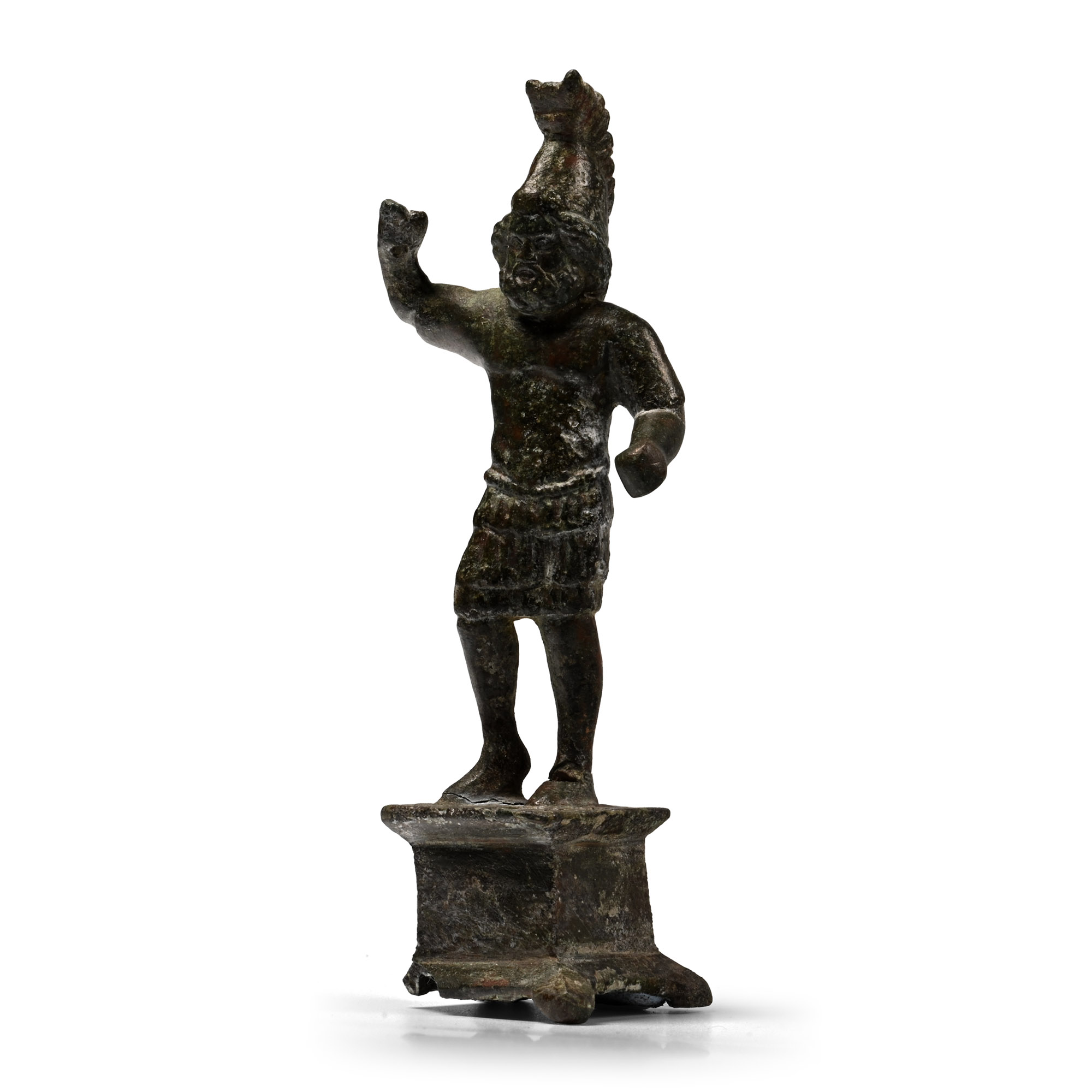
Roman Bronze Statuette of Mars on Original Plinth
2ND-3RD CENTURY A.D.
3 1/4 in. (49.3 grams, 84 mm).
Figurine of Mars finely modelled as a mature bearded male figure and clothed in a tunic and muscled cuirass (thorax statos); the right arm raised to strike with a weapon (absent) and the left, extended forward from the body, would have held a shield (absent); Pseudo-Corinthian helmet with a large double crest; the muscled cuirass worn over a padded garment (subarmalis) with two ranges of plates (pteryges); the legs bare; mounted on an integral socle base with stub feet; old collector's label stating 'Found at the site of a Roman Commandant's building, Roman fort near Munich. Bronze military votive altar statuette.' and 'Roman votive statuette of Mrs God of war on Orig plinth / found at fort site Munich, nr Commandant's building. Buried actual piece.'. [No Reserve]
ProvenanceFound Munich, Germany.
Acquired from Brigantia Antiques, York, UK, circa 2007.
Ian Wilkinson collection, Nottinghamshire, UK, formed since 1985.
Accompanied by two old handwritten dealer's tickets.
This lot is accompanied by an illustrated lot declaration signed by the Head of the Antiquities Department, Dr Raffaele D’Amato.
See Durham, E., Depicting the Gods: Metal Figurines in Roman Britain, Internet Archaeology, 2012.
CONDITIONTimeLine Auctions follows a vetting process to ensure the authenticity and legality of all items, reinforcing our commitment to integrity and responsible trading. Each antiquity, antique, and coin lot undergoes thorough examination by a vetting committee of at least ten external specialists, professional trade association members, scientists, and archaeologists: Our Vetting Process
AUCTIONS:
TimeLine is a leading auction house specialising in antiquities, ancient art, collectables, natural history, coins, medals, and books. Our auctions offer museums, collectors, historians, and enthusiasts the opportunity to acquire unique and historically significant pieces.
-
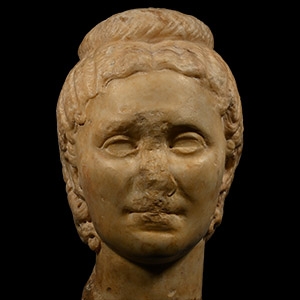
Life-Size Roman Portrait Head of a Roman Lady, Possibly The Empress Salonina
Late 3rd century A.D.Sold for (Inc. bp): £7,800
Portrait head of a woman with an elaborate coiffure, with the hair at the back parted in the middle and the two strands folded over each other and then pulled to the front to form a looped horizontal layer, then parted in the middle of the forehead and drawn to the back of the head, thereby forming ripples; individual curls represented along the hairline up to the completely exposed ears; some modern infills to the forehead area above the left eye, both upper eyelids, both cheeks in the middle area, left nostril and the chin up to the lower lip; heavily cleaned. 16 kg, 34.5 cm
Acquired on the Parisian art market. with Bernard Tinivella, Saint-Ouen. Accompanied by an academic report by Dr Raffaele D’Amato. This lot has been checked against the Interpol Database of stolen works of art and is accompanied by a search certificate number no.12464-228803. This lot has been cleared against the Art Loss Register database, and is accompanied by an illustrated lot declaration signed by the Head of the Antiquities Department, Dr Raffaele D’Amato.
The coiffure is known as 'Scheitelzopf hairstyle' or 'reverse plait'. The closest parallel for this hairstyle is a portrait bust in the Palazzo dei Conservatori (inv. no. 2767), which corresponds in every detail, including the various decorative curls. The same type of hairstyle, albeit with variations in the details (decorative curls and position of the hair loop), is found on a few other portraits of women that were dated to the Period of Gallienus by Marianne Bergmann. Some of the portraits in this typologically related group are likely to be private portraits. Nonetheless, the question must be raised as to whether the portrait shows a member of the imperial family. Hereby physiognomic features and especially imperial coin portraits need to be taken into account. In this context, it is important to note that both eyeballs were reworked, whereby the iris was completely erased. Furthermore, there are pick marks on the eyebrows, eyelids, nose, cheeks, mouth and chin (partly filled in modern times). If these were intentional changes made in the context of the practice of Damnatio memoriae, they would indicate that a lady from the imperial family was represented. The neck has been prepared for insertion into a sculpture. -
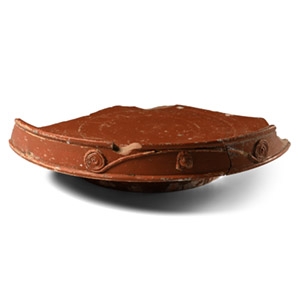
Roman Redware Footed Dish Fragment with Maker's Mark
4th century A.D.Sold for (Inc. bp): £39
Comprising a large portion of a shallow round dish with ring foot, a shoe-shaped maker's mark 'GELLI' to the centre. 220 grams, 17.6 cm
Ex German art market, 2000s. Acquired from an EU collector living in London. From the collection of Surrey, UK, gentleman. This lot is accompanied by an illustrated lot declaration signed by the Head of the Antiquities Department, Dr Raffaele D’Amato. -
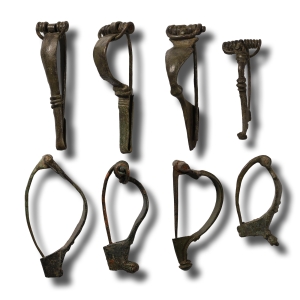
Roman Bronze Bow Brooch Collection
1st century-3rd century A.D.Sold for (Inc. bp): £182
Including P-Shaped, Kraftig Profilierte and other types. 86 grams total, 45-65 mm
From an English collection formed before 2000. This lot is accompanied by an illustrated lot declaration signed by the Head of the Antiquities Department, Dr Raffaele D’Amato.
