
Loading, please wait...


LOT 0185
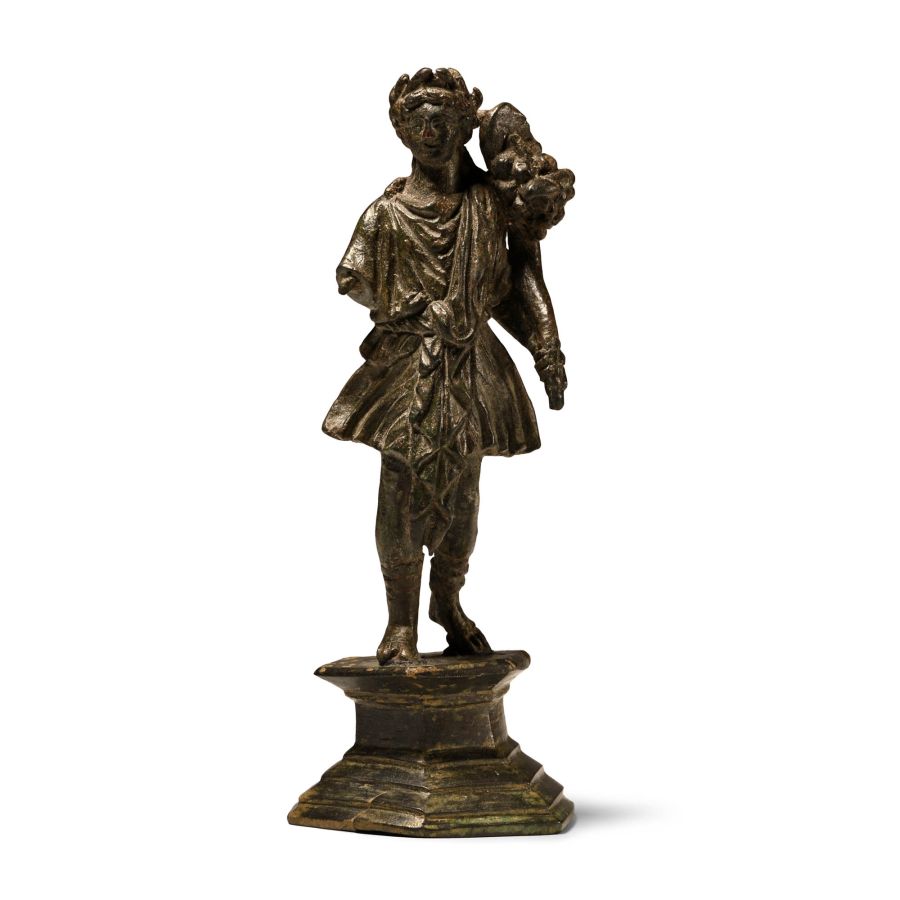
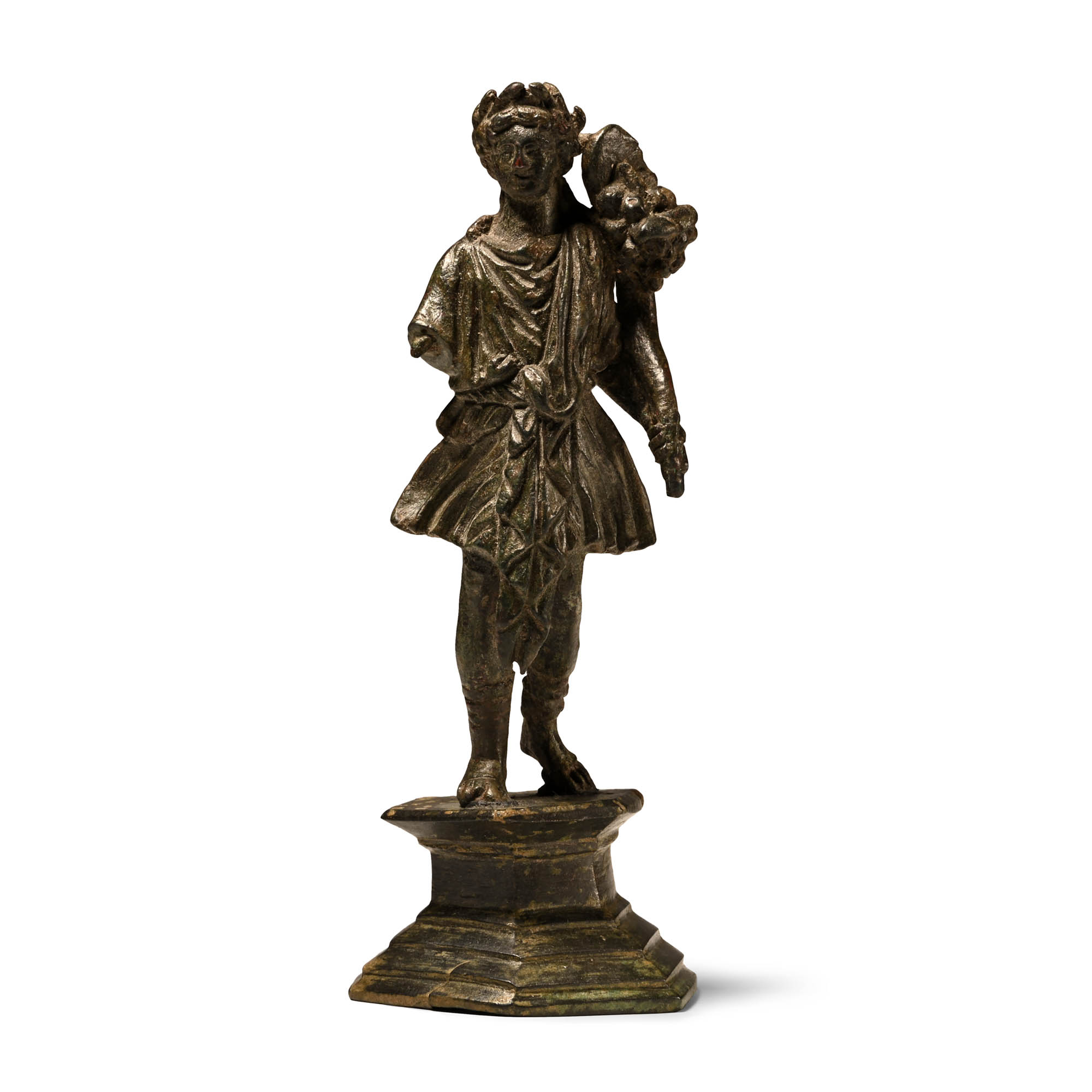
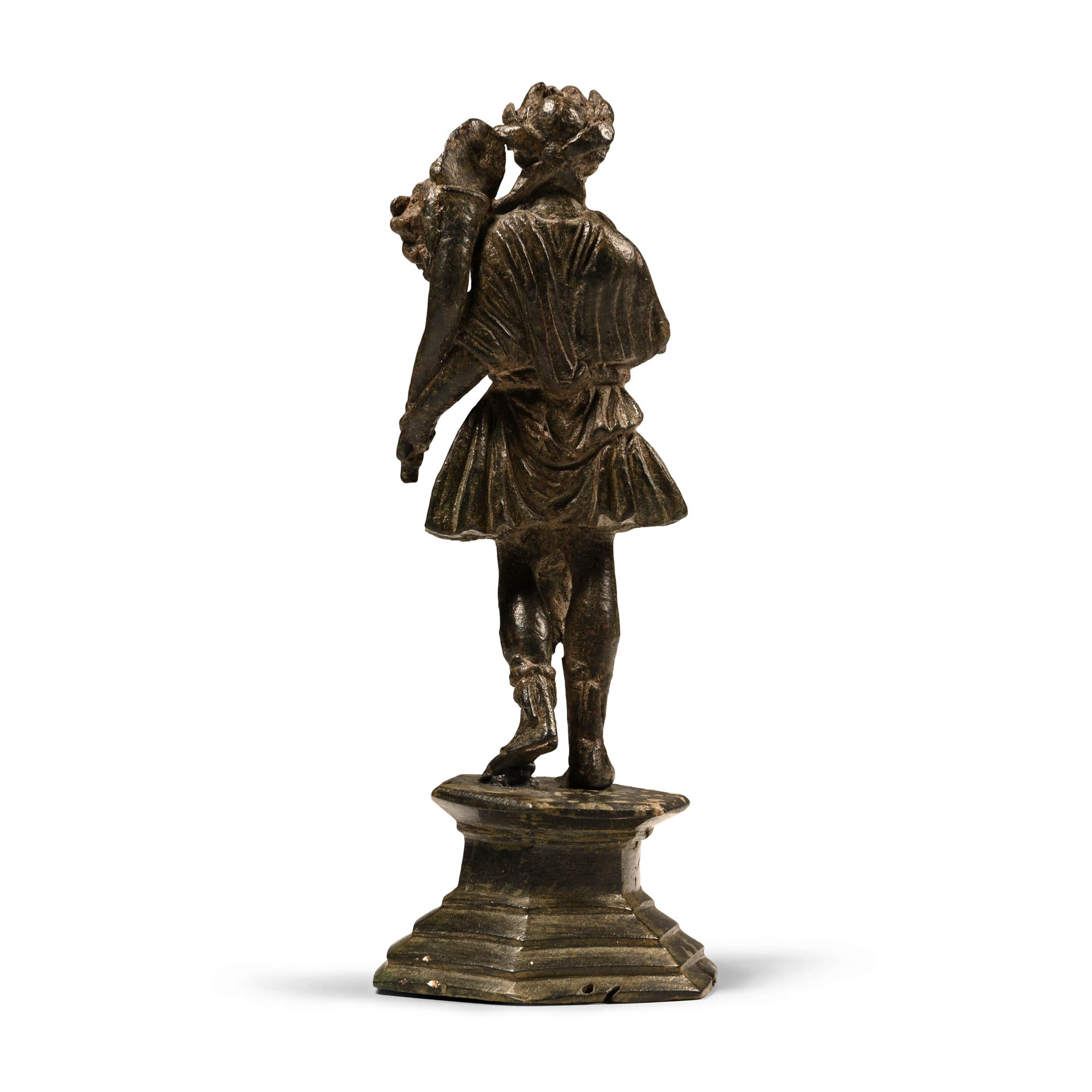
Roman Bronze Statuette of Lar Holding Cornucopia
2ND CENTURY A.D.
5 1/4 in. (264 grams, 13.2 cm).
Possibly representing the god Silvanus, dressed in a short-sleeved tunic, gathered at the waist by a belt, wearing short boots and holding a cornucopia in his left arm; mounted on a polyhedral base.
ProvenanceFrom a private family collection formed since the early 19th century, thence by descent.
Property of a New Zealand legal professional.
Accompanied by an academic report by Dr Raffaele D’Amato.
This lot has been checked against the Interpol Database of stolen works of art and is accompanied by search certificate number no.12323-223710.
Cf. Reinach, S., Repertoire de la statuarie grecque et romaine, Paris, 1930, p.497, nos.6, 7 (Madrid and Wien); 499, nos.2, 3, 4, 6; 500 no.2 for the type; Rolland, H., Bronzes Antiques de Haute Provence, Paris, 1965, items 128-131 (especially 131), 454, for comparable examples; Daremberg & Saglio, Dictionnaire des Antiquités Grecques et Romaines, Paris, 1873-1917; for similar Silvanus as a Lar, see a bronze statuette in the British Museum, museum no. 1865,0712.18, in Walters, H.B., Catalogue of the Bronzes in the British Museum. Greek, Roman & Etruscan Bronzes, London, 1989, no.1523.
FootnotesMost probably our specimen is from a private house, or private sacellum. The style of the statuette and comparison with other similar pieces points to a dating under the Trajan or Hadrian Empire. The true altar of the lares was the domestic fireplace, centre of the Roman domus, and their temple, the atrium.
CONDITIONTimeLine Auctions follows a vetting process to ensure the authenticity and legality of all items, reinforcing our commitment to integrity and responsible trading. Each antiquity, antique, and coin lot undergoes thorough examination by a vetting committee of at least ten external specialists, professional trade association members, scientists, and archaeologists: Our Vetting Process
AUCTIONS:
TimeLine is a leading auction house specialising in antiquities, ancient art, collectables, natural history, coins, medals, and books. Our auctions offer museums, collectors, historians, and enthusiasts the opportunity to acquire unique and historically significant pieces.
-
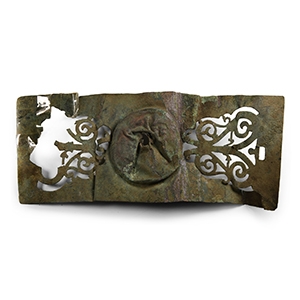
Large Roman Bronze Military Mount
2nd-3rd century A.D.Estimate: £120 - 170 (+bp*)
Opening Bid: £65
Composed of a central domed boss and openwork volutes to the sides; for a sword belt or a chariot, one corner separated. 69 grams, 14 cm wide
Good condition, very rare
Acquired 1960s-1990s. Late Alison Barker collection, a retired London barrister.
In 3rd century A.D. the sword (spatha) was mainly carried suspended from a broad baldric usually on the soldier’s left side. This sword’s shoulder belt, visible on many monuments related to the 3rd century, was composed from a leather strap, reinforced on the rims. The four specimens of Vimose provided valuable information about the shape of the baldric: one end was broad and finished in a straight edge, the other tapered to a narrow strip. They were decorated with silver disks (phalerae) of circa 6.4 cm. of diameter, with rings on the reverse for fastening. These phalerae were of different shapes, styles and decorations: we can observe a range from simple copper-alloy discs to bronze openwork pieces fitted with a plate or an openwork disc showing elaborate figures. They were usually attached at about 29-30 cm from the wider and squared top of the baldric. One of the finial parts of the baldric was in fact very wide and ended with a straight edge, upon which could be placed a hinged rectangular openwork terminal plate (like our specimen), attached to a belt terminal pendant. The lack, in our specimen, of holes for the attachment rivets could also support the thesis that the piece is not for a baldric, but a mount for cart or chariot as some examples in a similar style found in Roman North Africa. -
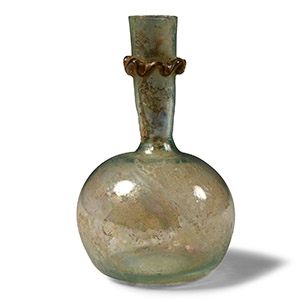
Roman Decorated Glass Flask
1st century A.D.Sold for (Inc. bp): £286
With piriform body, tubular neck with flat rim, applied undulating amber glass trail below the mouth. 50 grams, 11.8 cm
From a London, UK, collection, 1990s. -
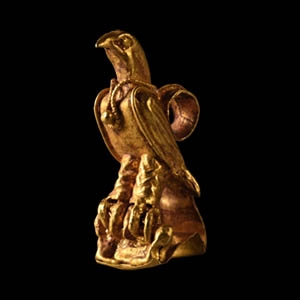
Roman Gold Eagle Pendant
2nd century B.C.-2nd century A.D.Sold for (Inc. bp): £2,340
Depicted as a standing eagle with closed wings, long striated tail extending to the small pedestal; with detailing to wings, beak, eyes and feathers; a filigree collar with small medallion around the neck; holding a small rabbit in its claws; suspension loop to the back. 2.83 grams, 27 mm
From a private family collection formed since the early 19th century, thence by descent. Property of a New Zealand legal professional. This lot has been checked against the Interpol Database of stolen works of art and is accompanied by search certificate number no.12329-223711.
The motif of an eagle and hare is linked with the story of the Trojan War. On their way towards Troy, the two brothers Agamemnon and Menelaus, the Atreides, saw two eagles swoop down upon a pregnant hare and tear her to shreds. They interpreted it as a good omen: the two eagles were the warrior brothers, and the hare Troy.
