
Loading, please wait...
_900x900.jpg "Roman Bronze Statuette of a Wild Boar")
_200x200.jpg "Roman Bronze Statuette of a Wild Boar")
_900x900.jpg "Roman Bronze Statuette of a Wild Boar")
_200x200.jpg "Roman Bronze Statuette of a Wild Boar")
.jpg "Roman Bronze Statuette of a Wild Boar")
.jpg "Roman Bronze Statuette of a Wild Boar")
LOT 0152
Roman Bronze Statuette of a Wild Boar
1ST-2ND CENTURY A.D.
2 in. (51.26 grams, 52 mm).
Modelled in the round with ridge of bristles along the spine.
ProvenanceUK private collection before 2000.
Acquired on the UK art market.
Private collection, London, UK.
TimeLine Auctions follows a vetting process to ensure the authenticity and legality of all items, reinforcing our commitment to integrity and responsible trading. Each antiquity, antique, and coin lot undergoes thorough examination by a vetting committee of at least ten external specialists, professional trade association members, scientists, and archaeologists: Our Vetting Process
AUCTIONS:
TimeLine is a leading auction house specialising in antiquities, ancient art, collectables, natural history, coins, medals, and books. Our auctions offer museums, collectors, historians, and enthusiasts the opportunity to acquire unique and historically significant pieces.
-
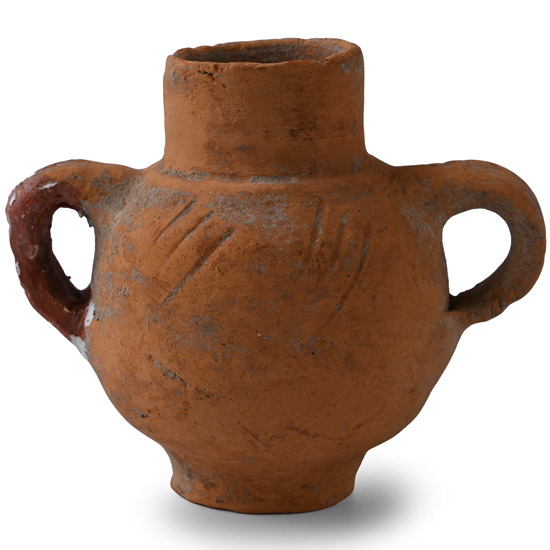
Roman Terracotta Twin-Handled Pot
Circa 1st-4th century A.D.Sold for (Inc. bp): £59
Comprising a bulbous body with hatched decoration above the shoulder, a narrow foot and a tubular neck with two strap handles. 123 grams, 85.5 mm high
From the private collection of Mr Brian Edwards, New Malden, Surrey, UK, formed from the late 1970s-early 1980s; thence by descent. Accompanied by the original collector's data sheet with reference no.A120. -
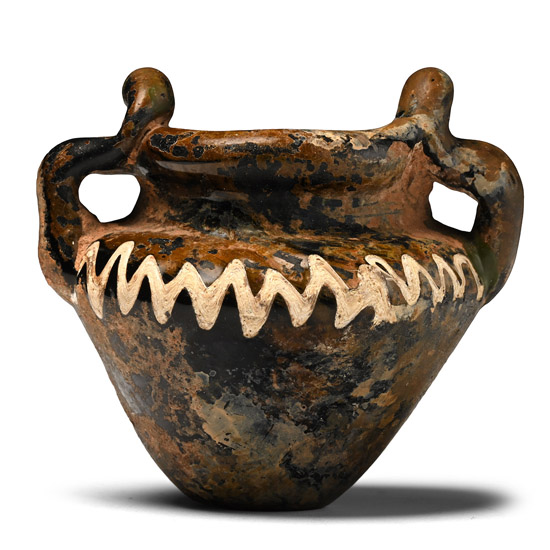
Roman Miniature Glass Jar
4th-5th century A.D.Estimate: £200 - 300 (+bp*)
Opening Bid: £100
With broad shoulder and conical body, everted rim, two loop handles and applied undulating band to the shoulder. 51.34 grams, 47 mm wide
Acquired 1970s-1996. Property of a North American collector. London collection, 2016.
This jar is a Syro-Palestinian type. Similar jars were found in the graves of Beit Fajjar, Palestine, and usually dated at the 4th-5th centuries A.D. Their colour is usually yellow-green or light green, but purple is also used. -
.jpg)
Roman Cobalt Blue Glass Unguentarium
1st-3rd century A.D.Sold for (Inc. bp): £910
Delicate cobalt-blue glass unguentarium comprising a piriform body with slight constriction at the base of the cylindrical neck, everted folded rim and a slightly concave base; traces of earthly deposits to the surface. 15 grams, 88 mm
Private collection, 1990s-early 2000s.
