
Loading, please wait...
_900x900.jpg "Roman Bronze Statue of Zeus with Eagle")
_200x200.jpg "Roman Bronze Statue of Zeus with Eagle")
_900x900.jpg "Roman Bronze Statue of Zeus with Eagle")
_200x200.jpg "Roman Bronze Statue of Zeus with Eagle")
.jpg "Roman Bronze Statue of Zeus with Eagle")
.jpg "Roman Bronze Statue of Zeus with Eagle")
LOT 0129
Roman Bronze Statue of Zeus with Eagle
2ND-3RD CENTURY A.D.
5 3/4 in. (310 grams, 14.5 cm high).
Standing nude with a wreath resting on his head, hair and beard forming a dense mass of curls; naturalistic facial detailing, long and slender muscular torso, depicting a harmonious anatomy with sharp divisions of the abdominal muscles; right arm lowered, once holding a thunderbolt, the left arm raised; a small cloak draped around the torso; an eagle with open wings standing beside him; cotton-reel base.
ProvenanceEx German art market, 2000s.
Acquired from an EU collector living in London.
From the collection of Surrey, UK, gentleman.
Accompanied by an academic report by Dr Raffaele D'Amato.
This lot has been checked against the Interpol Database of stolen works of art and is accompanied by a search certificate number no.12467-230459.
This lot has been cleared against the Art Loss Register database, and is accompanied by an illustrated lot declaration signed by the Head of the Antiquities Department, Dr Raffaele D’Amato.
Exhibited at the Harwich Museum, Harwich, Essex, UK, 21st January-10th March 2025; accompanied by a copy of a photograph of the artefacts on display.
LiteratureCf. Reinach, S., Répertoire de la statuaire grecque et romaine, Paris, 1897, p.7, nos.1,3; 8 no.3, for the type; Rolland, H., Bronzes Antiques de Haute Provence, XVIII supplément à ‘Gallia’, Paris, 1965, nos.3-6, for similar.
FootnotesThis small bronze may have served as a devotional image in a personal shrine or used as votive object offered as dedication to the god.
CONDITIONTimeLine Auctions follows a vetting process to ensure the authenticity and legality of all items, reinforcing our commitment to integrity and responsible trading. Each antiquity, antique, and coin lot undergoes thorough examination by a vetting committee of at least ten external specialists, professional trade association members, scientists, and archaeologists: Our Vetting Process
AUCTIONS:
TimeLine is a leading auction house specialising in antiquities, ancient art, collectables, natural history, coins, medals, and books. Our auctions offer museums, collectors, historians, and enthusiasts the opportunity to acquire unique and historically significant pieces.
-
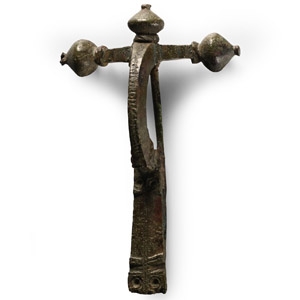
Roman Bronze Crossbow Brooch
4th century A.D.Sold for (Inc. bp): £111
With onion knop finials, deep bow, stepped junction with foot, trapezoidal foot with ring-and-dot motifs and integral catch; hinged pin to reverse. 17.4 grams, 59 mm
Acquired from Coincraft, London, UK. From the private collection of Kenneth Machin (1936-2020), Buckinghamshire, UK; his collection of antiquities and natural history was formed since 1948; thence by descent. Accompanied by an original certificate of authenticity from Coincraft. This lot is accompanied by an illustrated lot declaration signed by the Head of the Antiquities Department, Dr Raffaele D’Amato. -
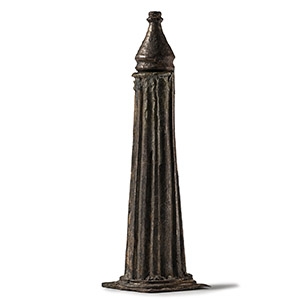
Roman Sheet-Silver Pyxis in the form of a Column
1st-2nd century A.D.Estimate: £600 - 800 (‡+bp*)
Opening Bid: £270
Formed as a fluted column on a square, stepped base; separate poppy-shaped lid; fine cracks to the rim. 14.2 grams, 83 mm
Ex Herbert A. Cahn, Basel, 1990s. Accompanied by a copy of an Art Loss Register certificate no.S00037854. This lot is accompanied by an illustrated lot declaration signed by the Head of the Antiquities Department, Dr Raffaele D’Amato. -
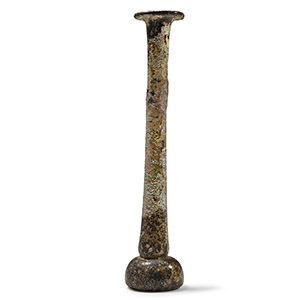
Roman Tall Glass Unguentarium
2nd-3rd century A.DSold for (Inc. bp): £104
Tall iridescent vessel with wide foot and dimpled base, tapering stem and flared rim, two small holes, repaired. 12.5 grams, 14.5 cm
Ex London art market 1990s. From a London, UK, collection. This lot is accompanied by an illustrated lot declaration signed by the Head of the Antiquities Department, Dr Raffaele D’Amato.
