
Loading, please wait...
_900x900.jpg "Roman Bronze Sleeping Dog")
_200x200.jpg "Roman Bronze Sleeping Dog")
.jpg "Roman Bronze Sleeping Dog")
LOT 0736
Roman Bronze Sleeping Dog
1ST CENTURY B.C.-5TH CENTURY A.D.
1 1/4 in. (30.9 grams, 32 mm).
Appliqué with domed underside, legs drawn up beneath the arched body; incised fur and other detailing. [No Reserve]
ProvenanceAcquired by a Swiss family in the mid-1980s to late 1990s, thence by descent.
Private collection, Switzerland, since the late 1990s.
TimeLine Auctions follows a vetting process to ensure the authenticity and legality of all items, reinforcing our commitment to integrity and responsible trading. Each antiquity, antique, and coin lot undergoes thorough examination by a vetting committee of at least ten external specialists, professional trade association members, scientists, and archaeologists: Our Vetting Process
AUCTIONS:
TimeLine is a leading auction house specialising in antiquities, ancient art, collectables, natural history, coins, medals, and books. Our auctions offer museums, collectors, historians, and enthusiasts the opportunity to acquire unique and historically significant pieces.
-
.jpg)
Bronze Roman Coin and Framed Limited Edition Print
3rd century A.D. and laterSold for (Inc. bp): £10
The coin of Constantine the Great (272-337 A.D.) mounted on 22 carat gold foil, framed with an art print signed by the artist David McAllister, depicting scenes of Roman military activity; limited edition number 172/1150. 1.26 kg, 49.5 x 37.5 cm
UK gallery, early 2000s. Accompanied by a previous numbered certificate of authenticity.
David McAllister's exciting design is a 'one of a kind' work that portrays the might and riches of the Roman civilisation. This limited edition print is a celebration of the award winning artist's lifetime dedication to historical paintings of the ancient world. To enhance appreciation of this rare and historic work, each individual print is signed and numbered by the artist. -
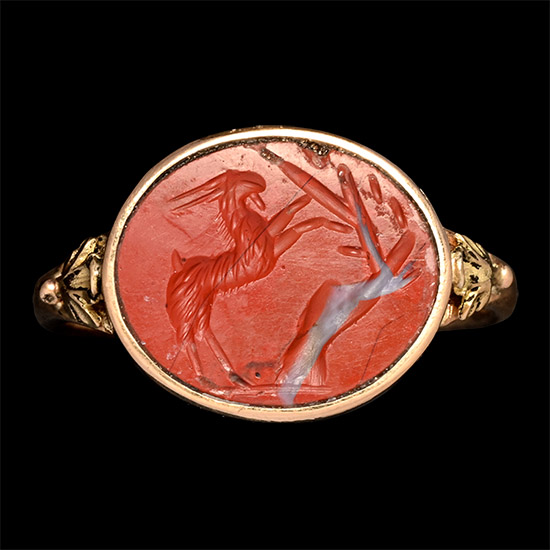
Roman Jasper Gemstone of a Grazing Goat in Gold Ring
2nd-3rd century A.D.Sold for (Inc. bp): £910
Intaglio of a bearded goat standing on its hind legs against a tree on which it browses; large fruits hanging from two of the boughs; from a third bough to the right of the tree hangs what may be a dead hare, or possibly another fruit; set into a later gold ring; supplied with a museum-quality impression. 4.10 grams, 20.70 mm overall, 17.90 x 14.56 mm internal diameter (approximate size British L, USA 5 3/4, Europe 11.24, Japan 10)
Private collection, Europe. Acquired on the English art market.
A single transparent vein in the jasper running from top left to bottom right has been utilised by the engraver to emphasise the trunk of the tree. -
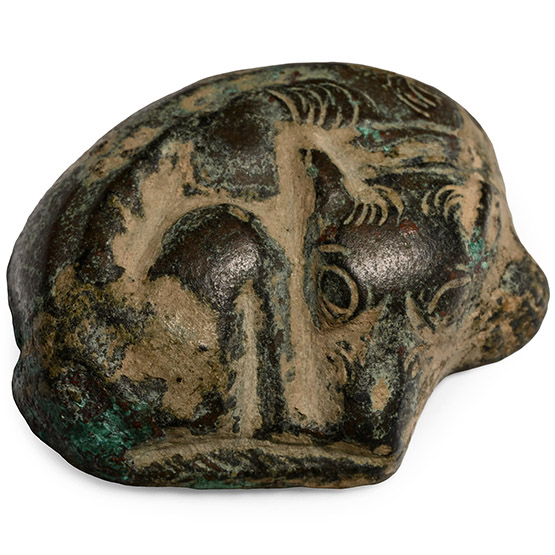
Roman Bronze Sleeping Dog
1st century B.C.-5th century A.D.Sold for (Inc. bp): £169
Appliqué with domed underside, legs drawn up beneath the arched body; incised fur and other detailing. 30.9 grams, 32 mm
Acquired by a Swiss family in the mid-1980s to late 1990s, thence by descent. Private collection, Switzerland, since the late 1990s.
