Loading, please wait...

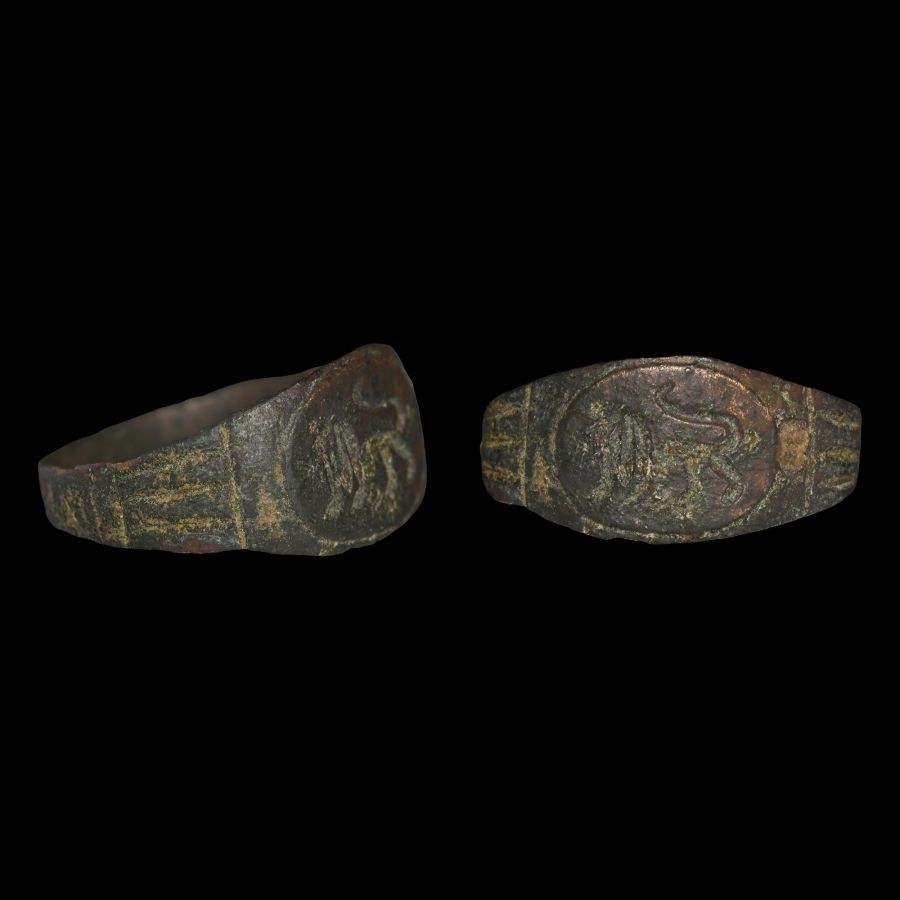
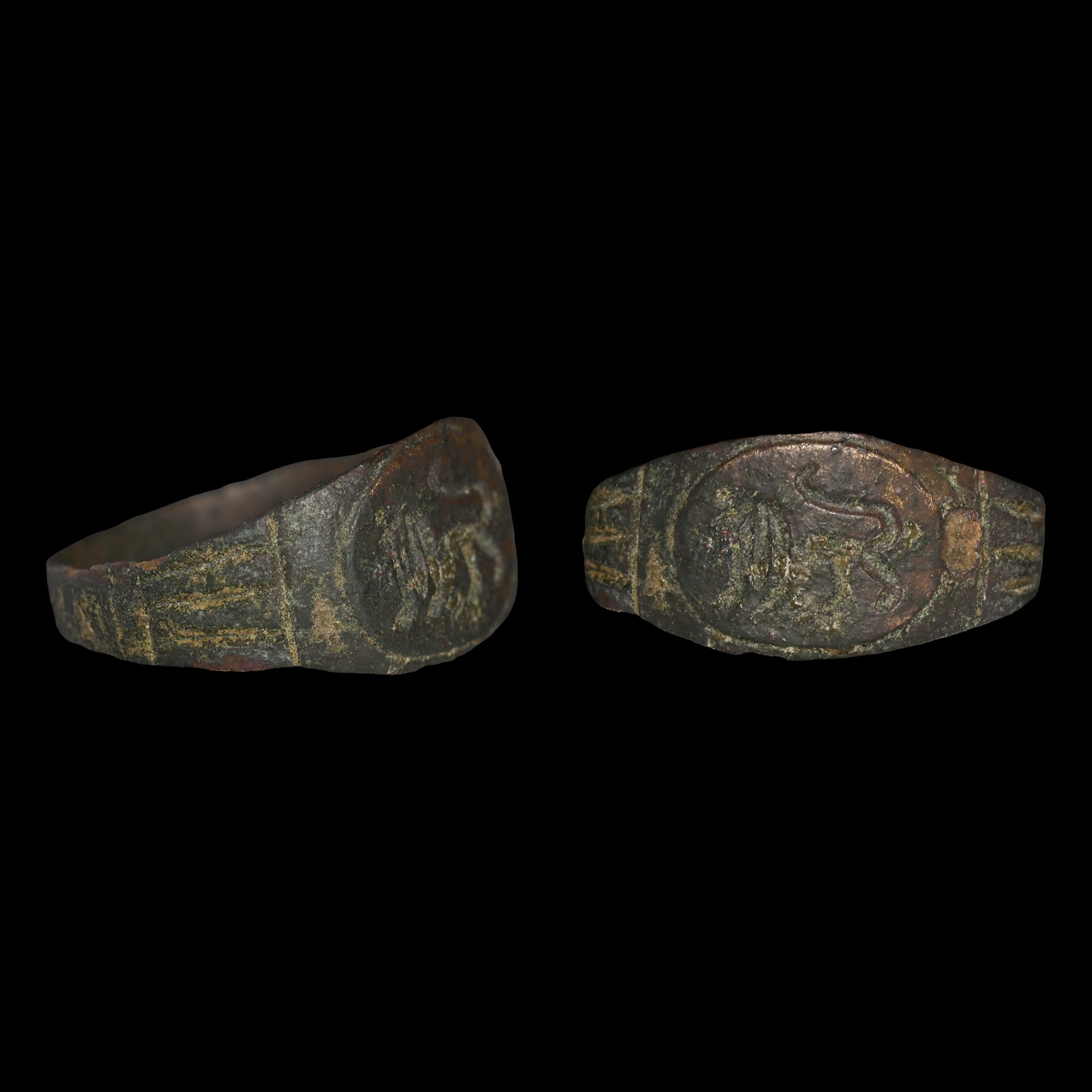
Roman Bronze Ring with Walking Lion Roman Bronze Ring with Walking Lion Roman Bronze Ring with Walking Lion
Use mousewheel to zoom in and out, click to enlarge
Details

LOT 0913

Roman Bronze Ring with Walking Lion

3RD-4TH CENTURY A.D.

3/4 in. (1.37 grams, 19.70 mm overall, 18.12 mm internal diameter (approximate size British M 1/2, USA 6 1/4, Europe 13.09, Japan 12)).

Featuring a slender hoop and fluted shoulders, an oval bezel with an advancing lion with its tail raised. [No Reserve]

Provenance

From the private collection of a European gentleman (1942-2024), formed since the 1970s.

CONDITION
VETTING:

TimeLine Auctions follows a vetting process to ensure the authenticity and legality of all items, reinforcing our commitment to integrity and responsible trading. Each antiquity, antique, and coin lot undergoes thorough examination by a vetting committee of at least ten external specialists, professional trade association members, scientists, and archaeologists: Our Vetting Process


AUCTIONS:

TimeLine is a leading auction house specialising in antiquities, ancient art, collectables, natural history, coins, medals, and books. Our auctions offer museums, collectors, historians, and enthusiasts the opportunity to acquire unique and historically significant pieces.

LOT 0913

Roman Bronze Ring with Walking Lion

Estimate £30 - 40€35 - 46 (for guidance only)$41 - 54 (for guidance only)

Current bid: £5 +BP*
(1 Bid, Reserve met)

Sign in to Bid

Please enter a e-mail
Please enter a password
Or Create Account here.
Please confirm to accept TC and Privacy policy

(1 Bid, Reserve met)   |   Current bid: £5
RELATED LOTS
  • Roman Marble Left Foot from a Sculpture
    Ex Nicolas Koutoulakis (1910-1996)
    Roman Marble Left Foot from a Sculpture
    2nd century A.D.

    Estimate: £3,000 - 4,000 (+bp*)

    Opening Bid: £1,500

    Comprising an elegantly carved lower part of the calf and foot, a detailed rendering of the toes; the proportions suggesting that the subject was a child or a young woman; mounted on a custom-made display stand. 771 grams total, 15 cm high including stand


    Nicolas Koutoulakis (1910-1996), thence by descent. Ex Galerie Dominique Thirion, Brussels, 1990s. Private collection of Mr K.A., France. with Kallos Gallery, London, UK. Accompanied by an academic report by Dr Raffaele D'Amato. This lot has been checked against the Interpol Database of stolen works of art and is accompanied by a search certificate number no.13010-246748.

    The foot was a prominent feature on sculptures: more susceptible to weathering and the ravages of time than a head or a torso, the fragments that survive are often badly damaged. It is also possible that this piece belonged to a sculpture created via the acrolith technique, in which the sculptor focused his attention solely on the unclothed parts of the figure, which were made from a more valuable material than the rest of the piece.

    Lot Details

  • Roman Gold Ring with Bust of the God Serapis
    Roman Gold Ring with Bust of the God Serapis
    1st-2nd century A.D.

    Estimate: £2,500 - 3,500 (‡+bp*)

    Bids: 1   |   Current Bid: £2,000

    Hollow-formed hoop with broad ellipsoid cell, inset red jasper intaglio profile bust of Serapis with modius; possibly a marriage, supplied with a museum-quality impression. 5.65 grams, 27.68 mm overall, 18.70 x 15.32 mm internal diameter (approximate size British L 1/2, USA 6, Europe 11.87, Japan 11)


    Private European collection. Acquired in 2002. This lot has been checked against the Interpol Database of stolen works of art and is accompanied by search certificate number no.13122-246778.

    Serapis was a Graeco-Egyptian god combining the Egyptian gods Osiris and Apis, but with a decidedly Greek appearance. He was promoted by Ptolemy I in the 3rd century BC to help unite the Greek and Egyptian people. Later, Ptolemaic rulers spread his worship, and Serapis became popular across the Roman Empire. Outside Egypt, he was often identified as Isis's partner, replacing Osiris. Over time, he also adopted traits associated with the Greek gods, Hades and Dionysus.

    Lot Details

  • Romano-British Bronze Chariot Rein Guide Pair
    Romano-British Bronze Chariot Rein Guide Pair
    England, 1st-2nd century A.D.

    Estimate: £200 - 300 (+bp*)

    Opening Bid: £100

    Matched pair of rein guides, each an oval loop with a collar and a rectangular loop below. 210 grams total, 74 mm each


    Found UK. From a UK collection formed in the 1980s. Property of an Essex, UK, gentleman.

    Lot Details