
Loading, please wait...
LOT 0836
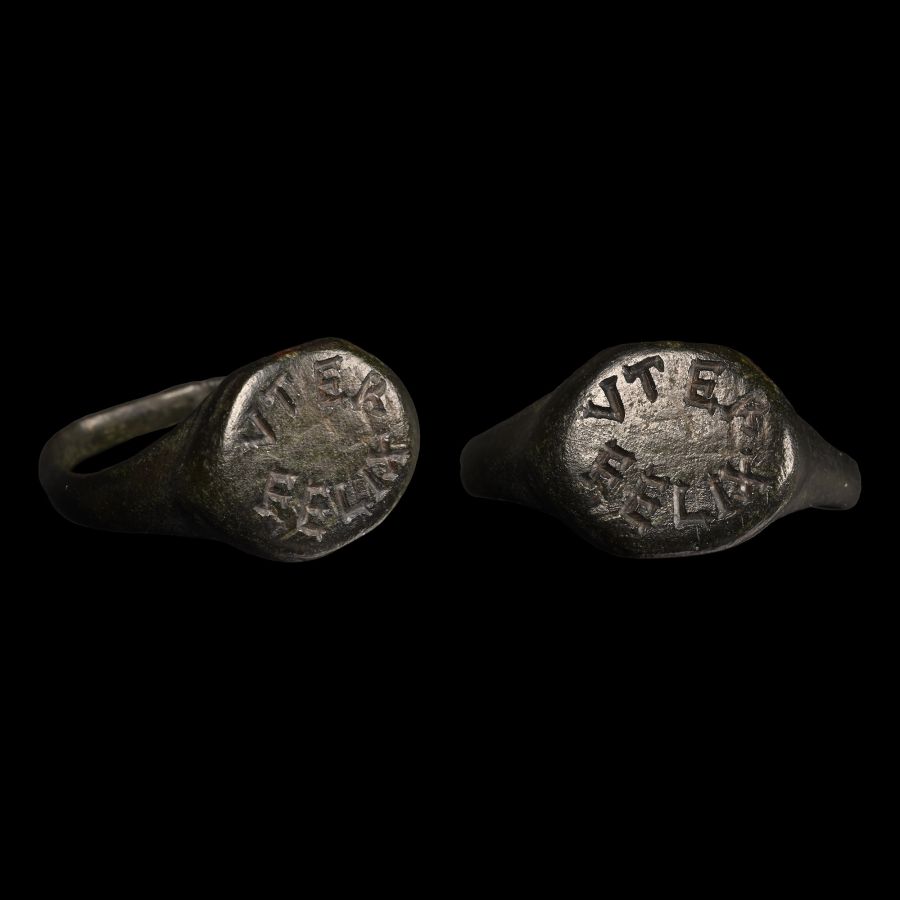
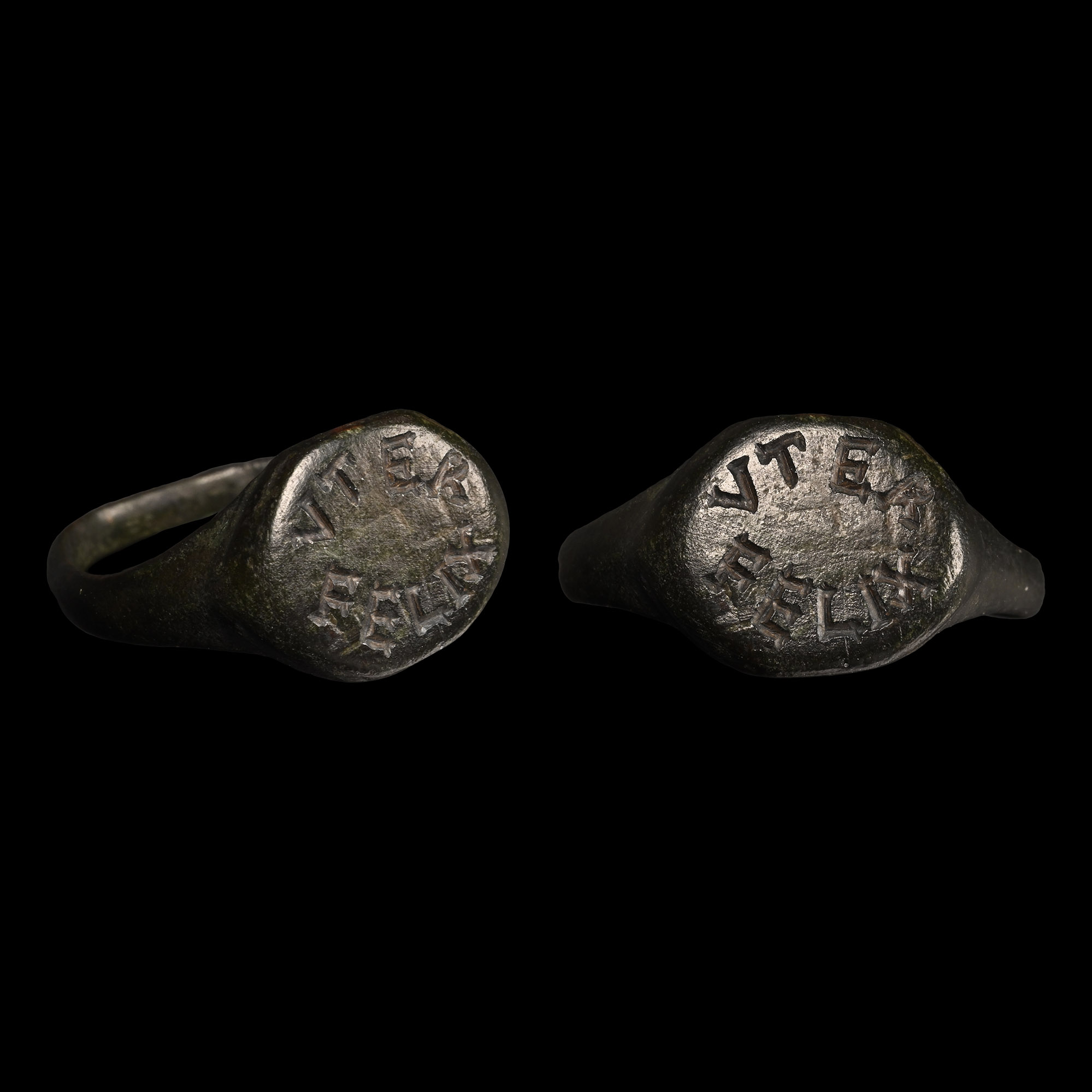
Roman Bronze Ring with 'VTER FELIX'
2ND-3RD CENTURY A.D.
3/4 in. (3.32 grams, 21.11 mm overall, 18.24 mm internal diameter (approximate size British O, USA 7, Europe 14.98, Japan 14)).
Ellipsoid bezel with incuse legend 'VTER / FELIX' for utere felix (use [this and be] lucky). [No Reserve]
ProvenanceEx German art market, 2000s.
Acquired from an EU collector living in London.
From the collection of Surrey, UK, gentleman.
This lot is accompanied by an illustrated lot declaration signed by the Head of the Antiquities Department, Dr Raffaele D’Amato.
Cf. Chadour, A.B., Rings. The Alice and Louis Koch Collection, volume I, Leeds, 1994, item 264, for type.
CONDITIONTimeLine Auctions follows a vetting process to ensure the authenticity and legality of all items, reinforcing our commitment to integrity and responsible trading. Each antiquity, antique, and coin lot undergoes thorough examination by a vetting committee of at least ten external specialists, professional trade association members, scientists, and archaeologists: Our Vetting Process
AUCTIONS:
TimeLine is a leading auction house specialising in antiquities, ancient art, collectables, natural history, coins, medals, and books. Our auctions offer museums, collectors, historians, and enthusiasts the opportunity to acquire unique and historically significant pieces.
-
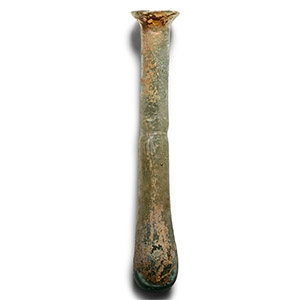
Roman Glass Lachrymatory
1st-2nd century A.D.Sold for (Inc. bp): £98
With long, narrow neck separated from the body by a constriction; funicular mouth. 19 grams, 12.3 cm
Ex W.Kern, Zurich, 1950s-1970s (d.1980s). Accompanied by a copy of an Art Loss Register certificate no.S00086748. This lot is accompanied by an illustrated lot declaration signed by the Head of the Antiquities Department, Dr Raffaele D’Amato.
A lachrymatory (from Latin lacrima, tear) is a type of earthenware or, more commonly, glass container found in Roman and Greek tombs, thought to be bottles into which the relatives of the deceased had dropped their tears. They most likely contained ointments, and the discovery of so many of these containers (unguentaria) in tombs is due to the use of ointments in funeral ceremonies. These lachrymatories are usually shaped like a spindle or flask with a long neck and a bulb-shaped body. -
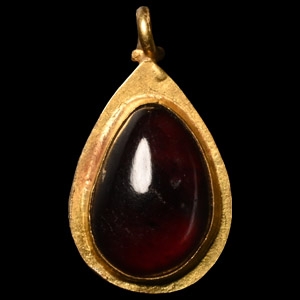
Roman Gold and Garnet Pendant
1st-4th century A.D.Sold for (Inc. bp): £494
Gold teardrop pendant with inset cabochon garnet in stepped cell, loop above. 1.20 grams, 15 mm
Ex property of a late Japanese collector, 1970-2000s. This lot is accompanied by an illustrated lot declaration signed by the Head of the Antiquities Department, Dr Raffaele D’Amato. -

Roman Blue Glass Bead Necklace String
1st-4th century A.D. and laterSold for (Inc. bp): £130
Restrung to a Y-shape using a variety of beads, the central feature composed of larger beads including a teardrop-shaped bead with impressed dots. 10.9 grams, 33 cm
Acquired 1980-2015. Ex Abelita family collection. This lot is accompanied by an illustrated lot declaration signed by the Head of the Antiquities Department, Dr Raffaele D’Amato.
