Loading, please wait...

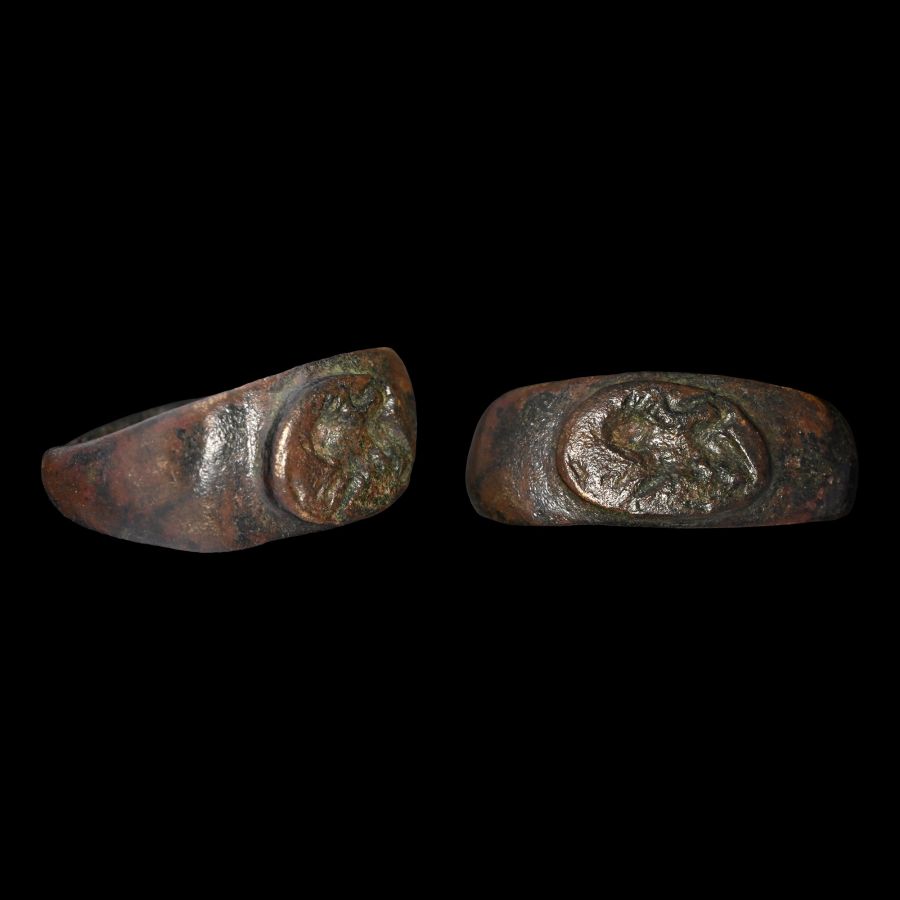
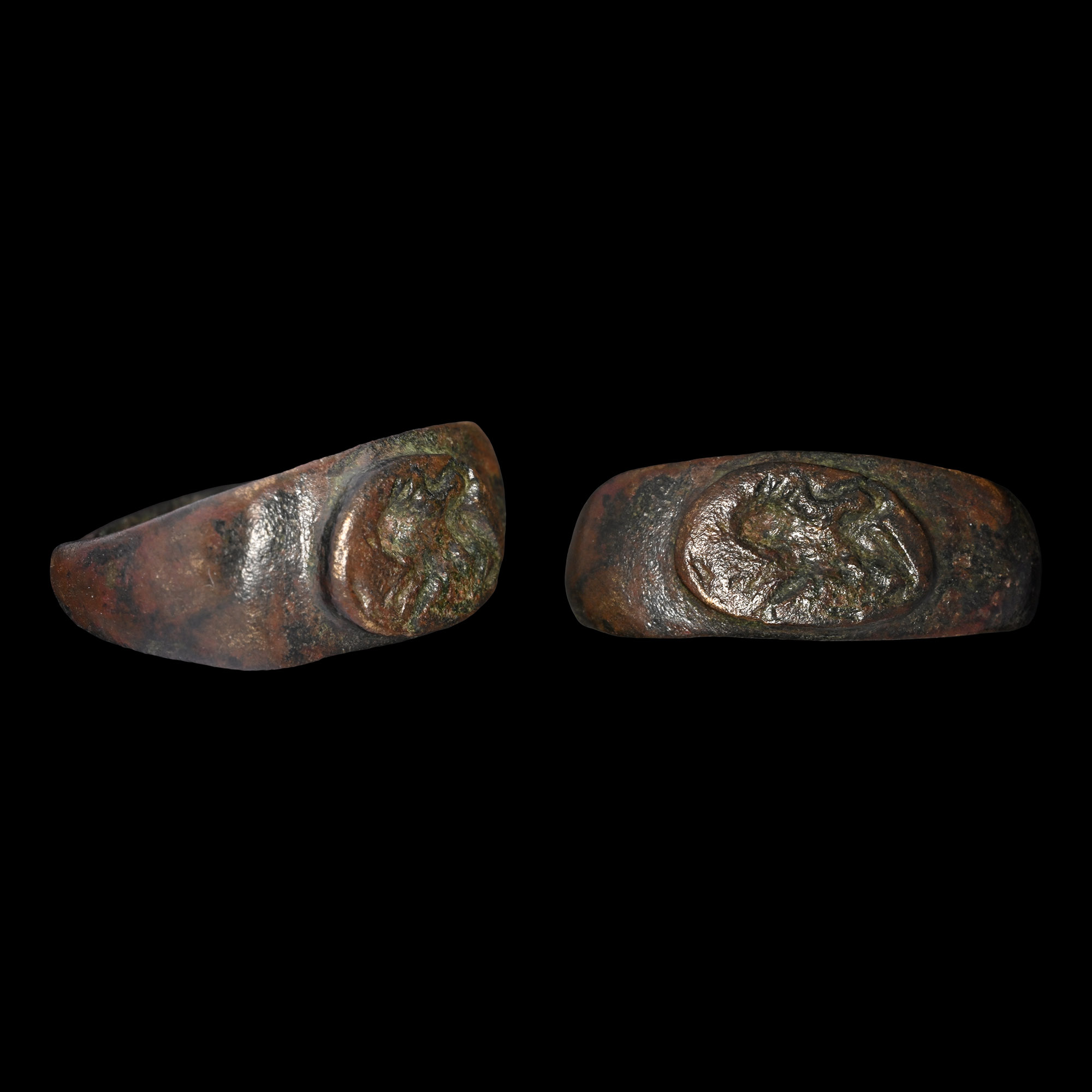
Roman Bronze Ring with Lion Roman Bronze Ring with Lion Roman Bronze Ring with Lion
Use mousewheel to zoom in and out, click to enlarge
Details

LOT 0801

Roman Bronze Ring with Lion

1ST-2ND CENTURY A.D.

1 in. (4.71 grams, 23.21mm overall, 19.26 x 14.59 mm internal diameter (approximate size British K, USA 5 1/4, Europe 9.95, Japan 9)).

The hoop expanding towards the angled shoulders, oval bezel with a leaping lion facing left. [No Reserve]

Provenance

Ex German art market, 2000s.
Acquired from an EU collector living in London.
From the collection of a Surrey, UK, gentleman.

CONDITION
VETTING:

TimeLine Auctions follows a vetting process to ensure the authenticity and legality of all items, reinforcing our commitment to integrity and responsible trading. Each antiquity, antique, and coin lot undergoes thorough examination by a vetting committee of at least ten external specialists, professional trade association members, scientists, and archaeologists: Our Vetting Process


AUCTIONS:

TimeLine is a leading auction house specialising in antiquities, ancient art, collectables, natural history, coins, medals, and books. Our auctions offer museums, collectors, historians, and enthusiasts the opportunity to acquire unique and historically significant pieces.

LOT 0801

Roman Bronze Ring with Lion

Estimate £60 - 80€70 - 93 (for guidance only)$81 - 108 (for guidance only)

Opening Bid
£5 (EUR 6; USD 7) +BP*

Sign in to Bid

Please enter a e-mail
Please enter a password
Or Create Account here.
Please confirm to accept TC and Privacy policy

Bids: 0
RELATED LOTS
  • Roman Sapphire Cameo with Bust of Serapis Later Converted to Saint John the Evangelist
    Roman Sapphire Cameo with Bust of Serapis Later Converted to Saint John the Evangelist
    Circa 2nd-3rd century A.D., converted 6th-7th century A.D.

    Estimate: £3,000 - 4,000 (+bp*)

    Opening Bid: £500

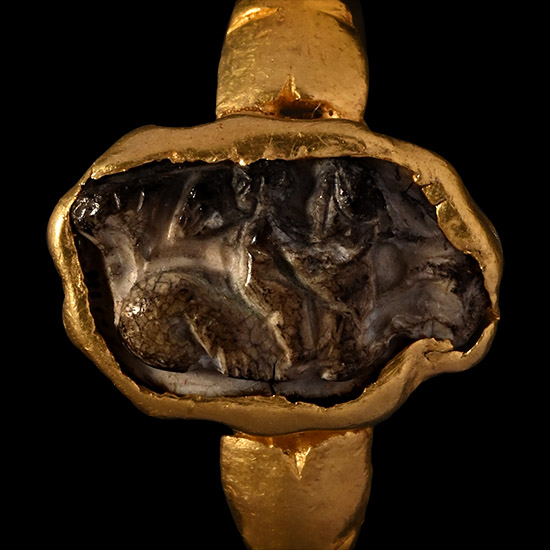
    Carved in the half-round on a sapphire crystal showing striations on the reverse, depicting the upper body of Serapis with modius and pleated tunic, eagle with spread wings placed on the chest. 5.06 grams, 23 mm


    Acquired circa 1980. Property of a Middlesex gentleman. This lot has been checked against the Interpol Database of stolen works of art and is accompanied by search certificate number no.13351-255640.

    This is a prime example of late antique or early medieval spolia, where a pagan motif was converted into a Christian one with minimal mental or manual adaptation into a visual fusion of Serapis and Saint John. During the Roman Empire, especially in the 2nd and 3rd centuries AD, depictions of the 'bust of the God Serapis standing on an eagle' were extremely popular. The eagle symbolised Jupiter-Serapis, as well as Roman power. When the Empire became Christian, this combination was immediately recognised as the Evangelist John, accompanied by his symbol, the eagle. The modius (kalathos) symbolised fertility and dominion over the underworld when placed on Serapis's head. However, it was often incorrectly (or deliberately) interpreted by Christian observers as an early form of a crown, halo, or priestly headdress. As sapphire is extremely difficult to work with, the modius was often left standing, emphasising the figure's imperial or divine dignity. There are documented cases of this kind. Most famous example: 'Gem of Serapis' (Cab. Méd., Paris), or the reinterpretation of depictions of Jupiter as God the Father. During the Christianisation process, pagan gods with beards and eagles (Jupiter/Serapis) were reclassified as John the Evangelist or Christ himself en masse.

    Lot Details

  • Agate Cameo with a Portrait of a Hellenistic Ruler
    Agate Cameo with a Portrait of a Hellenistic Ruler
    1st century B.C.

    Estimate: £2,000 - 3,000 (+bp*)

    Opening Bid: £1,000

    Detailed bust of a man with his curly hair secured by tainia with the ends hanging behind his neck, aquiline nose and prominent chin, tryphe still visible. 0.75 grams, 17 mm


    Formerly in a private collection of an European lady, 1970s-1980s. Private collection, UK. This lot has been checked against the Interpol Database of stolen works of art and is accompanied by search certificate number no.13306-257801

    The cameo represents a member of the Julio-Claudian dynasty. It could represent Agrippa, the son-in-law and victorious admiral of Augustus, who was appointed Augustus’ successor through a symbolic gift of a ring. It may alternatively represent Drusus Maior, Augustus’ stepson and another potential successor.

    Lot Details

  • Roman Sardonyx Gemstone in Silver Ring
    Roman Sardonyx Gemstone in Silver Ring
    1st century B.C.

    Estimate: £400 - 600 (+bp*)

    Opening Bid: £200

    An oval intaglio showing a hand with summum bonum: cornucopia and poppy ear, set in a later ring with granulation; supplied with a museum-quality impression. 3.37 grams, 23.00 mm overall, 16.66 mm internal diameter (approximate size British L 1/2, USA 6, Europe 11.87, Japan 11)


    Acquired on the European art market.

    Lot Details