
Loading, please wait...
_900x900.jpg "Roman Bronze Plaque with Eros on Lion")
_200x200.jpg "Roman Bronze Plaque with Eros on Lion")
.jpg "Roman Bronze Plaque with Eros on Lion")
LOT 0137
Roman Bronze Plaque with Eros on Lion
CIRCA 2ND-4TH CENTURY A.D.
4 in. (182 grams, 10.2 cm high).
Modelled in relief with openwork elements, stylised detailing to both figures; hollow reverse.
ProvenanceAcquired 1990s-early 2000s.
East Anglian private collection.
Cf. Mille, B., 'The Casting Techniques of Antique South Arabian Large Bronze Statues,' in Jett, P., McCarthy, B. and Douglas, J.G. (eds.), Scientific Research on Ancient Asian Metallurgy: Proceedings of Fifth Forbes Symposium at the Freer Gallery of Art, Washington, Smithsonian Institution, 28-29/10/2010, Washington, 2012, pp.225-247, fig.5, for similar images.
FootnotesHollow cast bronze images of Eros riding a lion are linked to the Eastern Levant and have been found for example in Tamna, probably a Roman import. The importance of long-distance contacts within the Eastern Mediterranean areas was rapidly reflected in provincial artistic styles, probably as soon as in Hellenistic times, at the beginning of the third century B.C., possibly even earlier. The unquestionable Greek influence led a number of scholars to define three main styles for the bronzes discovered in the eastern Roman provinces: a local type and iconography locally produced, Greek or Roman imports, and Oriental, Hellenistic, or Roman style, locally produced.
CONDITIONTimeLine Auctions follows a vetting process to ensure the authenticity and legality of all items, reinforcing our commitment to integrity and responsible trading. Each antiquity, antique, and coin lot undergoes thorough examination by a vetting committee of at least ten external specialists, professional trade association members, scientists, and archaeologists: Our Vetting Process
AUCTIONS:
TimeLine is a leading auction house specialising in antiquities, ancient art, collectables, natural history, coins, medals, and books. Our auctions offer museums, collectors, historians, and enthusiasts the opportunity to acquire unique and historically significant pieces.
-
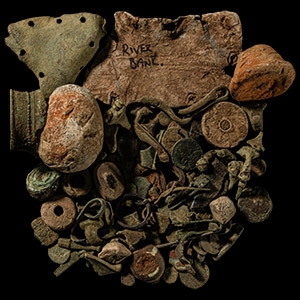
Roman 'St Albans' Bronze and Other Artefact Group
1st-4th century A.D.Sold for (Inc. bp): £72
Comprising a variety of items including lead weights, lead plaque inked with 'River Bank'; bronze brooches, coins, rings, mounts and other items, most fragmentary. 1.3 kg total, 1-10.6 cm
Found St Albans, Hertfordshire, UK. Acquired from the finder in 2008. Property of a Nottinghamshire gentleman. -
.jpg)
Roman Green Glass Footed Beaker with Trail
4th-5th century A.D.Estimate: £400 - 600 (+bp*)
Opening Bid: £200
Composed of a gently tapering U-shaped body with a more convex upper body, everted rim and domed foot, decorative applied trails to the equator. 72 grams, 10.8 cm high
Fine condition.
Paris collection, 1990s. From an important Paris gallery, France. Ex private Parisian collection. -
.jpg)
Roman Gold Ring with Carnelian Cameo of Eros
Early 3rd century A.D.Sold for (Inc. bp): £1,170
Composed of a convex hoop with expanding angled shoulders, oval bezel set with carnelian cameo gemstone carved with the head and face of Eros with pinched features and centrally-parted hair; a marriage. 7.09 grams, 21.79 mm overall, 17.87 mm internal diameter (approximate size British H 1/2, USA 4, Europe 6.81, Japan 6)
Acquired 1990s-early 2000s. East Anglian private collection.
This ring belongs to the typology of gold rings with gem (Type II, Variant I) of Ruseva-Slokoska classification.
