
Loading, please wait...
_900x900.jpg "Roman Bronze Phallic Pendant")
_200x200.jpg "Roman Bronze Phallic Pendant")
.jpg "Roman Bronze Phallic Pendant")
LOT 0772
Roman Bronze Phallic Pendant
1ST-3RD CENTURY A.D.
1 1/8 in. (7.9 grams, 29 mm).
Comprising a thick, elongated body with lateral testes, thin suspension loop above. [No Reserve]
ProvenanceEx German art market, 2000s.
Acquired from an EU collector living in London.
From the collection of Surrey, UK, gentleman.
Cf. Beutler, F. et al., Der Adler Roms. Carnuntum und der Armee der Cäsaren, Bad-Deutsch Altenberg, 2017, item 758, for type.
CONDITIONTimeLine Auctions follows a vetting process to ensure the authenticity and legality of all items, reinforcing our commitment to integrity and responsible trading. Each antiquity, antique, and coin lot undergoes thorough examination by a vetting committee of at least ten external specialists, professional trade association members, scientists, and archaeologists: Our Vetting Process
AUCTIONS:
TimeLine is a leading auction house specialising in antiquities, ancient art, collectables, natural history, coins, medals, and books. Our auctions offer museums, collectors, historians, and enthusiasts the opportunity to acquire unique and historically significant pieces.
-
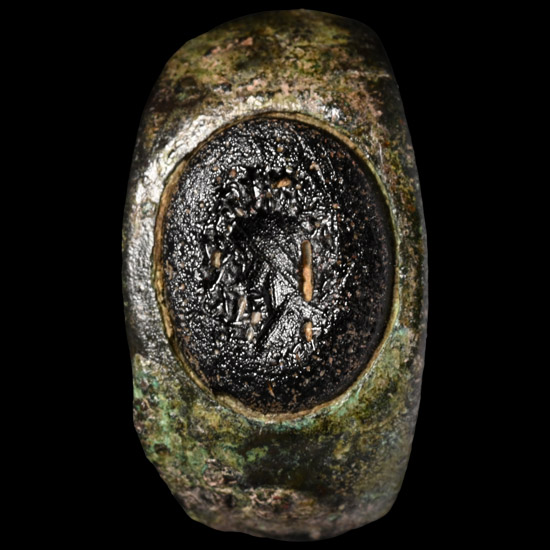
Roman Bronze Ring with Glass Gem
2nd-3rd century A.D.Sold for (Inc. bp): £59
With broad tapering shoulders, plaque inset with an ellipsoid intaglio profile bust. 6.92 grams, 24.70 mm overall, 20.35 x 16.77 mm internal diameter (approximate size British O 1/2, USA 7 1/4, Europe 15.61, Japan 15)
From the private collection of Mr Brian Edwards, New Malden, Surrey, UK, formed from the late 1970s-early 1980s; thence by descent. -
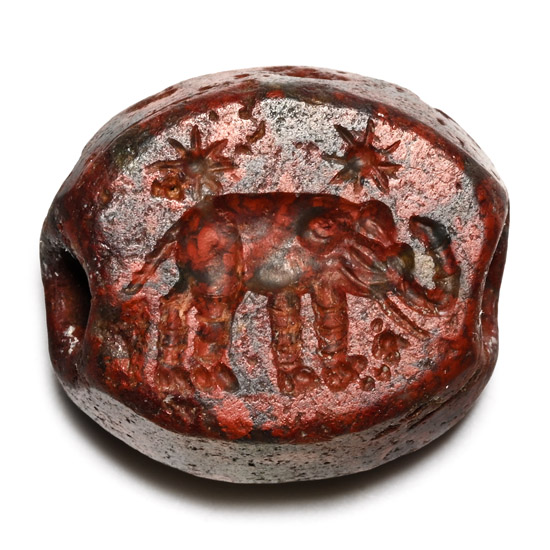
Roman Red Variegated Gemstone with Elephant
3rd century A.D.Sold for (Inc. bp): £1,040
Scaraboid type with incuse design to the underside of an elephant with stars above; supplied with a museum-quality impression. 3.04 grams, 17 mm
From the private collection of a European gentleman (1942-2024), formed since the 1970s.
The Romans first encountered elephants in Pyrrhos' army, and the representation of elephants in Roman art begins from this period. Victorious emperors like Caesar and Vespasian celebrated elephants on their coins. Apart from the celebration of elephants as ‘war machines’, the image of elephants was linked to other aspects in the Roman Imperial Period. Before becoming emperor, Elagabalus was one of the priests of Helios-Sun worship in Emesa. He had elephant depictions on his coins during his reign. The elephants raise their heads to the sun when the sun rises. Thus, the sun is represented on the gemstone together with the elephant. -
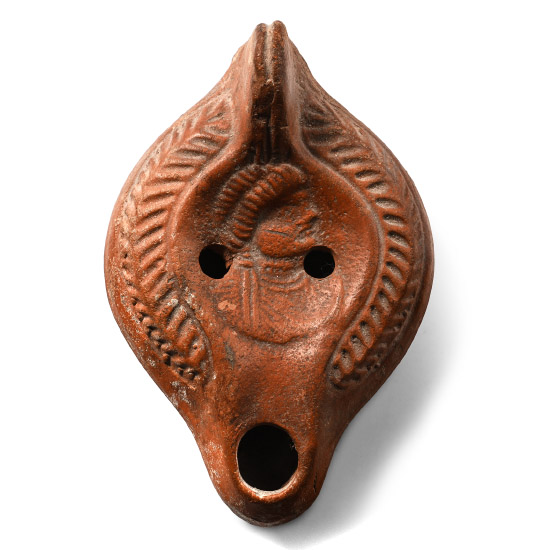
Roman Terracotta Oil Lamp with Female Bust
4th century A.D.Sold for (Inc. bp): £260
Low-relief wreath motif decorating the shoulder arranged like a palm tree, a female bust facing right on the discus and a lug handle to the rear. 110 grams, 11.3 cm
From the private coin collection of a West London, UK, gentleman, formed since the mid 1980s.
