Loading, please wait...

Use mousewheel to zoom in and out, click to enlarge

Details

LOT 0906

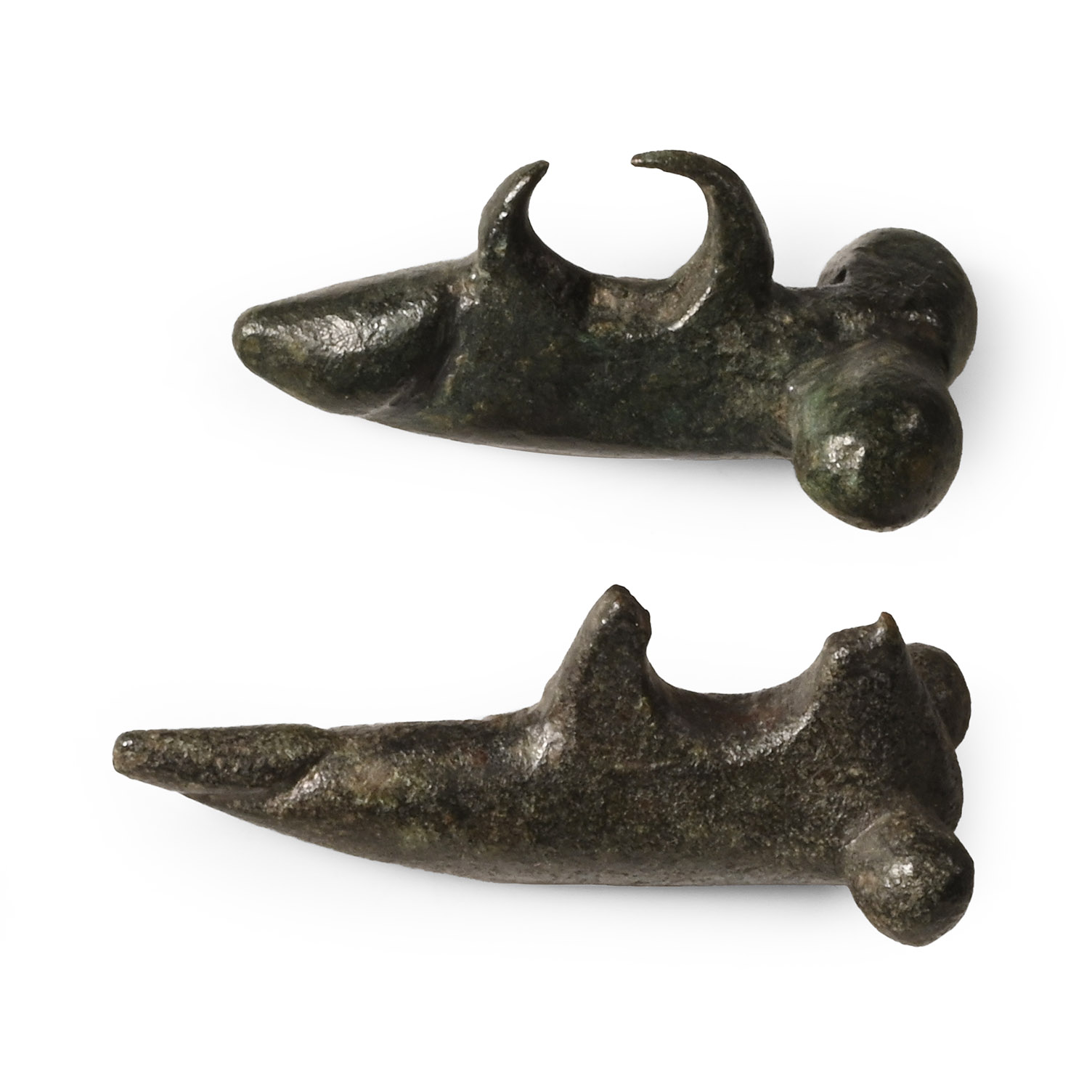
Roman Bronze Phallic Pendant Pair

2ND-3RD CENTURY A.D.

1 1/4 - 1 3/8 in. (21.1 grams total, 30-34 mm).

Comprising two stylised phalli with remains of suspension loop to the top. [2]

Provenance

Ex German art market, 2000s.
Acquired from an EU collector living in London.
From the collection of Surrey, UK, gentleman.

CONDITION

VETTING:

TimeLine Auctions follows a vetting process to ensure the authenticity and legality of all items, reinforcing our commitment to integrity and responsible trading. Each antiquity, antique, and coin lot undergoes thorough examination by a vetting committee of at least ten external specialists, professional trade association members, scientists, and archaeologists: Our Vetting Process


AUCTIONS:

TimeLine is a leading auction house specialising in antiquities, ancient art, collectables, natural history, coins, medals, and books. Our auctions offer museums, collectors, historians, and enthusiasts the opportunity to acquire unique and historically significant pieces.

LOT 0906

Roman Bronze Phallic Pendant Pair

Sold for (Inc. bp): £143

Print page

RELATED LOTS

  • Roman Bronze Cavalryman Statuette with Paenula
    Roman Bronze Cavalryman Statuette with Paenula
    1st-3rd century A.D.

    Sold for (Inc. bp): £221

    Modelled in the round in seated pose with both hands extended forwards to hold reins; the body covered by an open-fronted paenula riding cape; boots to the feet; mounted on a custom-made stand. 271 grams, 10.1 cm including stand


    Found in Britain. From a collection acquired on the UK art market from various auction houses and collections mostly before 2000. From an important Cambridgeshire estate; thence by descent.

    The statuette, like the one from Rouen published by Mackintosh, represents a link between the Romano-British and Gallo-British figurines of the cavalrymen and Imperial statuary. They are of relatively good workmanship and represents a rider seated on a walking horse. The rider is dressed in a short-sleeved tunic and the military paenula, echoing the representation of Marcus Aurelius on his horse. The raised arm could mean that he was wearing a spear.

    Lot Details

  • Large Roman Bronze Statuette of Jupiter
    Large Roman Bronze Statuette of Jupiter
    Circa 3rd century A.D.

    Sold for (Inc. bp): £468

    Modelled in the half-round and hollow to the reverse, the god with knees flexed, one of his sandaled feet resting on a ram's head; left arm raised to hold a sceptre (absent) and right hand holding a thunderbolt; pierced at the midriff for attachment; mounted on a custom-made stand. 1.1 kg, 21.5 cm including stand


    From a collection acquired on the UK art market from various auction houses and collections mostly before 2000. From an important Cambridgeshire estate; thence by descent.

    The figurine of Jupiter seems to be a provincial work of Gallo-Roman origin. Contrary to the iconographic tradition of the king of the gods, he is usually depicted nude and with a cloak on his left arm, the statuette shows a Jupiter covered by a large cloak and vestis talaris, which also closely resembles the Gallo-Roman iconography of Jupiter-Sucellus.

    Lot Details

  • Roman Gold Eagle Pendant
    Roman Gold Eagle Pendant
    2nd century B.C.-2nd century A.D.

    Sold for (Inc. bp): £2,340

    Depicted as a standing eagle with closed wings, long striated tail extending to the small pedestal; with detailing to wings, beak, eyes and feathers; a filigree collar with small medallion around the neck; holding a small rabbit in its claws; suspension loop to the back. 2.83 grams, 27 mm


    From a private family collection formed since the early 19th century, thence by descent. Property of a New Zealand legal professional. This lot has been checked against the Interpol Database of stolen works of art and is accompanied by search certificate number no.12329-223711.

    The motif of an eagle and hare is linked with the story of the Trojan War. On their way towards Troy, the two brothers Agamemnon and Menelaus, the Atreides, saw two eagles swoop down upon a pregnant hare and tear her to shreds. They interpreted it as a good omen: the two eagles were the warrior brothers, and the hare Troy.

    Lot Details

Stay up-to-date with the latest from TimeLine Auctions by joining our mailing list