
Loading, please wait...
LOT 0795
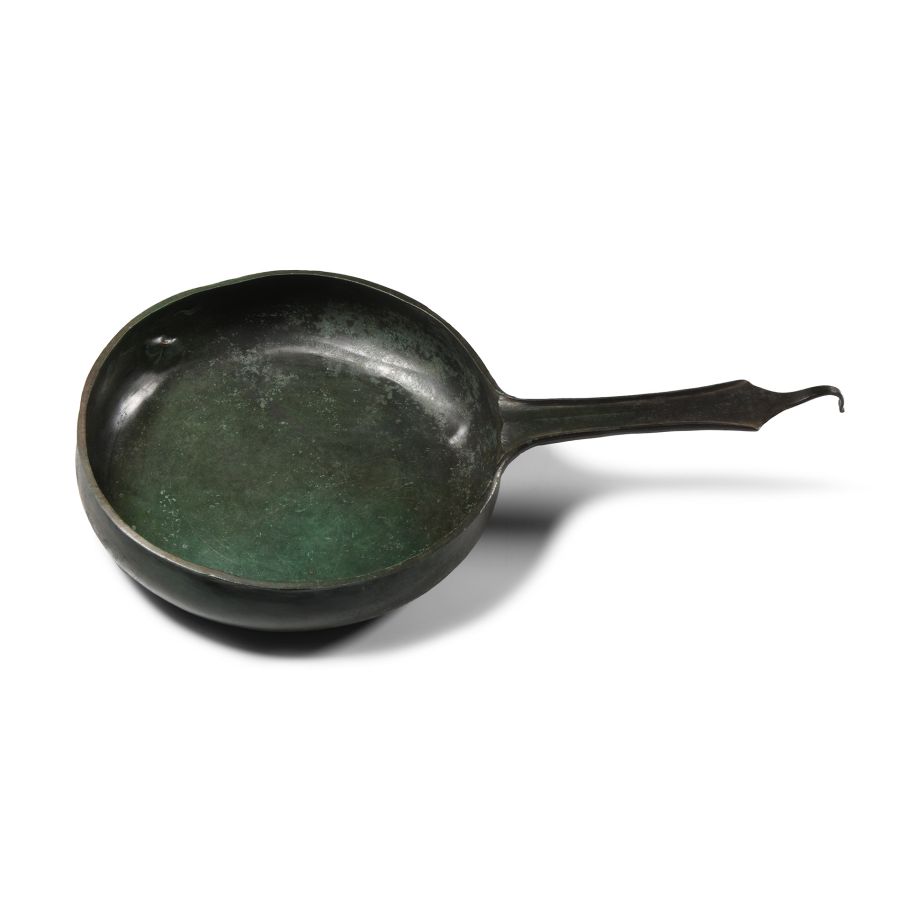
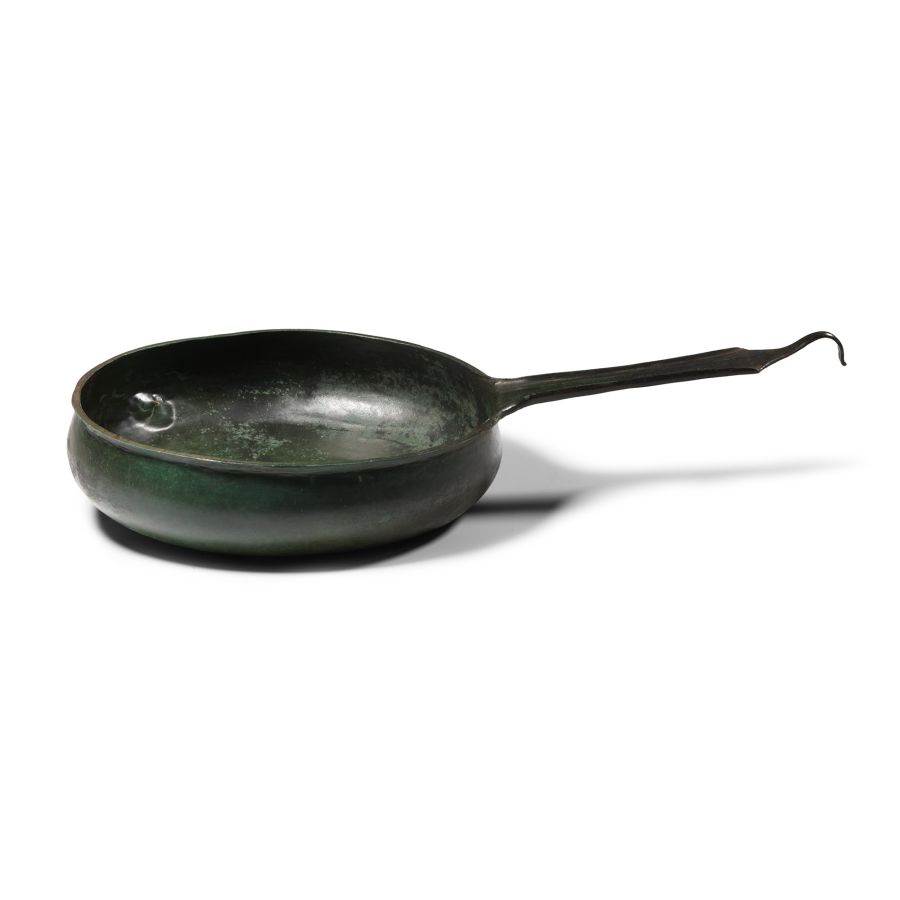
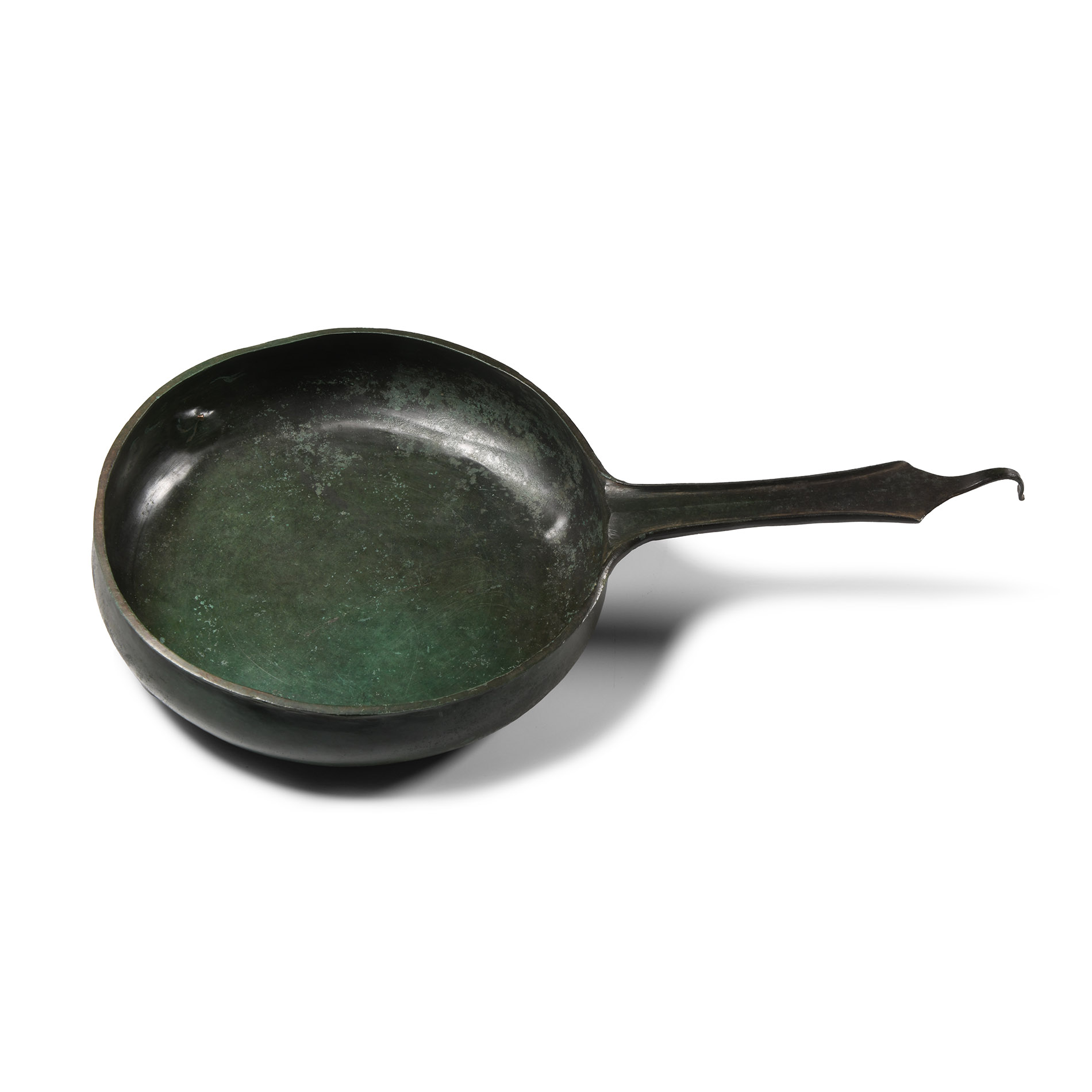
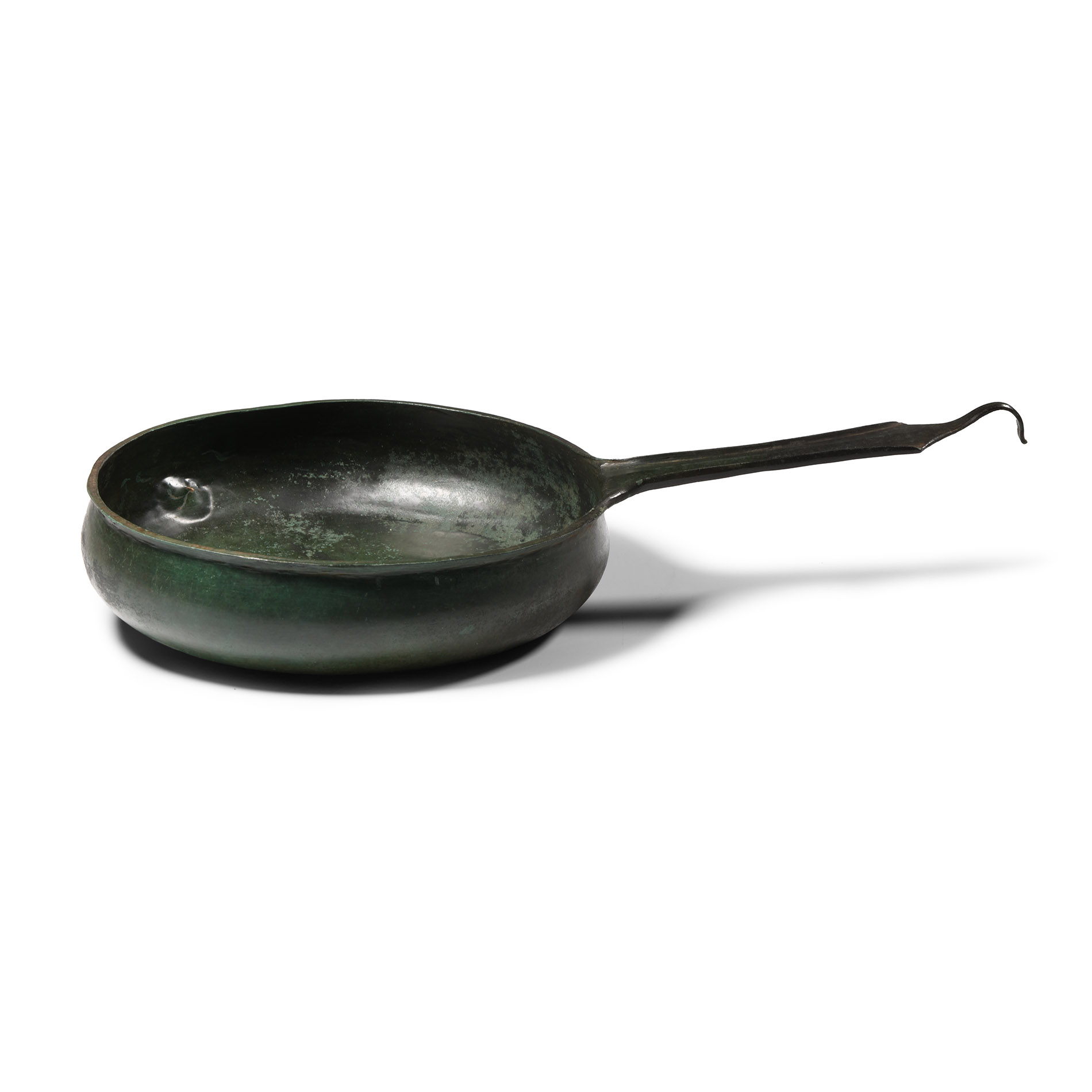
Roman Bronze Patera with Handle
1ST CENTURY B.C.-1ST CENTURY A.D.
15 1/2 in. (483 grams, 39.5 cm).
The bowl with a wide flat bottom and convex sides; the inside with incised concentric circles; flat handle with raised edges and hooked finial for suspension.
ProvenanceGerman private collection, Mr O., collecting in the 1950s-1960s; thence by descent.
with Bonhams, London, 7 July 2016, lot 191 (£3,000-5,000).
Accompanied by an academic report by Dr Raffaele D’Amato.
Accompanied by copies of the relevant Bonhams printed catalogue pages (full page).
This lot has been checked against the Interpol Database of stolen works of art and is accompanied by search certificate number no.11735-201189.
This lot is accompanied by an illustrated lot declaration signed by the Head of the Antiquities Department, Dr Raffaele D’Amato.
Exhibited at the Harwich Museum, Harwich, Essex, UK, 19th June-9th September 2024; accompanied by a copy of a photograph of the artefact on display.
LiteratureCf. Tassinari, S., La vaiselle de bronze, Romaine et Provinciale, au musée des antiquités nationales, Paris, 1975, fig.1, for a similar pan; for 1st century B.C.-1st century A.D. types see Willers, H., Neue Untersuchungen über die römische Bronze Industrie von Capua und von Niedergermanien, Hannover und Leipzig, 1907; Eggers, H.J., Der römische Import in freien Germanien, Hamburg, 1951, type 130; and the famous Aylesford specimen in Evans, A.J., ‘On a Late-Celtic Urn-Field at Aylesford, Kent, and on the Gaulish, Illyro-Italic, and Classical Connexions of the Forms of Pottery and Bronze-work there discovered’, in Archeologia, 2nd Series, Vol.52, London, 1890, pp.315-388; Cunliffe, B., Iron Age Communities in Britain, London, 2005, pp.152-9.
FootnotesThis vessel was part of Roman and provincial bronze instrumentum domesticum, i.e. culinary or domestic utility ware. Such cooking vessels are rare: some are found in central and northern Italy, in Pannonia, Germany and in Britain. The Aylesford Pan, today in the British Museum (inventory no.1886.1112.1), is one of the most important finds. This specimen (Eggers type 130), probably pre-Caesarian or Caesarian, was found in a grave together with a Celtic bucket and a jug.
CONDITIONTimeLine Auctions follows a vetting process to ensure the authenticity and legality of all items, reinforcing our commitment to integrity and responsible trading. Each antiquity, antique, and coin lot undergoes thorough examination by a vetting committee of at least ten external specialists, professional trade association members, scientists, and archaeologists: Our Vetting Process
AUCTIONS:
TimeLine is a leading auction house specialising in antiquities, ancient art, collectables, natural history, coins, medals, and books. Our auctions offer museums, collectors, historians, and enthusiasts the opportunity to acquire unique and historically significant pieces.
LOT 0795
Roman Bronze Patera with Handle
Estimate £800 - 1,000€930 - 1,160 (for guidance only)$1,080 - 1,350 (for guidance only)
-
Roman Glass Jug with Fillets
3rd-4th century A.D.Sold for (Inc. bp): £390
With bulbous body, flared rim and applied zigzag trail to neck, dimple base; old collector's labels to underside '2970' and 'L-16437'. 105 grams, 76 mm
M.C. (b.14.12.1933) and R.C. Burckhardt (b.10.05.1929), Basel, Switzerland, thence by descent. This lot is accompanied by an illustrated lot declaration signed by the Head of the Antiquities Department, Dr Raffaele D’Amato. -
Roman Gold Shield-Shaped Earring
2nd-3rd century A.D.Sold for (Inc. bp): £286
Comprising a plain hoop with hook-and-eye fastener, discoid shield decorated with filigree border of three bands of twisted wire and seven granules; to the centre, a bezel of spirally twisted wire; a broad hoop from previous pendant attachment. 3.31 grams, 18.24 mm
Acquired on the UK art market in the early 2000s. From the David John Dennis collection of ancient jewellery. Property of a Californian, USA, collector. This lot is accompanied by an illustrated lot declaration signed by the Head of the Antiquities Department, Dr Raffaele D’Amato.
David Dennis started collecting items when he was a 10 year old boy during the Blitz in London gathering parts of nose cones from shells and other pieces of shrapnel that had fallen from the skies. After the war he turned his attentions to cigarette cards, postage stamps, bank notes, coins and eventually ancient artefacts, predominately Roman jewellery. Now living in Cumbria with his daughter he decided it was time to part with his collections. -
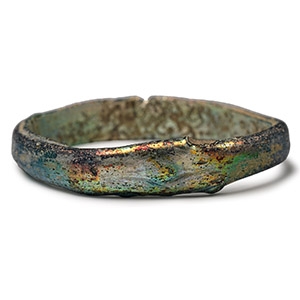
Roman Child's Iridescent Glass Bangle
3rd-4th century A.D.Sold for (Inc. bp): £98
D-shaped in section with iridescent surface. 3.09 grams, 38 mm
From an old English collection. Acquired from Helios Gallery in 2011. Ian Wilkinson collection, Nottinghamshire, UK, formed since 1985. This lot is accompanied by an illustrated lot declaration signed by the Head of the Antiquities Department, Dr Raffaele D’Amato.
