
Loading, please wait...
LOT 0827
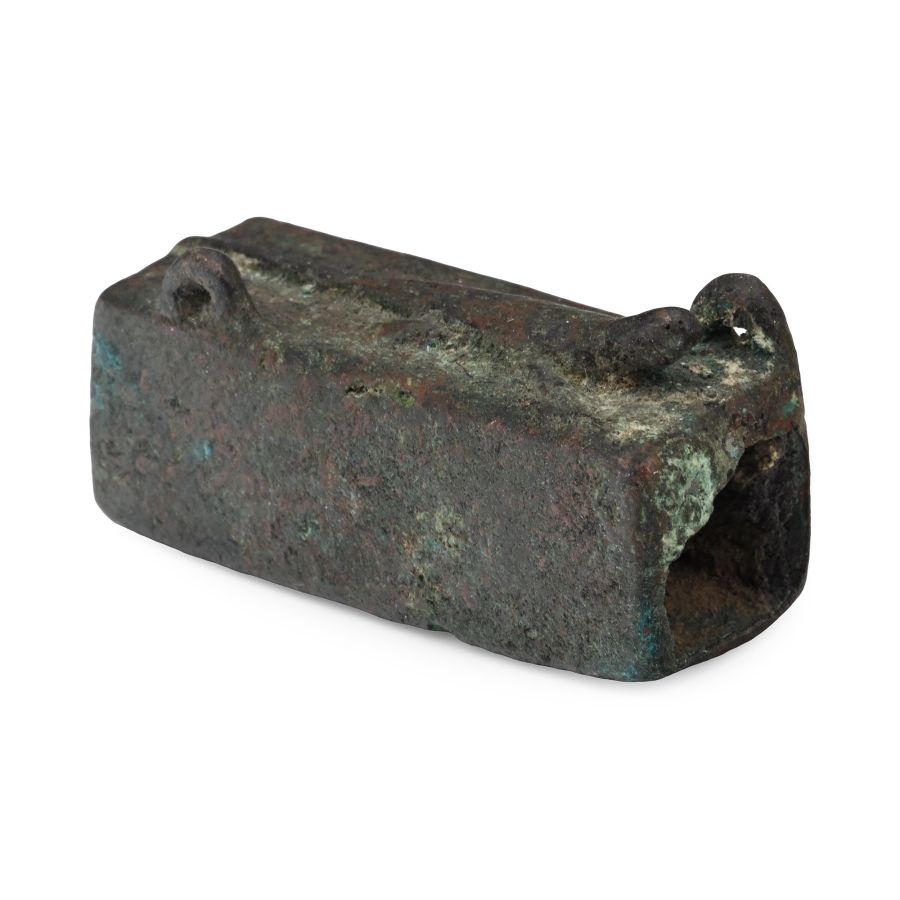
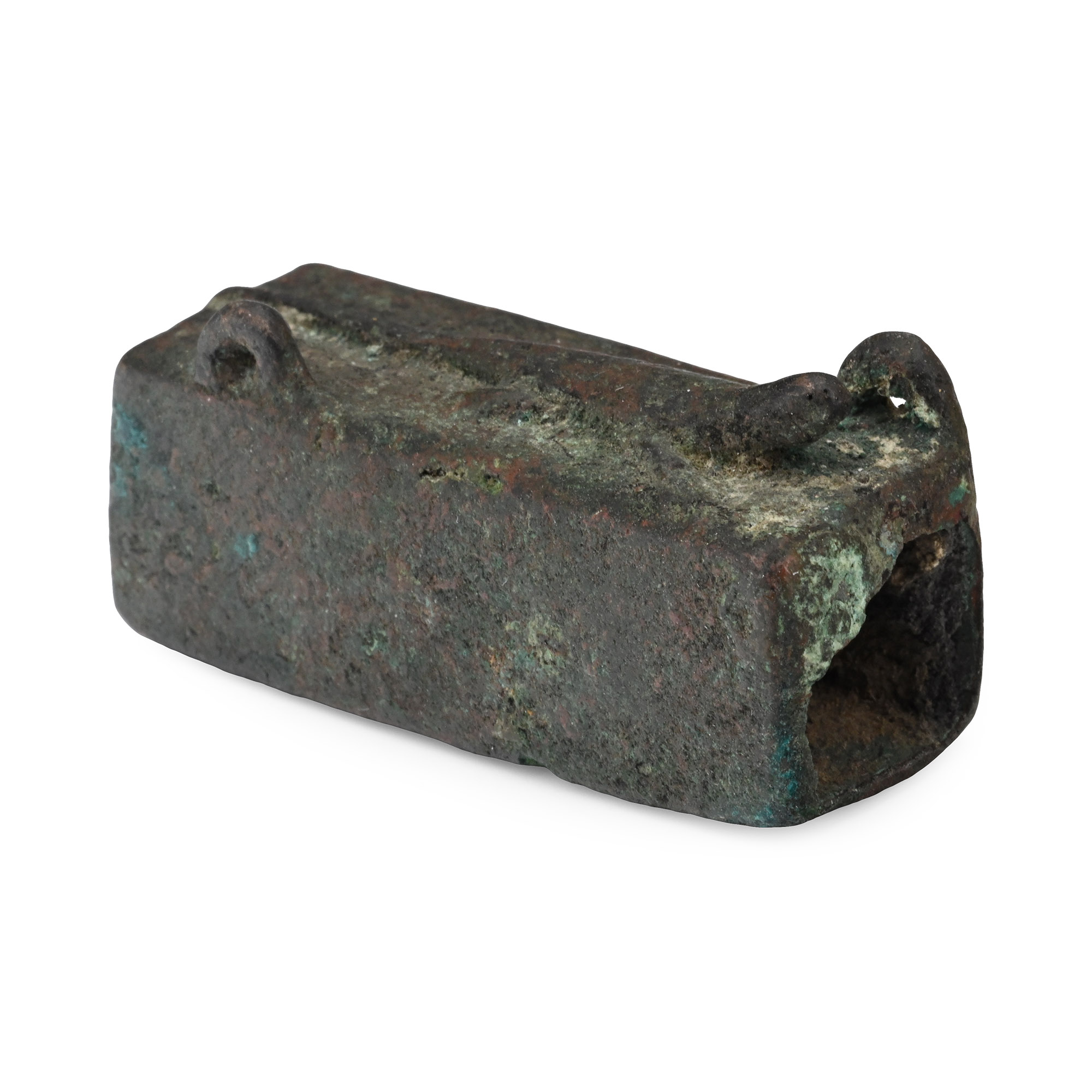
Roman Bronze Padlock Barrel with Lizard
43-410 A.D.
1 7/8 in. (29 grams, 48 mm).
Hollow square in cross-section, with thin walls; terminals with copper-alloy plate soldered onto them; moulded lizard decoration to the upper face consisting of a low oval body tapering to a thin tail; head raised and short legs spread out from the body; small indentation either side of the head representing the eyes, linear engraved texture the body for scales; two perforated lugs at opposed corners.
ProvenanceFound Gloucestershire, UK.
From the collection of a late Gloucestershire, UK, collector.
Accompanied by a copy of the British Museum's Portable Antiquities Scheme (PAS) report no.GLO-791057.
TimeLine Auctions follows a vetting process to ensure the authenticity and legality of all items, reinforcing our commitment to integrity and responsible trading. Each antiquity, antique, and coin lot undergoes thorough examination by a vetting committee of at least ten external specialists, professional trade association members, scientists, and archaeologists: Our Vetting Process
AUCTIONS:
TimeLine is a leading auction house specialising in antiquities, ancient art, collectables, natural history, coins, medals, and books. Our auctions offer museums, collectors, historians, and enthusiasts the opportunity to acquire unique and historically significant pieces.
-
.jpg)
Roman Silver Ring with Horse Gemstone
Circa 2nd-3rd century A.D.Sold for (Inc. bp): £416
Hoop with rounded shoulders set with jasper intaglio of a horse advancing on a baseline; supplied with a museum-quality impression. 8.55 grams, 23.94 mm overall, 15.43 mm internal diameter (approximate size British E 1/2, USA 2 1/2, Europe 3, Japan 3)
UK private collection since 1956. Formed in the 1950s by Mr and Mrs S. Broukal, thence by descent. Private collection, England. -
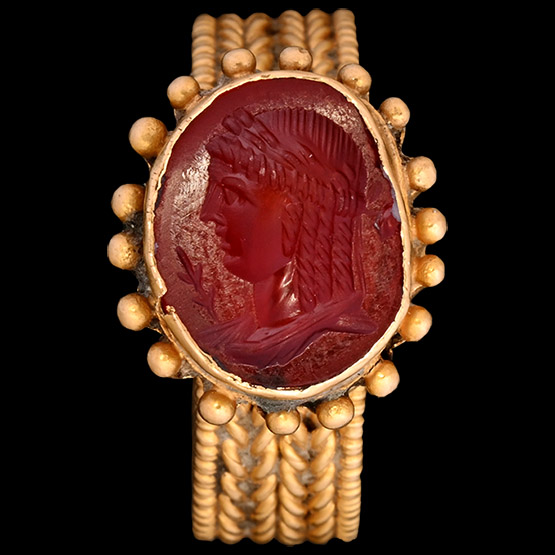
Roman Carnelian Gemstone of the God Apollo in Byzantine Gold Ring
1st century B.C.-1st century A.D. and laterEstimate: £3,000 - 4,000 (+bp*)
Opening Bid: £1,500
Roman intaglio depicting youthful god Apollo in profile, set into a 5th-7th century A.D. Byzantine ring with flat-section hoop with roped bands and pelleted border, fluted hemispherical bezel with ribbed underside; supplied with a museum-quality impression. 6.46 grams, 26.66 mm overall, 17.29 x 16.50 mm internal diameter (approximate size British M 1/2, USA 6 1/4, Europe 13.09, Japan 12)
Private collection, 1950s. Private collection, M.G., South Germany, 2000. with Gorny and Mosch, 14 December 2016, no.259. Private collection, England. This lot has been checked against the Interpol Database of stolen works of art and is accompanied by search certificate number no.13135-249517. -
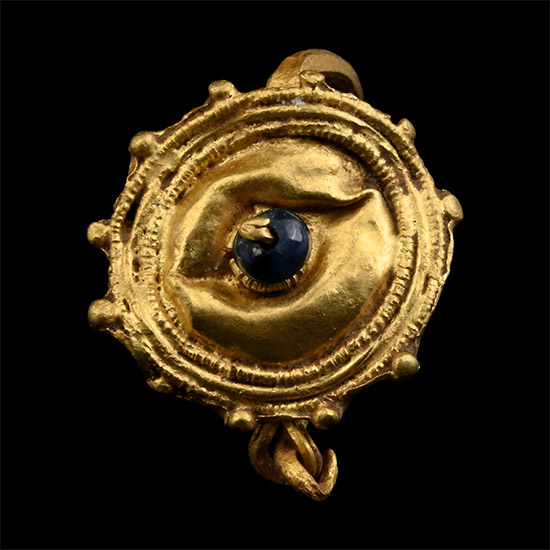
Roman Gold Earring
1st-4th century A.D.Sold for (Inc. bp): £312
Discoid plaque with beaded wire border, radiating granules to the rim, glass bead centre. 2.53 grams, 20 mm
Ex German art market, 2000s. Acquired from an EU collector living in London. From the collection of a Surrey, UK, gentleman.
