
Loading, please wait...
_900x900.jpg "Roman Bronze Musical Flute")
_200x200.jpg "Roman Bronze Musical Flute")
_900x900.jpg "Roman Bronze Musical Flute")
_200x200.jpg "Roman Bronze Musical Flute")
.jpg "Roman Bronze Musical Flute")
.jpg "Roman Bronze Musical Flute")
LOT 0563
Roman Bronze Musical Flute
CIRCA 2ND-3RD CENTURY A.D.
9 in. (87 grams, 23 cm).
An extremely rare aulos or tibia with round-section body, six circular holes to one side and a D-shaped hole to the reverse.
ProvenanceFrom the late Alison Barker collection, a retired London barrister; from her collection formed early 1960s-1990s.
Accompanied by an academic report by Dr Raffaele D'Amato.
This lot has been checked against the Interpol Database of stolen works of art and is accompanied by search certificate number no.11055-184396.
See Daremberg, C.V. & Saglio, E. (eds.), Dictionnaire des Antiquités Grecques et Romaines, Paris, 1873-1917, fig.6965; see a cast of the Roman flute from Pompeii, in the Spurlock Museum of World Cultures (inventory 1916.07.0011); Wardle, M.A., Musical Instruments in the Roman World, London, 1981, for iconography (pp.35ff., 115ff. and especially pl.22), and original specimens from Pompeii, pls.1-2; the closest parallel in Palagyi, T., Facsady, A., Romains de Hongrie, Lyon, 2002, p.117, fig.259 (bronze tibia from Pannonia, Savaria, today Szombathely).
FootnotesThe flute was used for religious ceremonies and for entertainment. The pyrrhic, a war dance of Doric origin, was a rapid dance to the double flute, and made to resemble an action in battle.
CONDITIONTimeLine Auctions follows a vetting process to ensure the authenticity and legality of all items, reinforcing our commitment to integrity and responsible trading. Each antiquity, antique, and coin lot undergoes thorough examination by a vetting committee of at least ten external specialists, professional trade association members, scientists, and archaeologists: Our Vetting Process
AUCTIONS:
TimeLine is a leading auction house specialising in antiquities, ancient art, collectables, natural history, coins, medals, and books. Our auctions offer museums, collectors, historians, and enthusiasts the opportunity to acquire unique and historically significant pieces.
LOT 0563
Roman Bronze Musical Flute
Estimate £4,000 - 6,000€4,640 - 6,960 (for guidance only)$5,400 - 8,100 (for guidance only)
-
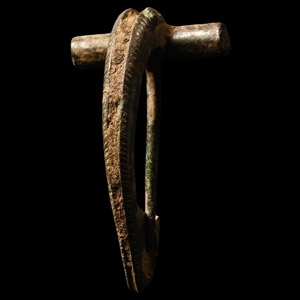
Romano-British Colchester-Derivative Bow Brooch
Circa 1st-2nd century A.D.Sold for (Inc. bp): £72
With hinge at the cross-bar and pin beneath, deep bow with vertical channel; notched detailing. 12.9 grams, 47 mm
Found East Lindsey, Lincolnshire, UK. Ex private Merseyside, UK, collection. Accompanied by a copy of the British Museum's Portable Antiquities Scheme report no.SWOR-A26E93. -
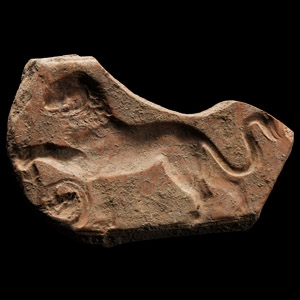
Roman Terracotta Lion Mould
1st-4th century A.D.Sold for (Inc. bp): £338
The amorphous fragment with a mould in the form of a lion advancing left to one face, one front paw raised. 107 grams, 10.4 cm
Acquired 1980-2015. Ex Abelita family collection. -
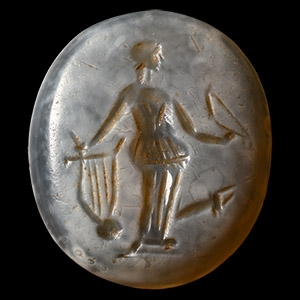
Roman Chalcedony Gemstone with Muse Euterpes
1st century A.D.Estimate: £800 - 1,000 (+bp*)
Opening Bid: £444
The muse standing on a baseline with her head in profile, resting her left arm on a cithara, carrying a laurel branch in her extended right hand, the weight of the body resting on the right leg. 0.77 grams, 14 mm
Acquired in the late 1980s-early 1990s. Important North West London collection.
The muse is Euterpe, the muse of music as well as lyrical poetry. The motif can be related to numerous representations of Apollo, in which he appears leaning on a column on which the lyre or tripod is placed. It is a serial representation, based on statuary prototypes, which were widely copied by Hellenistic-Roman artisans, where the figure of Apollo, here, is transformed in that of the muse of music.
