
Loading, please wait...


LOT 0822
Roman Bronze Military Pendant
CIRCA 1ST-2ND CENTURY A.D.
1 3/4 in. (4.66 grams, 46.6 mm).
Formed as a leaf with lobed scrolls above, looped suspension point with wolf-head detailing; knop finial below. [No Reserve]
ProvenanceEx German art market, 2000s.
Acquired from an EU collector living in London.
From the collection of a Surrey, UK, gentleman.
Cf. Unz, C., Deschler-Erb, E., Katalog der Militaria aus Vindonissa, Militärische Funde, Pferdegeschirr und Jochteile bis 1976, Brugg, 1997, pl.50, nos.1365,1366,1371, for the type.
CONDITIONTimeLine Auctions follows a vetting process to ensure the authenticity and legality of all items, reinforcing our commitment to integrity and responsible trading. Each antiquity, antique, and coin lot undergoes thorough examination by a vetting committee of at least ten external specialists, professional trade association members, scientists, and archaeologists: Our Vetting Process
AUCTIONS:
TimeLine is a leading auction house specialising in antiquities, ancient art, collectables, natural history, coins, medals, and books. Our auctions offer museums, collectors, historians, and enthusiasts the opportunity to acquire unique and historically significant pieces.
-
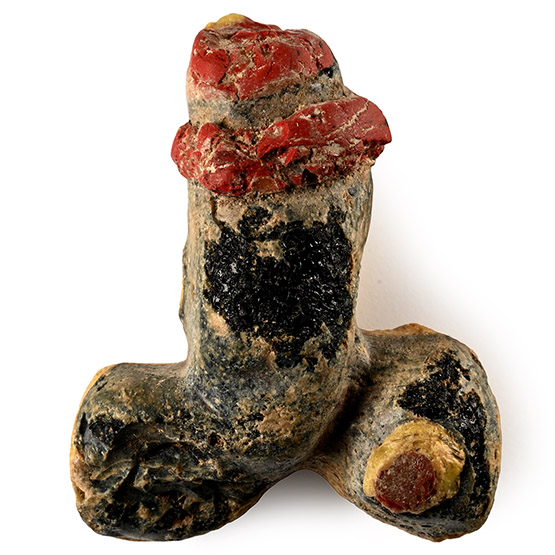
Roman Glass Phallic Amulet
1st century B.C.-1st century A.D.Sold for (Inc. bp): £468
Modelled in the round with applied red-glass collar, pierced through the shaft for suspension. 11.4 grams, 32 mm
Acquired in the mid 1980s-1990s. Private collection, Switzerland, thence by descent. Private collection, since the late 1990s.
In the Roman world, the phallus was a symbol of luck or fertility, and it was believed to have apotropaic functions. Pendants, amulets and small objects were worn by all sorts of people as symbols of protection, especially by young children, according to Varro and Pliny the Elder. The phallus is also commonly found on reliefs, frescoes and lamps from the Graeco-Roman world. -
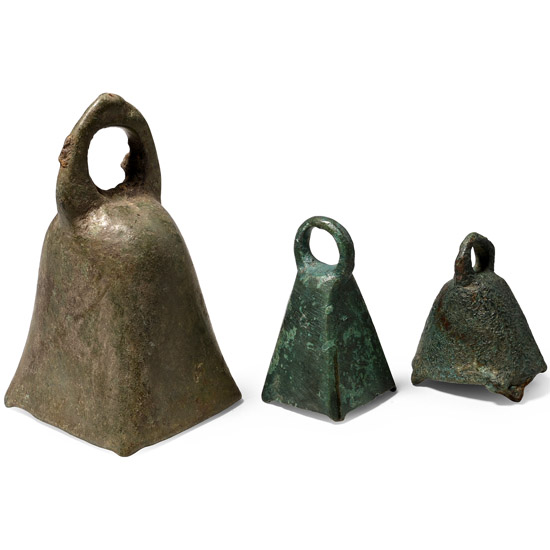
Roman Bronze Bell Collection
1st-4th century A.D.Sold for (Inc. bp): £182
Comprising three bells, each rectangular in plan with a loop above and small lobes at each corner. 295 grams total, 48-92 mm
Ex German art market, 2000s. Acquired from an EU collector living in London. From the collection of a Surrey, UK, gentleman. -
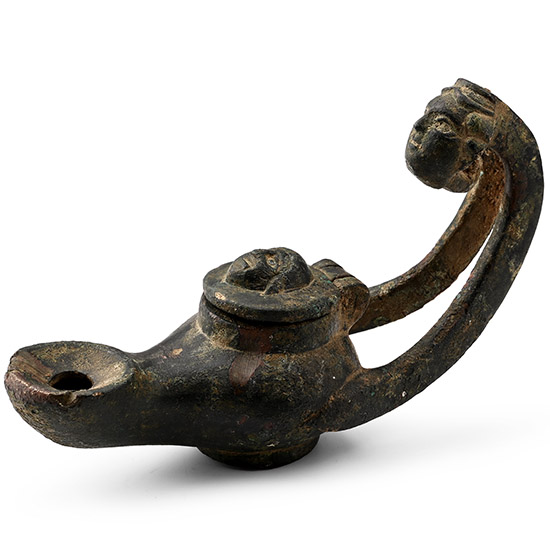
Roman Bronze Oil Lamp with Masks
1st-2nd century A.D.Sold for (Inc. bp): £1,170
With an elongated body, long nozzle with a rounded tip; raised rim to filling hole with hinged lid bearing a mask with sockets to the eyes for silver inserts; handle curved and terminating in a female mask with hair dressed in tiers, eyes recessed to be inlaid with silver; broad nozzle with cup and raised rim; socket to underside for mounting on a stand. 560 grams, 15.5 cm
From the collection of a gentleman, acquired on the London art market in the 1990s.
The lamp is crafted in a very fine style, probably in a classical form from the 1st or 2nd century. It belongs to a type known and widespread in the Mediterranean, with parallels in Paris, Madrid, the museums of Cadiz, Tarragona, and Aquileia.
