
Loading, please wait...

LOT 0643
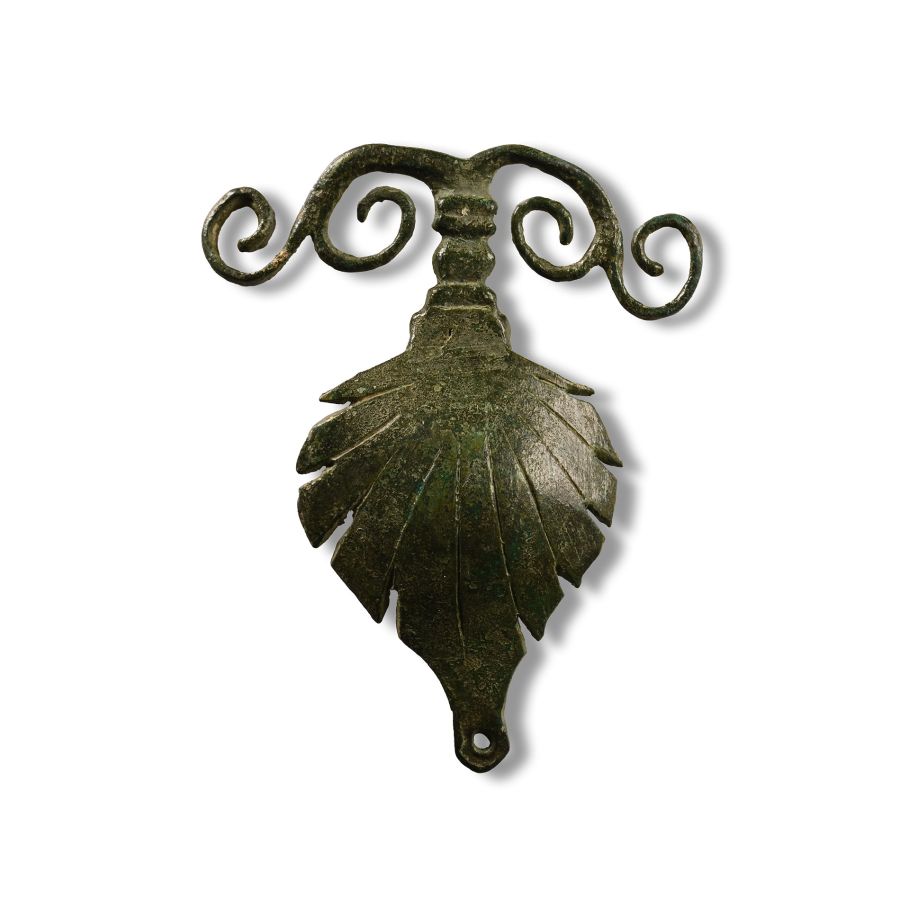
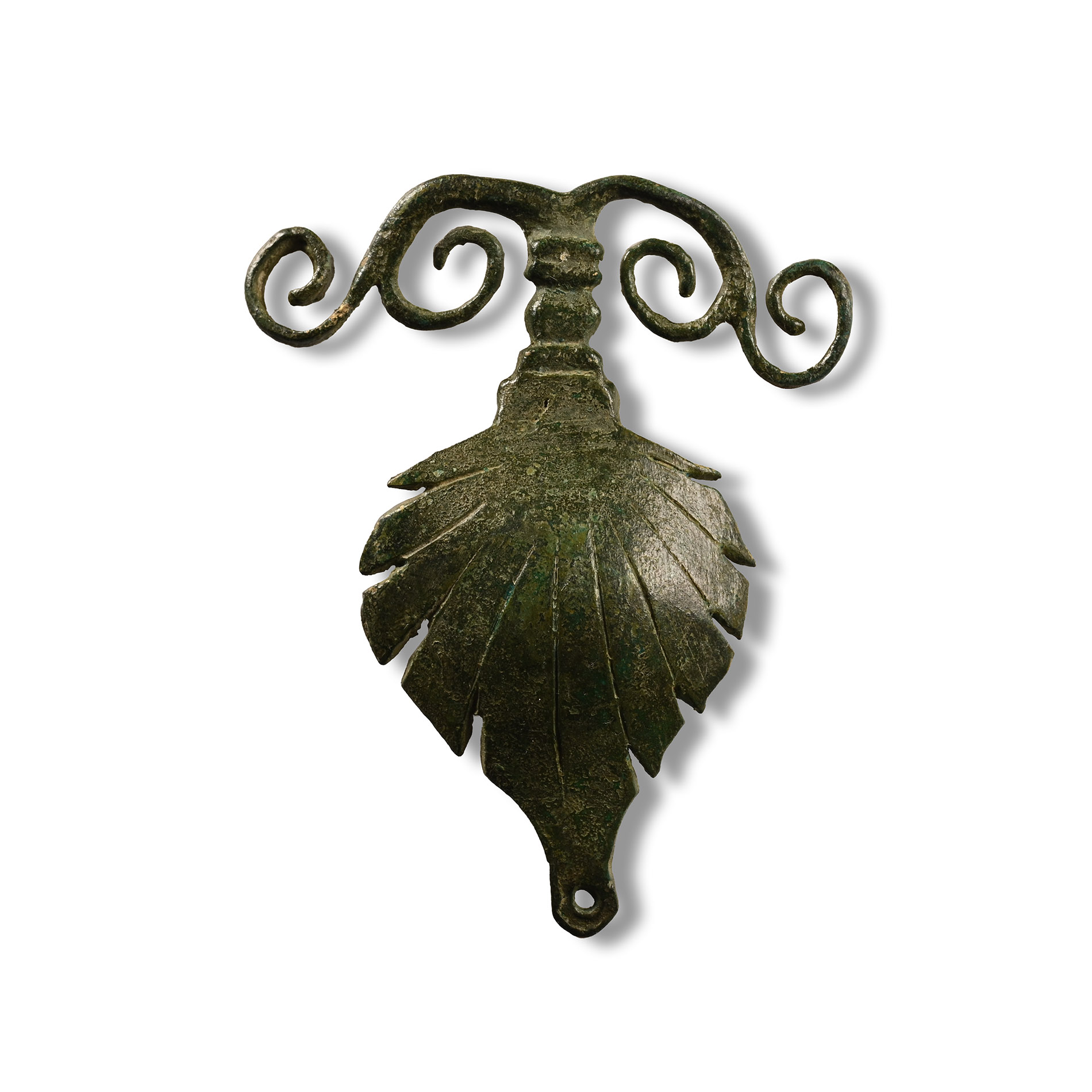
Roman Bronze Military Mount From a Pompeii Gladius Scabbard
1ST CENTURY A.D.
2 in. (6.12 grams, 50 mm).
Comprising a domed vine-leaf with notched edge and incised veins, finial with lateral scrolled tendrils; pierced for attachment. [No Reserve]
ProvenanceAcquired on the London art market in the late 1980s-1990s.
From the family collection of an East London, UK, gentleman.
This lot is accompanied by an illustrated lot declaration signed by the Head of the Antiquities Department, Dr Raffaele D’Amato.
Cf. Unz, C., Deschler-Erb, E., Katalog der Militaria aus Vindonissa, Militärische Funde, Pferdegeschirr und Jochteile bis 1976, Brugg, 1997, pl.9, nos.149-164, for several similar examples; for reconstruction on the scabbard see Connolly, P., Greece and Rome at war, London, 2006, p.232, figs.5, 11, 22, 308, 310.
FootnotesThe sword of Pompeii typology was the main side weapon of the Roman legionary from the second half of the 1st century A.D. until the end of the 2nd century A.D. In the Flavian Age, the scabbard was decorated with various bronze appliques: openwork decorated copper-alloy plates and chape, and over the chape, this distinctive bronze foliage mount, used only for these typologies of scabbards.
CONDITIONTimeLine Auctions follows a vetting process to ensure the authenticity and legality of all items, reinforcing our commitment to integrity and responsible trading. Each antiquity, antique, and coin lot undergoes thorough examination by a vetting committee of at least ten external specialists, professional trade association members, scientists, and archaeologists: Our Vetting Process
AUCTIONS:
TimeLine is a leading auction house specialising in antiquities, ancient art, collectables, natural history, coins, medals, and books. Our auctions offer museums, collectors, historians, and enthusiasts the opportunity to acquire unique and historically significant pieces.
LOT 0643
Roman Bronze Military Mount From a Pompeii Gladius Scabbard
Sold for (Inc. bp): £130
-
Roman Floor Mosaic Tesserae Group
1st-4th century A.D.Sold for (Inc. bp): £312
Mixed group of cuboid and other stone tesserae, some embedded in concrete matrix. 164 grams total, 8-23 mm
From the collection of a late East Anglian teacher and antiquarian who retired to the Isle of Wight in Hampshire, UK. He amassed a large collection of objects between the 1960s-1980s. This lot is accompanied by an illustrated lot declaration signed by the Head of the Antiquities Department, Dr Raffaele D’Amato. -
.jpg)
Roman Bronze Military Compass and Tweezers Multi-Tool
Circa late 2nd-4th century A.D.Sold for (Inc. bp): £169
Featuring a compass and tweezers, free-moving collar to one arm, one arm with two oval terminals and one tapering to a point. 19 grams, 90 mm
Acquired before 2000. From the collection of a European gentleman living in the UK. This lot is accompanied by an illustrated lot declaration signed by the Head of the Antiquities Department, Dr Raffaele D’Amato.
This instrument, a type of circinus formed of two flat-section arms, was widely used by masons and carpenters, as well as for making wall decorations for the preparation of repetitive elements such as spirals or circles. It was widely used by the agrimensores of the army, as is proven by a very similar specimen found in Carnuntum, the camp of the Legio XIIII Gemina. -
Roman Carnelian Intaglio with Spes
2nd-3rd century A.D.Sold for (Inc. bp): £208
Standing and facing left with her right hand raised an holding a budding flower; inscription in Greek 'KAΛ(OΣ)' (= beautiful) on the left. 0.74 grams, 13 mm
Ex R. Sebastia Coch (1908-1969) collection, Barcelona; thence by descent. English art market, 2018. Accompanied by a copy of an Art Loss Register certificate no.S00143341. This lot is accompanied by an illustrated lot declaration signed by the Head of the Antiquities Department, Dr Raffaele D’Amato.
