
Loading, please wait...
LOT 0933
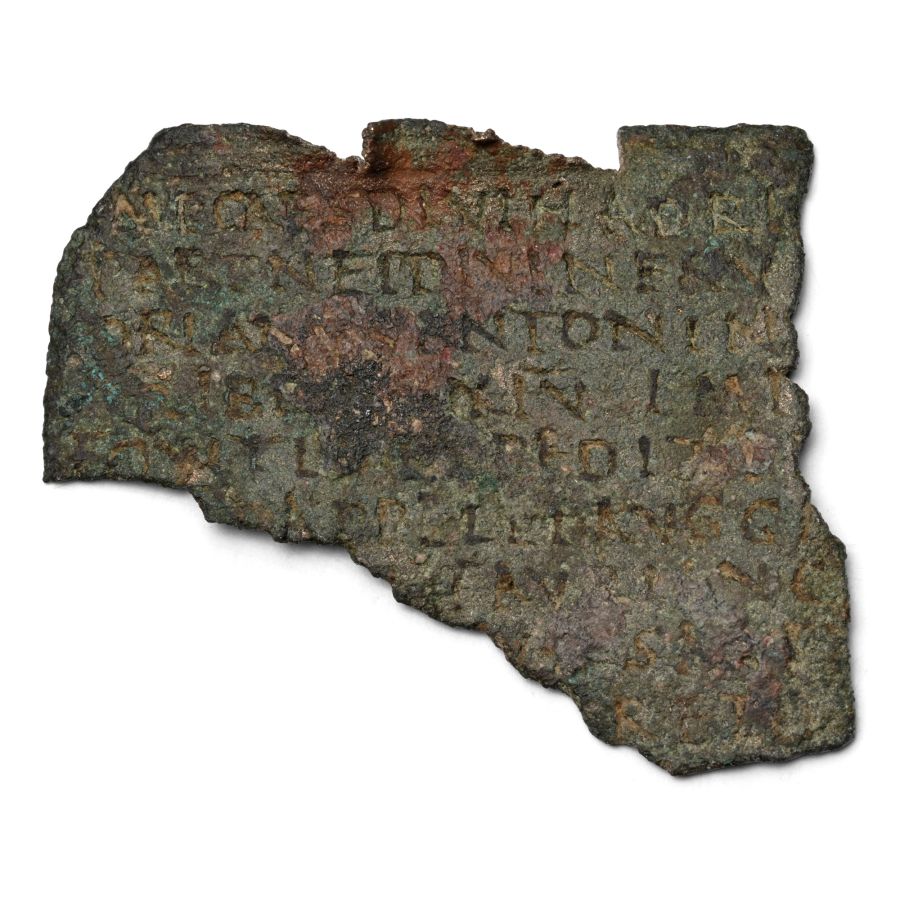
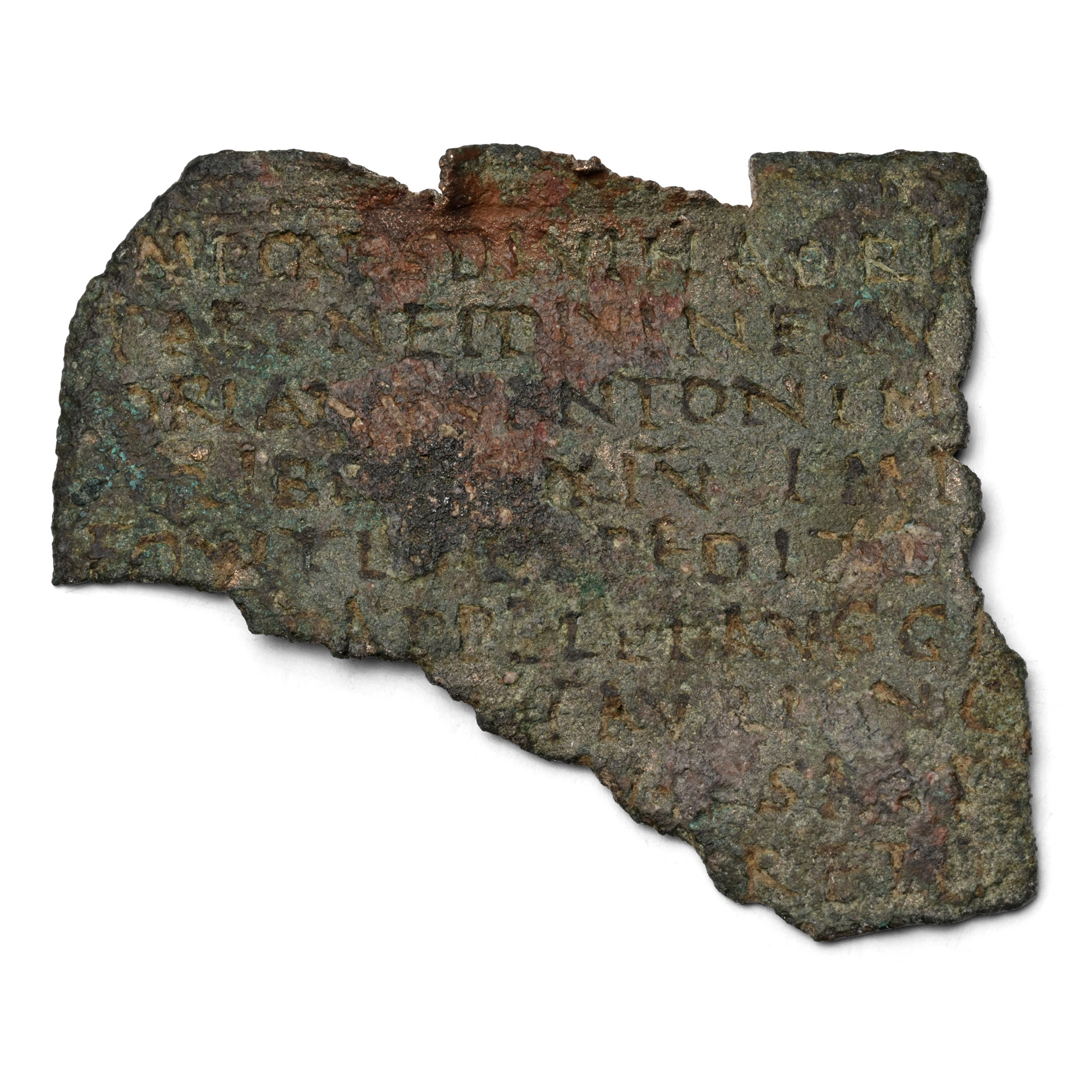
Roman Bronze Military Diploma Fragment Issued Under Antoninus Pius for Mauretania Tingitana
161 A.D.
2 in. (12 grams, 53 mm).
An irregular diploma fragment with seven partial lines of densely arranged text to one side and nine lines of partial text to the other, translating to:
a:
[i]MP(erator) CAES(ar) DIVI HADRI[ani f(ilius) divi traiani] / 31 letters
PART(hici) NEP(os) DIVI NERV[ae pron(epos) t(itus) aelius had] / 31 letters
RIAN[u]S ANTONIN[us aug(ustus) pius pont(ifex) max(imus) / 29 letters
[t]RIB(unicia) P[ot(estate) x]XIV IMP(erator) [ii co(n)s(ul) iv p(ater) p(atriae)] / 23 letters
EQVITIB(us) ET PEDITIB[us qui milit(averunt) in al(is)] / 30 letters
[iii qua]E APPELL(antur) I AVG(usta) GA[ll(orum) et i gall(orum)] / 28 letters
[taurian(a)1 et] TAVRI[a]N(a) C(ivium) [r(omanorum) victr(ix) et coh(ortibus) ..2] / 29 letters
[iii astur(um) c(ivium) r(omanorum) et ii s]VR(orum) SAG(ittariorum) ET [6-10 letters] / 28-30 letts
[14-16 letters c(ivium)] R(omanorum) ET II [8-10 letters] // 28-30 letters?
b:
[i]MP(erator) CAES(ar) [divi hadriani f(ilius) divi traiani part(ici) nep(os)] / 38 letters
DIVI [nervae pron(epos) t(itus) aelius hadrianus] / 30 letters
ANTON[inus aug(ustus) pius pont(ifex) max(imus) trib(unicia) pot(estate)] / 30 letters
XXIV [imp(erator) ii co(n)s(ul) iv p(ater) p(atriae)] / 16 letters
EQVITIB(us) E[t peditibus qui milit(averunt) in al(is) iii quae appell(antur) i aug(usta)] / 47 letters
GALL(orum) ET I G[all(orum) taurian(a)3 et taurian(a) c(ivium) r(omanorum) victr(ix) et
coh(ortibus) ..4 iii] / 44 letters
ASTVR(um) [c(ivium)] R(omanorum) E[t ii sur(orum) sag(ittariorum) .... i ituraeor(um)?5] /40 letters
C(ivium) R(omanorum) ET V DA
hispan(orum) et iv gall(orum)?7 et i asturum] / 38 letters
ET CALLAE[c(orum)] E[t ........] /
[ca. 6 letters] C(ivium) R(omanorum) ET [.......] /
[.... et sunt in mauretania tingitana sub q(uinto) claudio feroce aeronio montano]. [No Reserve]
Acquired on the UK art market.
Property of a gentleman collector.
Accompanied by a copy of an illustrated transliteration report by Dr Ittai Gradel.
This lot is accompanied by an illustrated lot declaration signed by the Head of the Antiquities Department, Dr Raffaele D'Amato.
TimeLine Auctions follows a vetting process to ensure the authenticity and legality of all items, reinforcing our commitment to integrity and responsible trading. Each antiquity, antique, and coin lot undergoes thorough examination by a vetting committee of at least ten external specialists, professional trade association members, scientists, and archaeologists: Our Vetting Process
AUCTIONS:
TimeLine is a leading auction house specialising in antiquities, ancient art, collectables, natural history, coins, medals, and books. Our auctions offer museums, collectors, historians, and enthusiasts the opportunity to acquire unique and historically significant pieces.
LOT 0933
Roman Bronze Military Diploma Fragment Issued Under Antoninus Pius for Mauretania Tingitana
Sold for (Inc. bp): £845
-
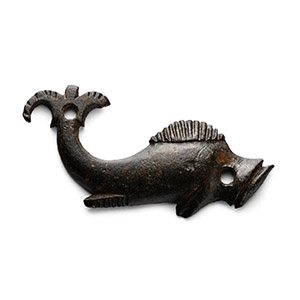
Roman Bronze Dolphin Mount
2nd-4th century A.D.Sold for (Inc. bp): £234
Modelled in the half-round, dolphin in profile with dentilled fin and tail. 5.66 grams, 38 mm
Ex German art market, 2000s. Acquired from an EU collector living in London. From the collection of a Surrey, UK, gentleman. This lot is accompanied by an illustrated lot declaration signed by the Head of the Antiquities Department, Dr Raffaele D'Amato. -
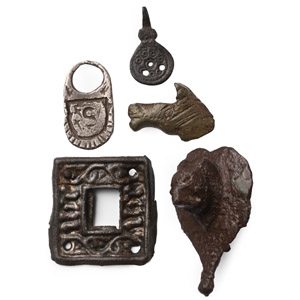
Roman to Tudor Bronze Artefact Group
2nd-16th century A.D.Sold for (Inc. bp): £78
Comprising: a heart-shaped mount with a central lion-head; a rectangular mount with decorative border in low-relief; a horse head modelled in the round; an oval silver pendant with S and stars; hooked tag with ring-and-dot motifs. 38.7 grams total, 23-42 mm
Acquired on the UK art market in the 1970s-1990s. Property of a Nottinghamshire, UK, gentleman. This lot is accompanied by an illustrated lot declaration signed by the Head of the Antiquities Department, Dr Raffaele D'Amato.
The use of hooked tags for fastening first became fashionable during the Anglo-Saxon period. They are usually triangular or circular in shape, of sheet metal (normally bronze or occasionally in silver) and have two or three attachment holes at the widest end. -
.jpg)
Roman Bronze Figure of a Bathing Young Girl
3rd-4th century A.D.Estimate: £3,000 - 4,000 (‡+bp*)
Opening Bid: £1,500
Standing nude female figure with hair dressed in a chignon, left hand clasped to the chest and right arm bent; mounted on a tiered display stand. 448 grams total, 17.4 cm including stand
Acquired in the late 1980s. Private collection, since the late 1990s. This lot has been checked against the Interpol Database of stolen works of art and is accompanied by a search certificate number no.12862-241687. This lot has been cleared against the Art Loss Register database, and is accompanied by an illustrated lot declaration signed by the Head of the Antiquities Department, Dr Raffaele D'Amato.
The girl is depicted in the act of girding her chest with a fascia, similar to the one illustrated in the famous mosaics of Piazza Armerina, where the band is worn together with a subligaculum that covers her lower parts. It is modelled after a real two-piece bath costume of the ancient Romans.
