
Loading, please wait...
LOT 0130
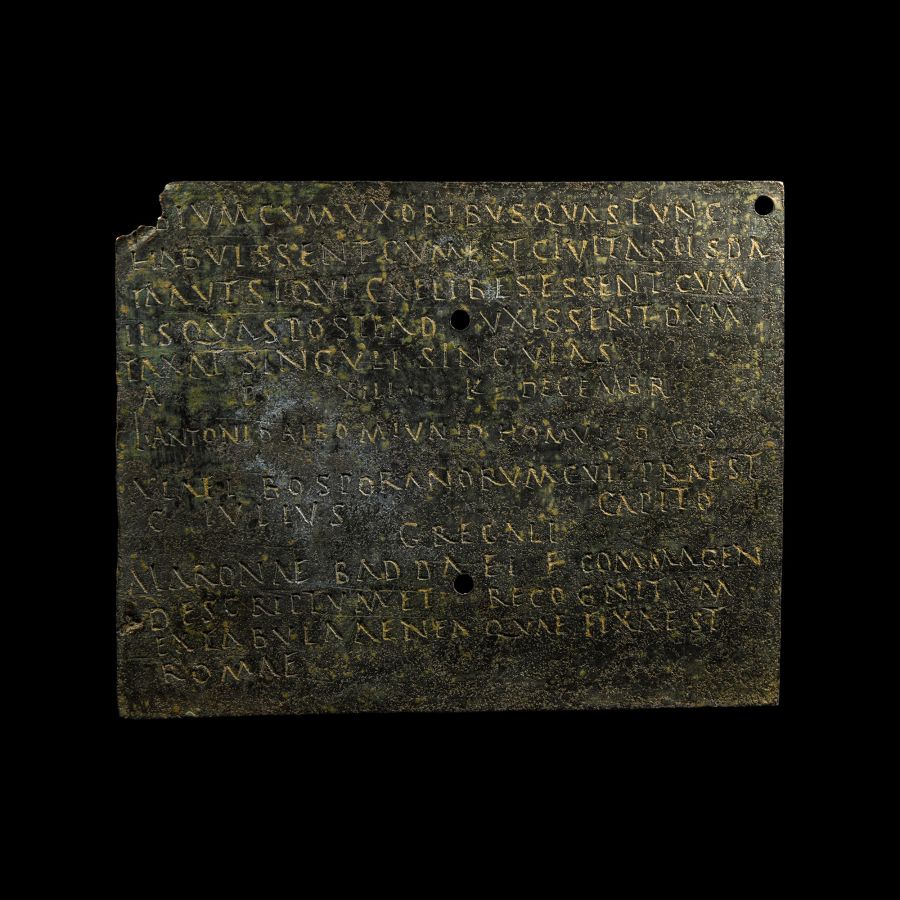
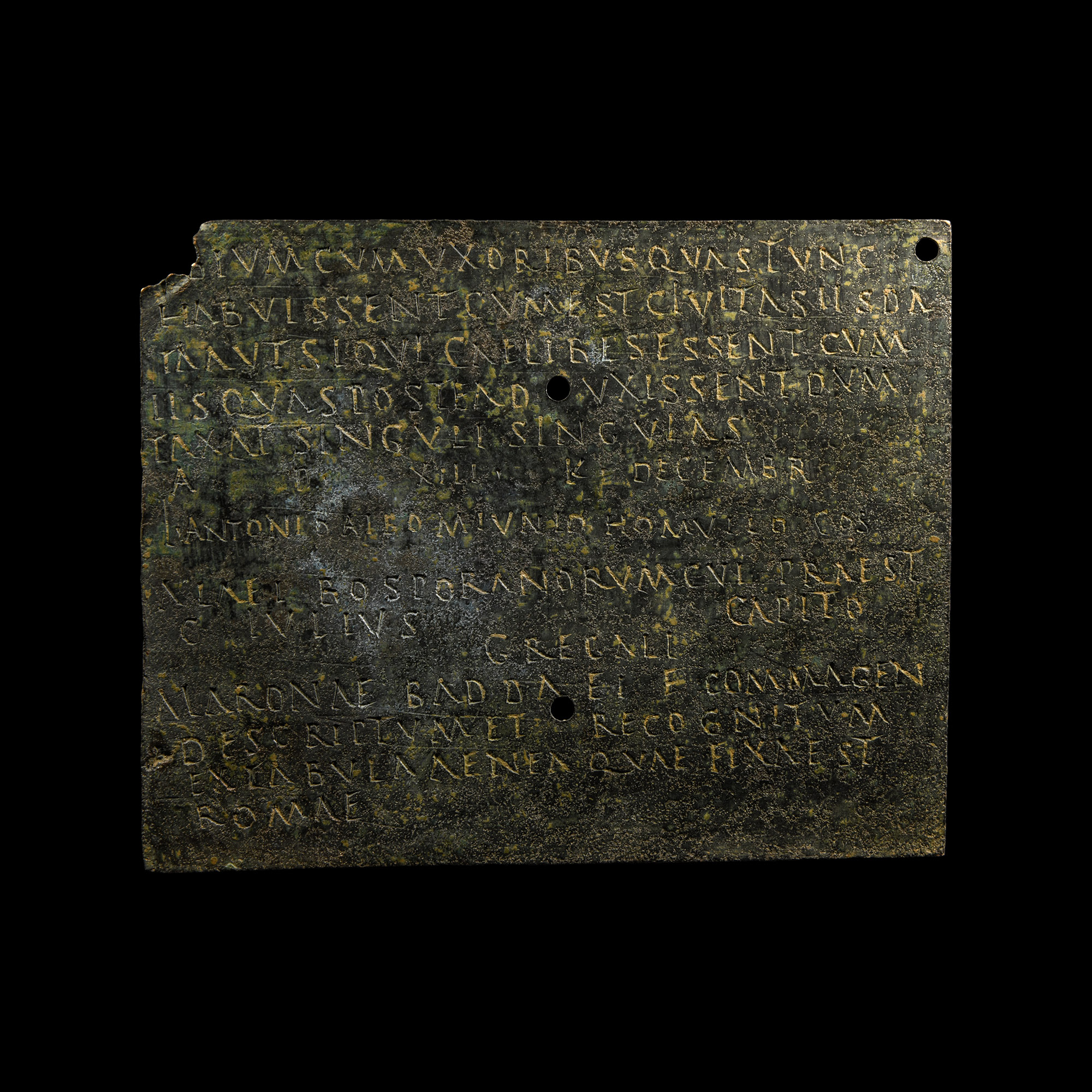
Roman Bronze Military Diploma for Marona, son of Baddaus, a Soldier of Ala Bosporanorum
DATED 19TH NOVEMBER 102 A.D.
6 5/8 in. (214 grams, 17 cm).
Bifacial discharge plaque honesta missio, for a soldier from Commagene serving under Emperor Trajan; Side A: diplomatic text in fourteen lines of seriffed capitals:
[IMPERATOR CAESAR DIVI NERVAE FILIVS NERVA TRAIANVS AVGVSTVS GERMANICVS DACICVS PONTIFEX MAXIMVS TRIBVNICIA POTESTATE VI IMPERATOR IIII CONSUL IIII
PATER PATRIAE ... QUORUM NOMINA SUBSCRIPTA SUNT IPSIS LIBERIS POSTERISQUE EORVM CIVITATEM DEDIT ET CO] NUBIVM CVM UXORIBVS QVAS TVNC
HABVISSENT CVM EST CIVITAS IIS DA-
TA AVT SIQVI CELIBES ESSENT CVM
IIS QUAS POSTEA DVXISSENT DVM-
TAXAT SINGVLI SINGVLAS
A (NTE) D(IEM) XIII K(ALENDAS) DECEMBR(ES)
L(VCIO) ANTONIO ALBO M(ARCO) IVNIO HOMVLLO CO(N)S(VLIBVS)
ALAE BOSPORANORVM CVI PRAEST
C(AIVS) IVLIUS CAPITO
GREGALI
MARONAE BADDAEI F(ILIO) COMMAGEN(IENSI)
DESCRIPT(VM) ET RECOGNIT(VM)
EX TABVLA AENEA QVAE FIXA EST ROMAE
Translation:
The Emperor Caesar Nerva Traianus Augustus, conqueror of Germany, conqueror of Dacia, son of the deified Nerva, pontifex maximus, in his sixth year of tribunician power, four times acclaimed Imperator, four times consul, father of his country, has granted to the ones...whose names are written below, citizenship for themselves, their children and descendants, and the right of legal marriage with the wives they had when citizenship was granted to them, or, if any were unmarried, with those they later marry, but only a single one each. 19 November, in the consulships of Lucius Antonius Albus and Marcus Iunius Homullus (A.D. 102). To Marona, son of Baddaus, from Commagene, soldier of the Ala Bosporanorum, commanded by Gaius Iulius Capito. Copied and checked from the bronze tablet set up at Rome.
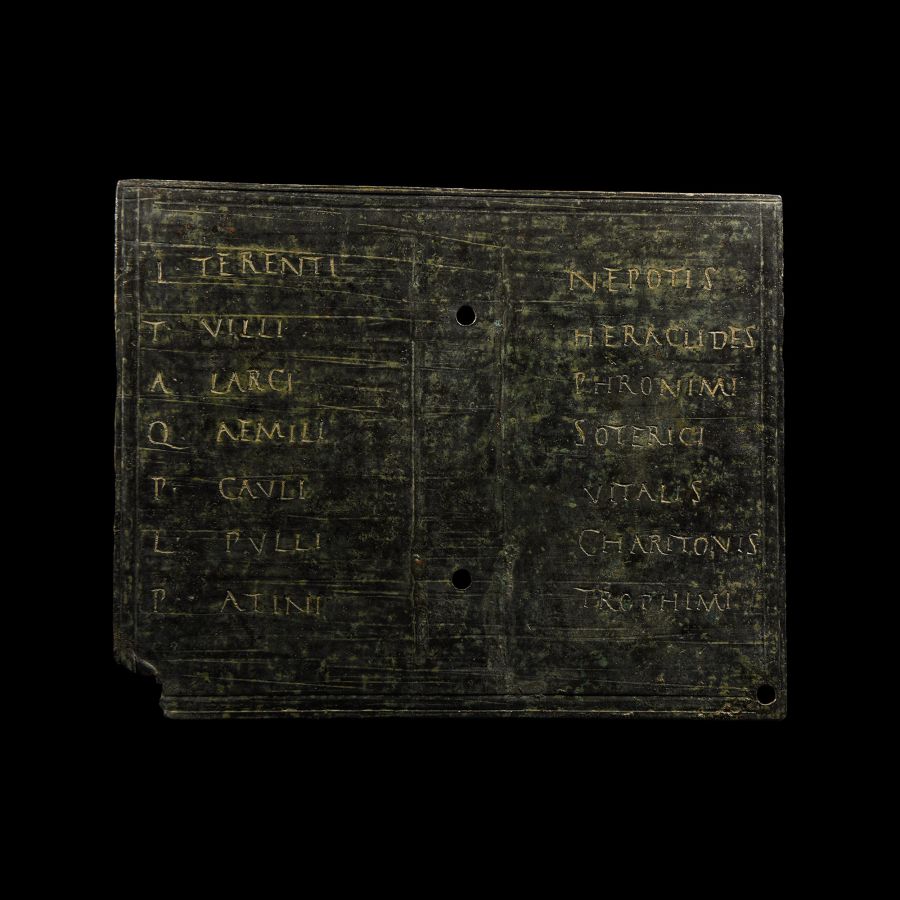
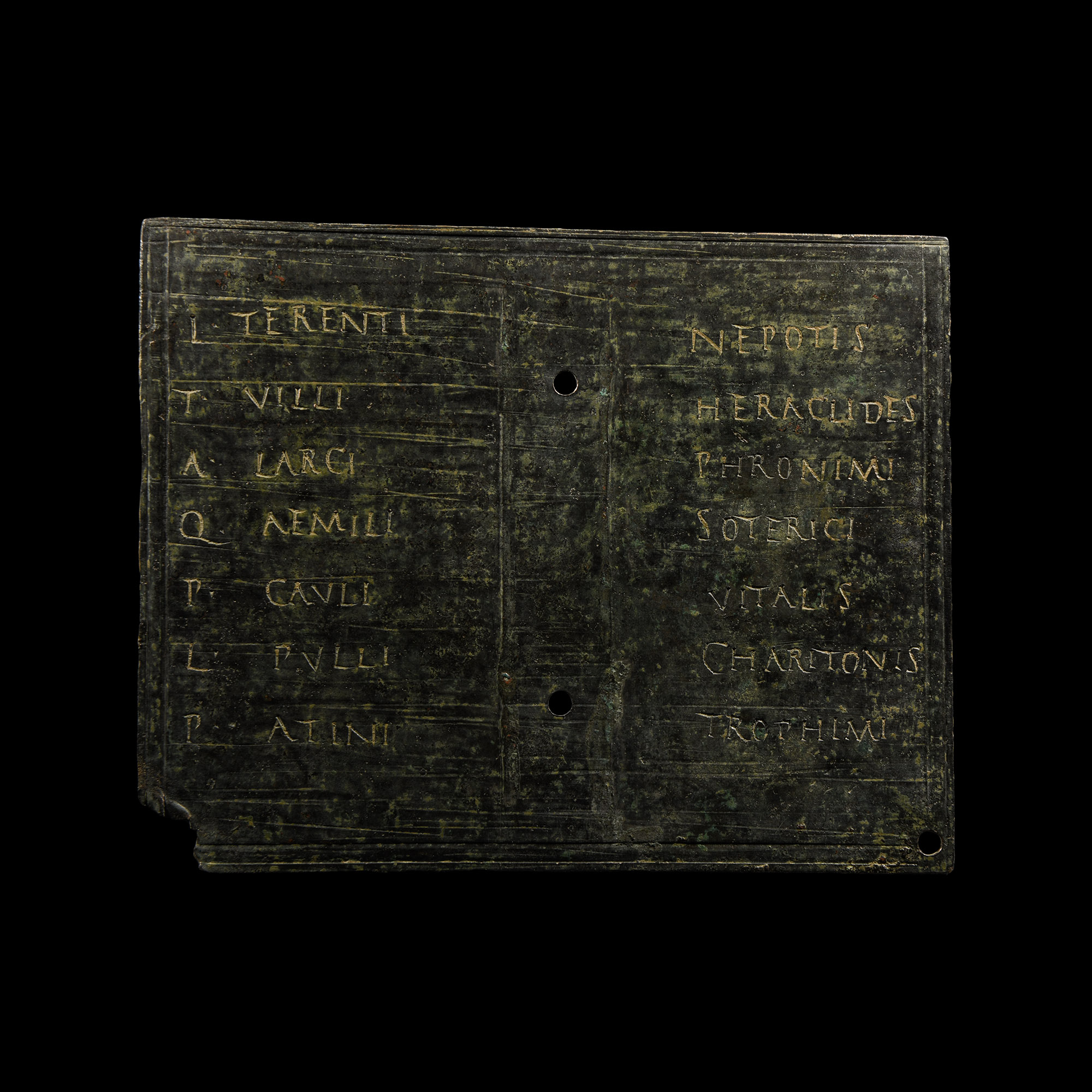
Side B: tabulation in two columns of witness names in seriffed rustic capitals:
L. TERENTI • NEPOTIS (Seal of) Lucius Terentius Nepos
T. VILLI • [hole for sealing the document] HERACLIDES (Seal of) Titus Villus Heraclides
A. LARCI • PHRONIMI (Seal of) A. Larcius Phronimus
Q • AEMILI • SOTERICI (Seal of) Quintus Aemilius Sotericus
P. CAVLI • VITALIS (Seal of) Publius Caulius Vitalis
L. PVLLI • [hole for sealing the document]CHARITONIS (Seal of) Lucius Pullius Chariton
P. ATINI • TROPHIMI (Seal of) Publius Atinius Trophimus
Ex old English collection.
London art market, 1980s.
This lot has been checked against the Interpol Database of stolen works of art and is accompanied by search certificate number no.11858-207740.
In the 1st century the Ala Bosporanorum was camped near the Euphrates. It was stationed in Dacia in the 2nd century; stayed for a while in Vecel, from where it went to Maroskeresztúr, where stamped bricks of their building work appear. The unit was also stationed in upper Pannonia in 116 A.D.
CONDITIONTimeLine Auctions follows a vetting process to ensure the authenticity and legality of all items, reinforcing our commitment to integrity and responsible trading. Each antiquity, antique, and coin lot undergoes thorough examination by a vetting committee of at least ten external specialists, professional trade association members, scientists, and archaeologists: Our Vetting Process
AUCTIONS:
TimeLine is a leading auction house specialising in antiquities, ancient art, collectables, natural history, coins, medals, and books. Our auctions offer museums, collectors, historians, and enthusiasts the opportunity to acquire unique and historically significant pieces.
LOT 0130
Roman Bronze Military Diploma for Marona, son of Baddaus, a Soldier of Ala Bosporanorum
Sold for (Inc. bp): £4,940
-
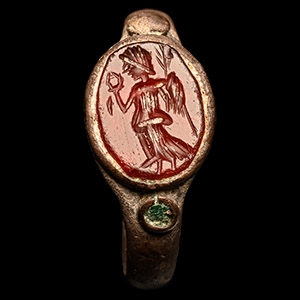
Eastern Roman Silver Ring with Victory Holding Wreath and Palm Branch Gemstone
2nd-3rd century A.D.Estimate: £500 - 700 (+bp*)
Opening Bid: £278
With circular hoop expanding at the shoulders, oval bezel flanked by two bosses; the bezel set with a carnelian gemstone engraved with the winged goddess Victory, dressed in a chiton with overfold, walking on tiptoes to the left and holding a laurel wreath in her right hand and a palm branch in her left. 3.20 grams, 19.78 mm overall, 16.22 mm internal diameter (approximate size British K, USA 5 1/4, Europe 9.95, Japan 9)
Acquired in the late 1980s-early 1990s. Important North West London collection.
This type derives from a statue by Lysippos and appears on statues, reliefs, coins, and gems for purposes of political propaganda. In some variants on gems, Victory has her foot up on a globe, is seated and wears a helmet, an Erote gives her a palm, or the shield is propped against a trophy, a column or a palm tree. -
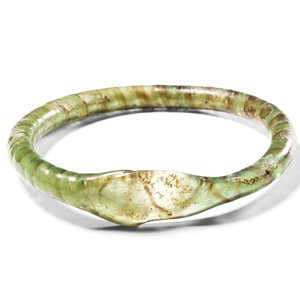
Roman Glass Bracelet
1st-4th century A.D.Sold for (Inc. bp): £208
Twisted in dark green colour with a black spiral band within, flattened plaque. 23.8 grams, 78 mm wide
Acquired 1980-2015. Ex Abelita family collection. -
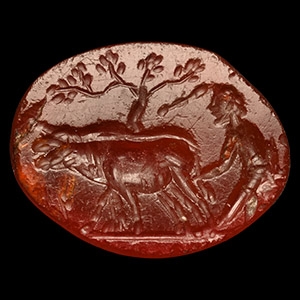
Roman Carnelian Gemstone with Farmer and Oxen
1st-2nd century A.D.Sold for (Inc. bp): £780
The oval intaglio engraved with a man driving a pair of oxen with plough to left, a detailed tree with branches in the background, ground line under the oxen. 0.38 grams, 10 mm
Acquired in the late 1980s-early 1990s. Important North West London collection.
The gem could refer to the Augustan program of restoration of peace and security in the empire, after the agitated period of civil wars, with the possibility for men to return peacefully to their lands in a now peaceful empire. However, we cannot exclude that the image also refers to the well-known episode of Greek mythology, when Odysseus, to escape the call to arms in Troy, feigned madness by ploughing the fields without interruption, until he was unmasked by Palamedes, cousin of Agamemnon, who placed Odysseus' infant son Telemachus in front of the plough, forcing Odysseus to stop and reveal feigned insanity.
