
Loading, please wait...
_900x900.jpg "Roman Bronze Marriage Mirror with Facing Busts and Inscription")
_200x200.jpg "Roman Bronze Marriage Mirror with Facing Busts and Inscription")
_900x900.jpg "Roman Bronze Marriage Mirror with Facing Busts and Inscription")
_200x200.jpg "Roman Bronze Marriage Mirror with Facing Busts and Inscription")
.jpg "Roman Bronze Marriage Mirror with Facing Busts and Inscription")
.jpg "Roman Bronze Marriage Mirror with Facing Busts and Inscription")
LOT 0103
Roman Bronze Marriage Mirror with Facing Busts and Inscription
CIRCA 4TH CENTURY A.D.
3 5/8 in. (130 grams, 91 mm).
Discoid in plan with a beaded rim and concentric rings; at the centre, two draped busts, a male and a female, with faint remains of inscription surrounding; the other side polished and tinned.
ProvenanceUK private collection before 2000.
London collection, acquired on the UK art market.
Cf. Beutler, F. et al., Der Adler Roms. Carnuntum und der Armee der Cäsaren, Bad-Deutsch Altenberg, 2017, items 858,860, for type.
FootnotesThe image on the back of the mirror depicts an imperial couple from the 4th century. The type of diadem worn by the male figure, clad in a paludamentum and cuirass, and the man's profile suggest a depiction of Constantine and Fausta, or of Constantine and his mother Helena.
CONDITIONTimeLine Auctions follows a vetting process to ensure the authenticity and legality of all items, reinforcing our commitment to integrity and responsible trading. Each antiquity, antique, and coin lot undergoes thorough examination by a vetting committee of at least ten external specialists, professional trade association members, scientists, and archaeologists: Our Vetting Process
AUCTIONS:
TimeLine is a leading auction house specialising in antiquities, ancient art, collectables, natural history, coins, medals, and books. Our auctions offer museums, collectors, historians, and enthusiasts the opportunity to acquire unique and historically significant pieces.
LOT 0103
Roman Bronze Marriage Mirror with Facing Busts and Inscription
Sold for (Inc. bp): £845
-
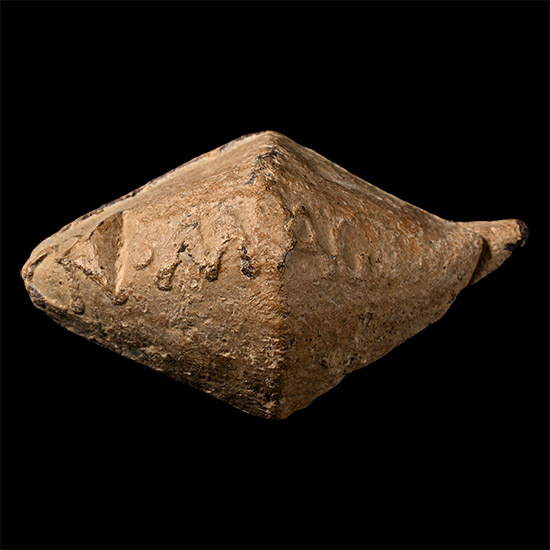
Roman Lead Cnaeus Pompey Battle of Munda Slingshot
1st century B.C.Sold for (Inc. bp): £221
Facetted lentoid-section sling shot (glans) with inscription in Latin letters 'CN' (Cneius) 'MAG' (Magnus) on one side, and 'IMP' for 'IMPERATOR' (victorious general) to the other side, i.e Gnaeus Pompeius Magnus Imperator (Pompey the Great the victorious general). 81grams, 43 mm
Previously from a private Spanish collection. Property of a Middlesex gentleman. Accompanied by a copy of a Spanish export licence. -
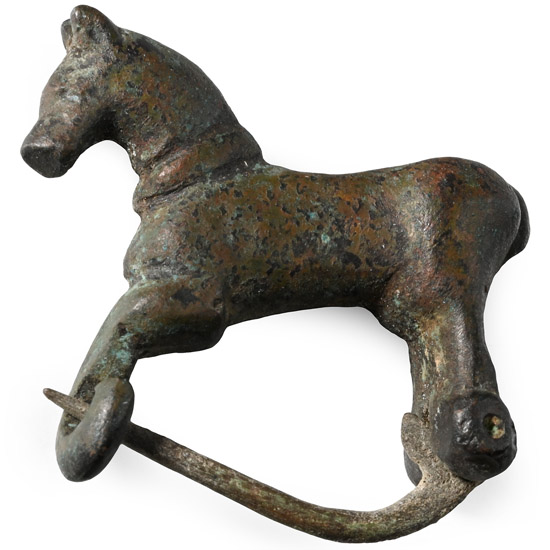
Roman Bronze Horse Brooch
2nd-3rd century A.D.Sold for (Inc. bp): £442
Bow brooch formed as a horse modelled in the round with a halter to the neck; fore-legs forming the catch, rear legs with a transverse bar and hinged pin beneath. 14.9 grams, 28 mm
From the private coin collection of a West London, UK, gentleman, formed since the mid 1980s. -
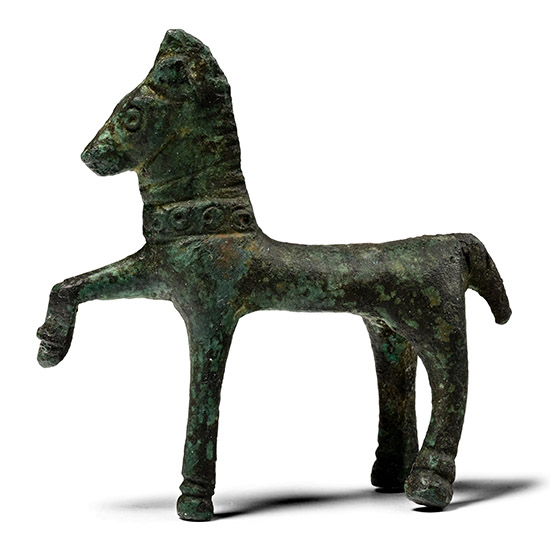
Roman Bronze Stepping Horse Statuette
100-300 A.D.Sold for (Inc. bp): £468
Modelled in the round with an elongated body and legs, right foreleg raised, head turned slightly to the right, a stamped ring-and-dot collar around the neck and eyes indicated by ring-and-dot motifs. 27.44 grams, 49 mm
From the private collection of a European gentleman (1942-2024), formed since the 1970s.
