
Loading, please wait...
LOT 0306
Roman Bronze Legionary Helmet with Inscription
1ST CENTURY B.C.
11 in. (17 3/4 in.) (2.2 kg, 28 cm (4 kg total, 45 cm high including stand)).
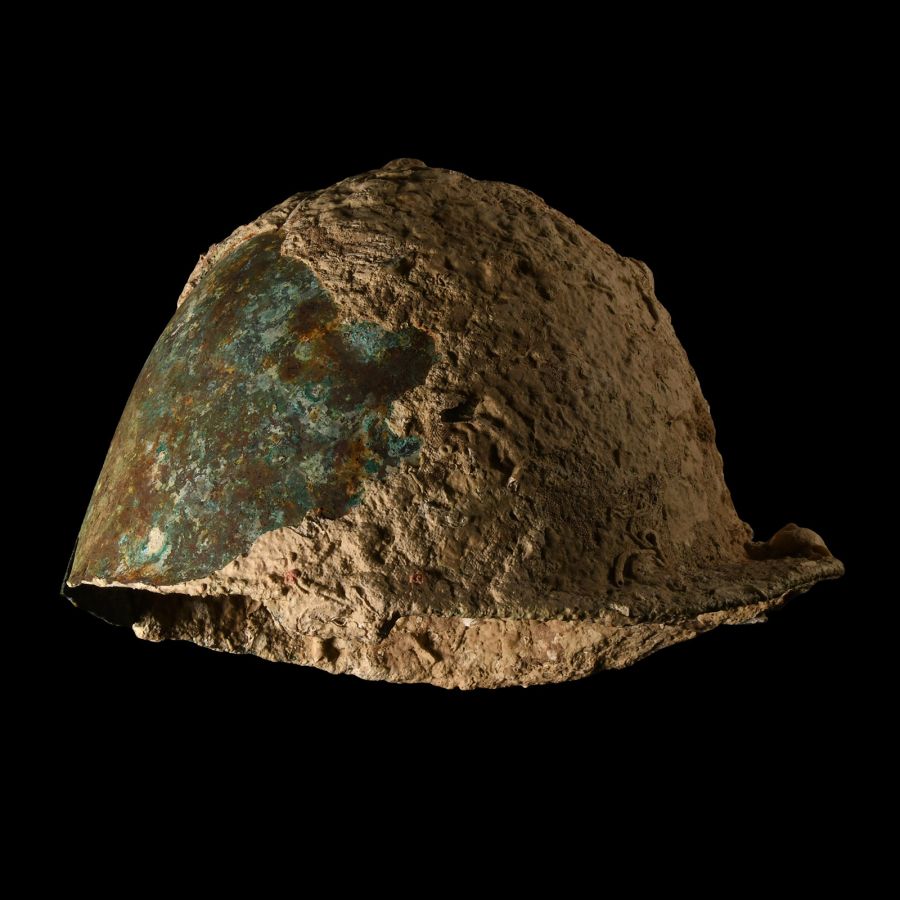
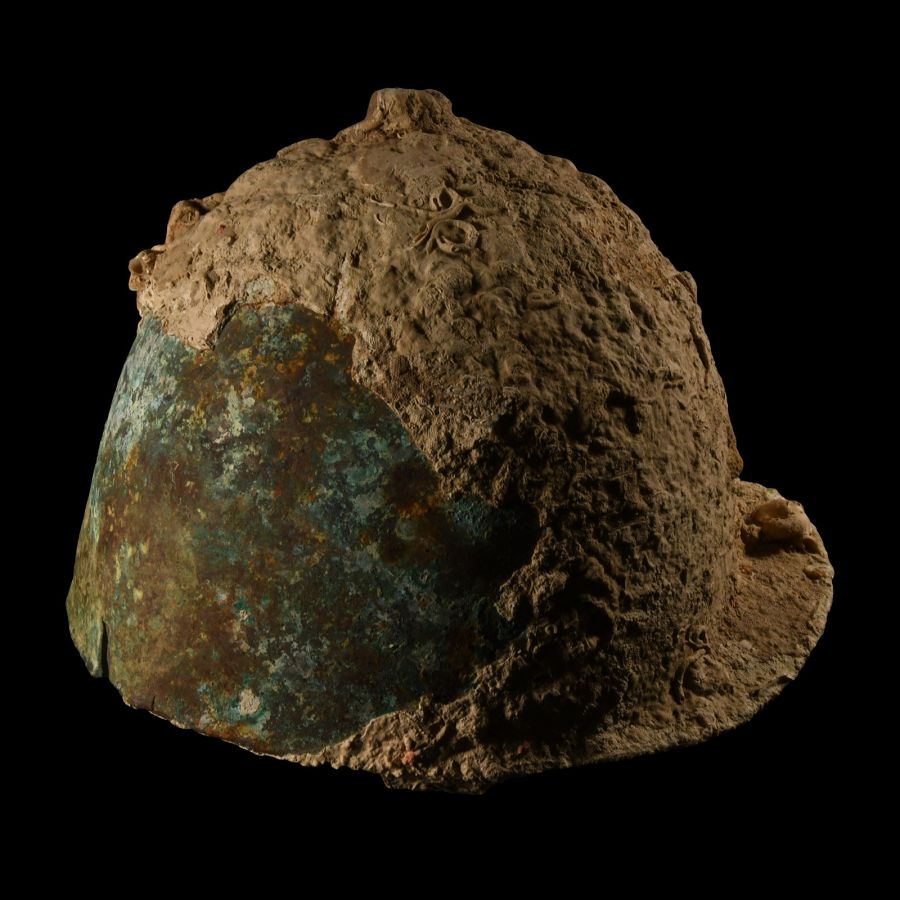
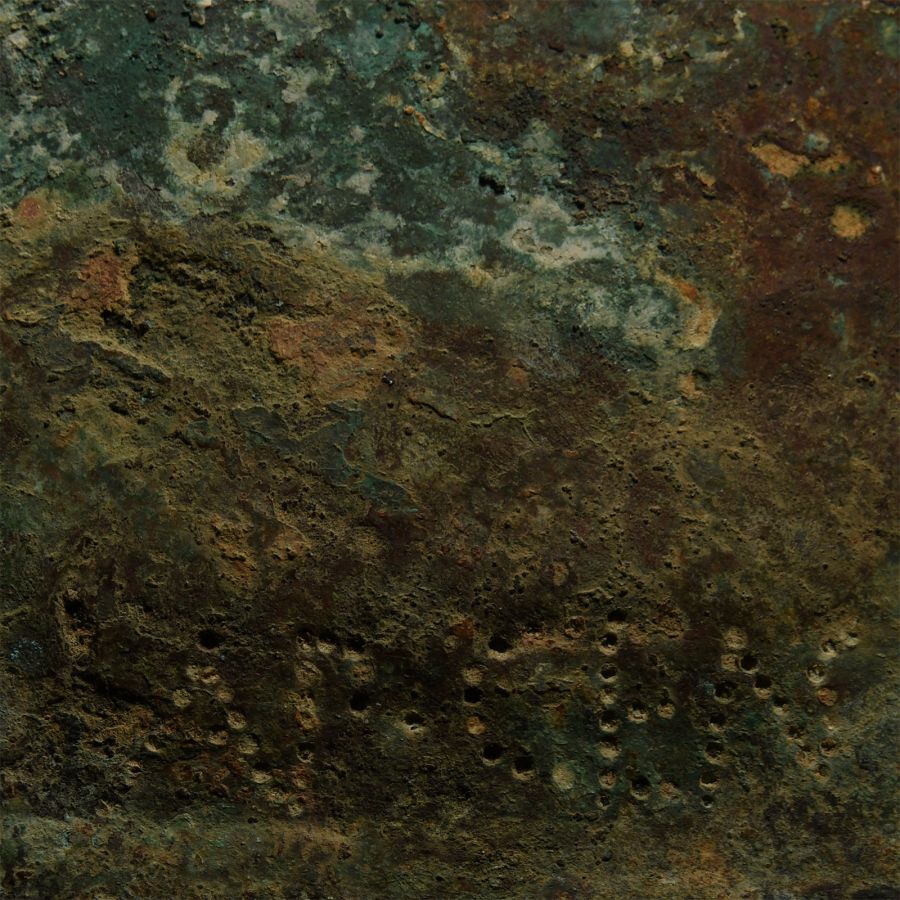
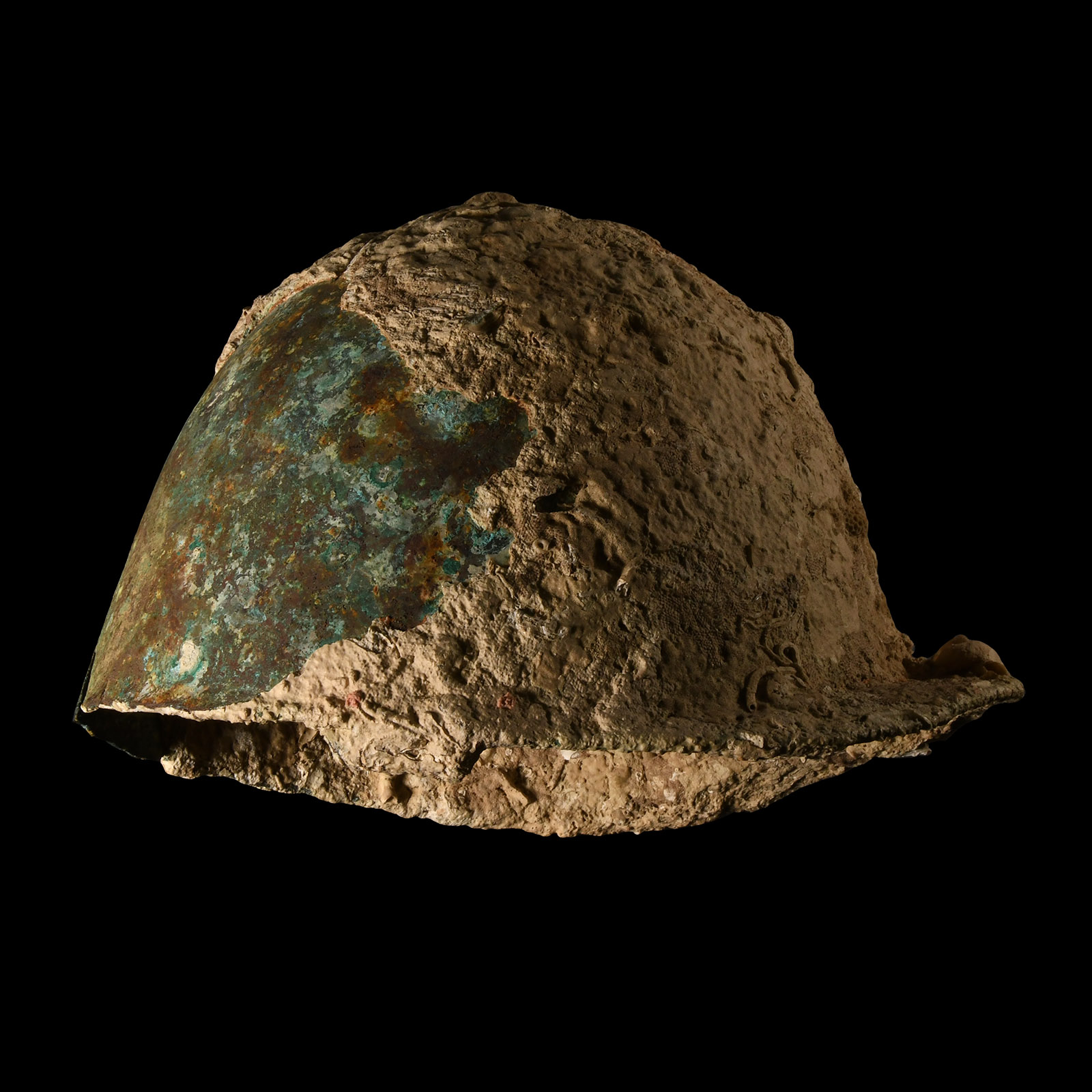
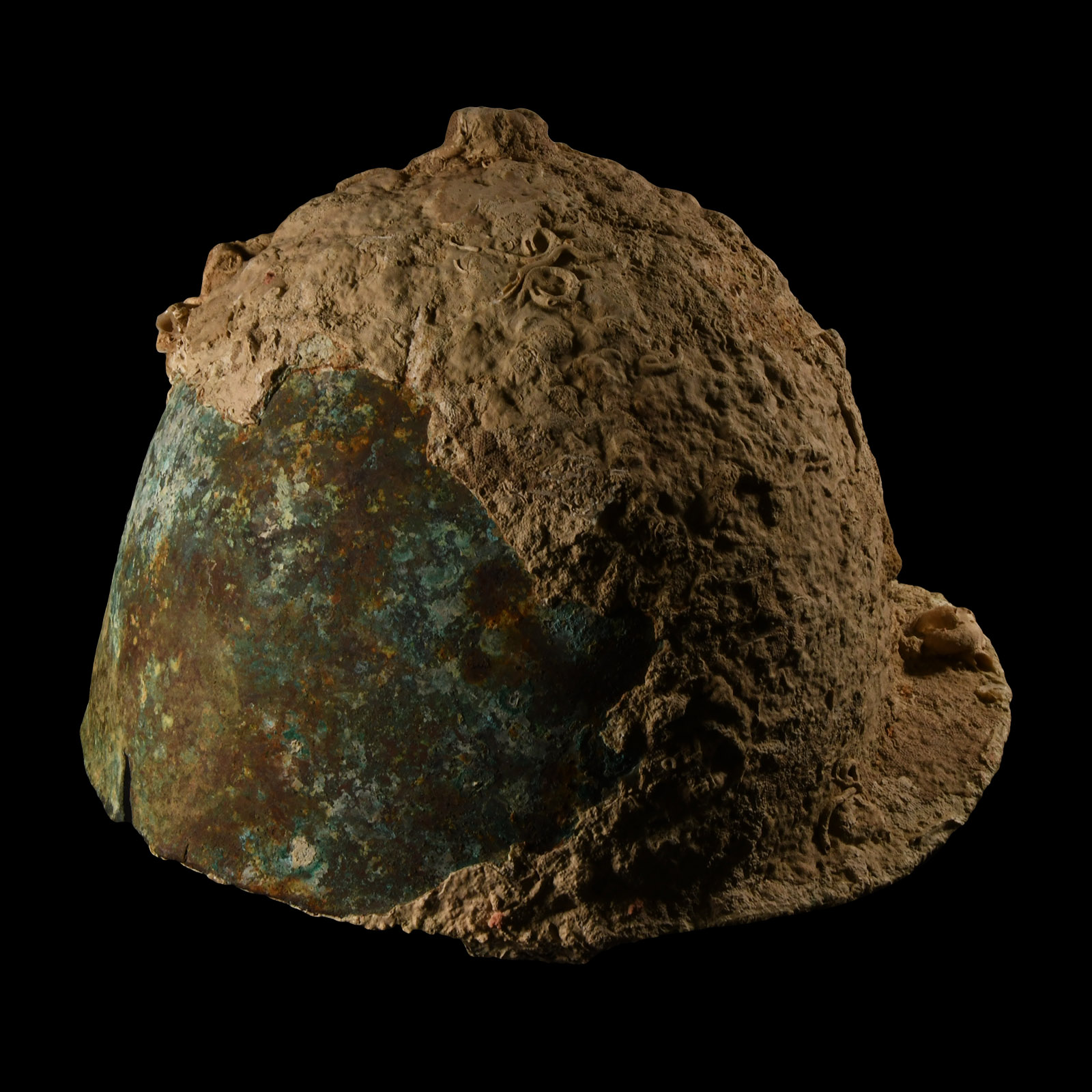
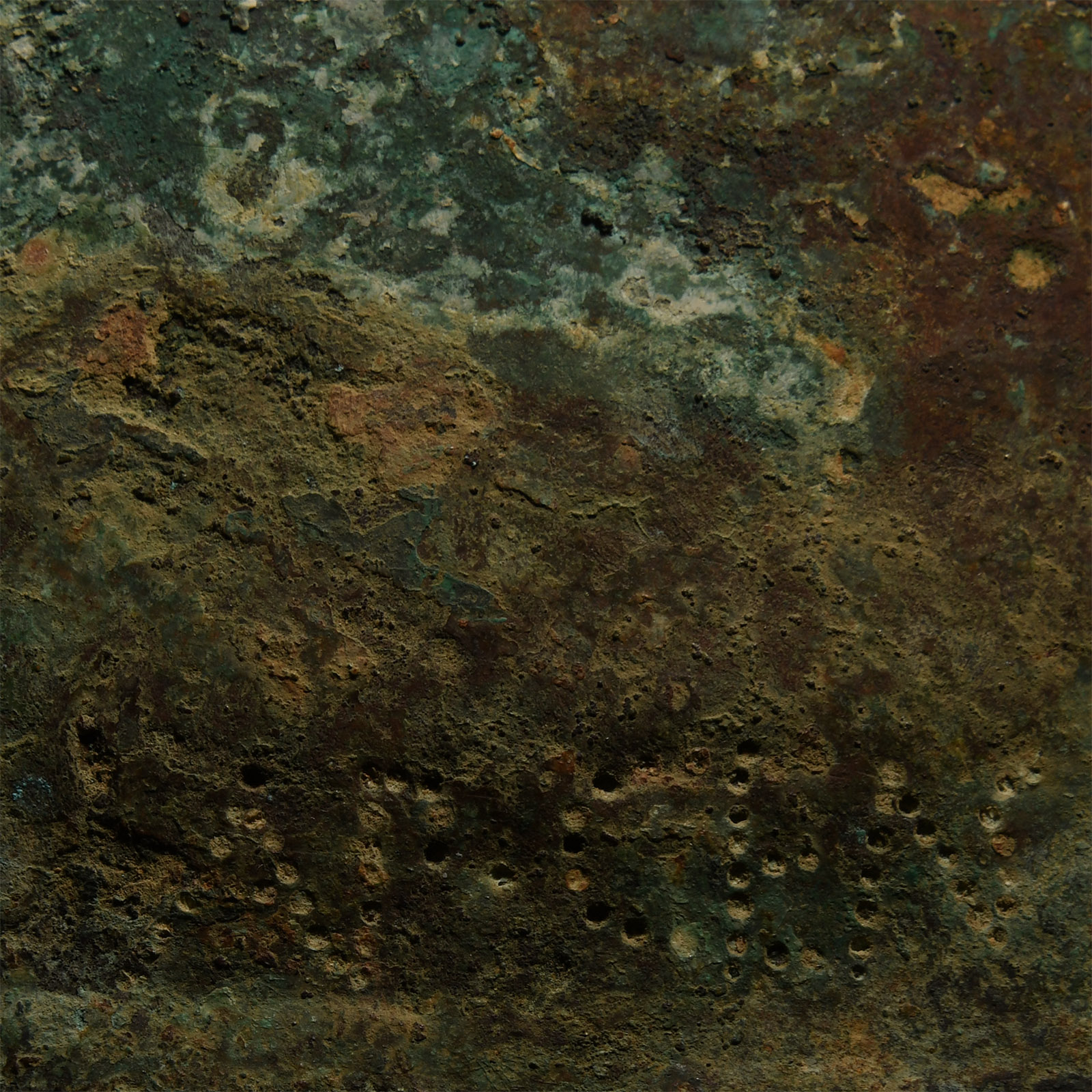
Montefortino helmet with bulbous domed skull and a plain crest knob with flattened top; plain and flat neck guard with thickened rim; the front with punched Latin inscription 'A N CFN'; the surface largely covered in marine encrustations; accompanied by a custom-made display stand.
ProvenancePrivate European collection, acquired 2001.
Accompanied by an academic report by Dr Raffaele D'Amato.
This lot has been checked against the Interpol Database of stolen works of art and is accompanied by searcher certificate no.11576-198953.
Cf. Robinson, R., The Armour of Imperial Rome, New York, 1975, pls.22-27, pp.18ff.; Schaaf, U., 'Etruskich-Römische Helme' in Antike Helme, RGZM Monographien 14, Mainz, 1988, pp.318-326, and nos.112-113; D'Amato, R., Arms and Armour of the Imperial Roman Soldier, London, 2009, fig.20; Junkelmann, M., Römische Helme, Mainz, 2000, pp.52ff., pl.VI (AG 537); Travis, H. & Travis J., Roman Helmets, Stroud, 2014, pp.51-52.
FootnotesThis Montefortino specimen belongs to type C or D of Robinson’s classification, also identified under the continental system as Buggenum. The helmets of this category, mainly legionary helmets, were produced in mass by the state to be supplied to the troops fighting in the civil wars of the 1st century B.C. Artistic sources of the same period provide evidence for the use of Montefortino and Buggenum type helmets in sea battles, which has been confirmed by archaeological finds from the Albenga ship. Legionary helmets bore punched inscriptions, indicating the name of the wearer and the unit, i.e. cohors, centuria or turma. Here the punched letters 'AN' refer probably to the initials of the owner (Ancus N.?), and 'CFN' to centuria of Fabius C.
CONDITIONTimeLine Auctions follows a vetting process to ensure the authenticity and legality of all items, reinforcing our commitment to integrity and responsible trading. Each antiquity, antique, and coin lot undergoes thorough examination by a vetting committee of at least ten external specialists, professional trade association members, scientists, and archaeologists: Our Vetting Process
AUCTIONS:
TimeLine is a leading auction house specialising in antiquities, ancient art, collectables, natural history, coins, medals, and books. Our auctions offer museums, collectors, historians, and enthusiasts the opportunity to acquire unique and historically significant pieces.
-
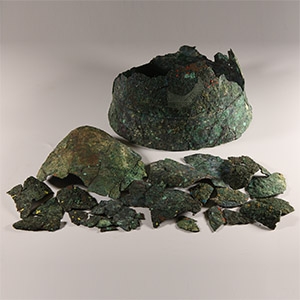
Greek Fragmentary Bronze Pilos Helmet
5th-4th century B.C.Sold for (Inc. bp): £2,015
Conical in shape, comprising a thick hammered bowl and broad rim with carination to the upper edge; remains of crest at brow and rear; a restoration project. 951 grams total, 1-24.5 cm
Ex Axel Guttmann Collection of Ancient Arms and Armour, Germany [1944-2001]. with Hermann Historica, 13 October 2010, lot 2169 [Part].
This type of helmet (called ‘bell-helmet’ by Connolly, 1981, p.70), named pilos after the Greek felt cap (in the Laconian shape, but distinguished from the cap by the noticeable point and the shape of the rim), had a conical shape and was pointed or rounded at the top. Its introduction was linked with the streamlining of Hoplite equipment, and it soon the replaced the closed Corinthian helmet. The helmet was widespread in the Greek and Mediterranean world from the last quarter of the 5th century B.C. and was widely used by continental Greeks, South Italian Greeks and Italic people, Etruscans, and even Romans. -
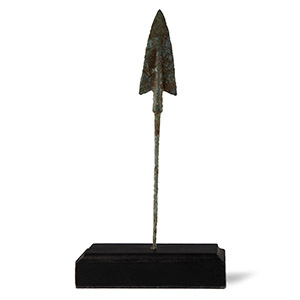
Large Luristan Arrowhead with Stand
14th-11th century B.C.Sold for (Inc. bp): £234
With triangular blade, having a barbed deltoid shape and a rounded projecting midrib tapering towards the sharp point, cylindrical stem and rectangular sectioned tang: accompanied by a custom-made display stand. 36 grams, 21.5 cm (140 grams total, 22.5 cm high including stand)
Acquired 1980-2015. Ex Abelita family collection.
According to Khorasani, this type of arrowhead belongs to a subcategory of the category of type V of Luristan arrow points. In the four categories of triangular bronze arrowheads from Luristan, Marlik and Northern Iran individuated by Negahban, subtypes C and D of type V are larger arrow or javelin heads, C with barbed shoulders and D with round shoulders. -
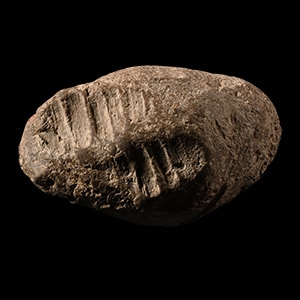
Roman Praetorian Guard Terracotta Sling Shot with Scorpion
1st century A.D.Sold for (Inc. bp): £286
Lentoid section with a raised 'keel' to one end, depicting a stylised scorpion. 25.75 grams, 43 mm
Ex Simmons Gallery, London E11, UK, in the 1990s. From a North London collection.
The sling (funda) with its lead (plumbea pondera) and stone missiles was used by special funditores, illustrated on Trajan’s Column where they are dressed in broad tunics with no armour, but carry a shield. Interestingly, this glans has the emblem usually associated with the Praetorian Guard - the scorpion. It was an emblem also used in Ptolemaic Egypt, and it is not impossible that this bullet could be Ptolemaic or Romano-Egyptian. We believe this bullet could be associated with the Praetorian regiments which means this could be one of the first pieces of evidence for their use.
