
Loading, please wait...
_900x900.jpg "Roman Bronze Horse Bow Brooch")
_200x200.jpg "Roman Bronze Horse Bow Brooch")
.jpg "Roman Bronze Horse Bow Brooch")
LOT 0657
Roman Bronze Horse Bow Brooch
CIRCA 3RD CENTURY A.D.
1 7/8 in. (29.8 grams, 47 mm).
With pricked ears, arched neck, D-shaped saddle and bobbed tail; the lower hindlegs developing into a headplate similar to a Roman crossbow brooch; the hinge-notch present on the headplate, the pin and catchplate absent. [No Reserve]
ProvenanceAcquired late 1980s-early 1990s.
Ex private collection, Nottinghamshire, UK.
Property of a Kent lady collector.
See Hattatt, R., Ancient Brooches and Other Artefacts, item 1644.
CONDITIONTimeLine Auctions follows a vetting process to ensure the authenticity and legality of all items, reinforcing our commitment to integrity and responsible trading. Each antiquity, antique, and coin lot undergoes thorough examination by a vetting committee of at least ten external specialists, professional trade association members, scientists, and archaeologists: Our Vetting Process
AUCTIONS:
TimeLine is a leading auction house specialising in antiquities, ancient art, collectables, natural history, coins, medals, and books. Our auctions offer museums, collectors, historians, and enthusiasts the opportunity to acquire unique and historically significant pieces.
-
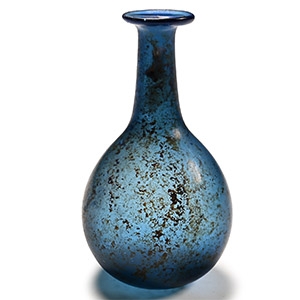
Roman Blue Glass Unguentarium
1st century A.D.Sold for (Inc. bp): £494
With piriform body, tapering neck and everted rim. 34 grams, 93 mm
From a London, UK, collection, 1990s. -
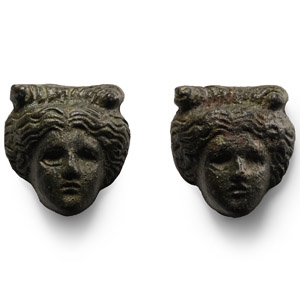
Roman Bronze Female Head Mount Pair
1st-4th century A.D.Sold for (Inc. bp): £169
Comprising two matched mounts, each showing a female face with rounded cheeks and hollow eyes, elaborate coiffure gathered on the top of the head; hollow reverse. 21.4 grams total, 24 mm each
Ex German art market, 2000s. Acquired from an EU collector living in London. From the collection of Surrey, UK, gentleman. -
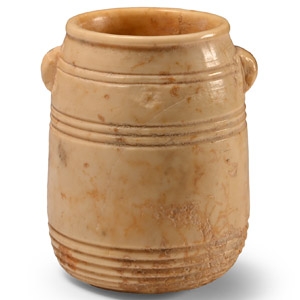
Late Roman Decorated Bone Pyxis
4th century A.D.Sold for (Inc. bp): £156
Barrel-shaped with everted rim, horizontal ribbing, inset base, lateral lug handles at the shoulder. 57 grams, 51 mm
From the private collection of Mr K.A., acquired in the 1990s-early 2000s.
