
Loading, please wait...


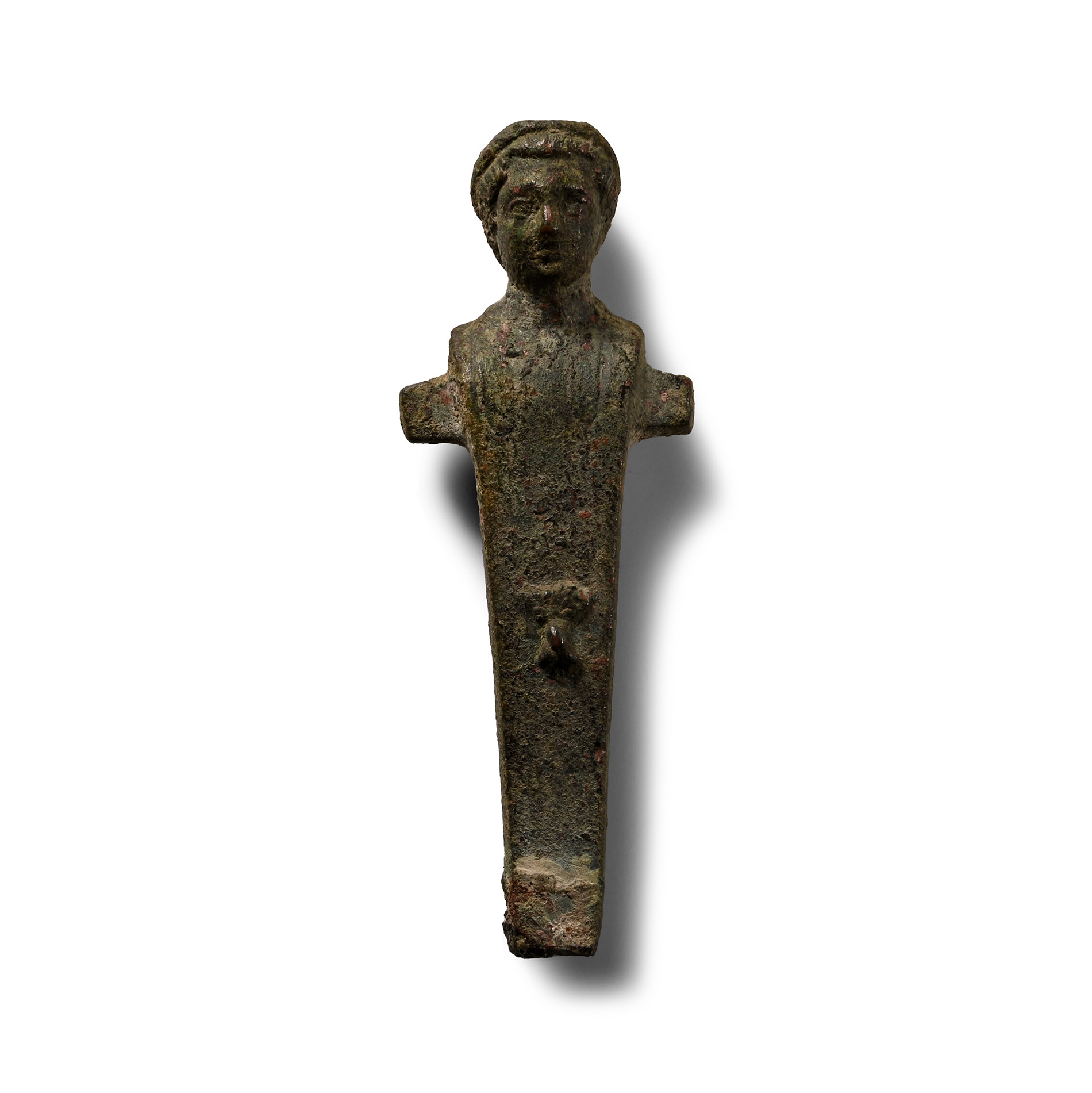
LOT 0636
Roman Bronze Herm Statuette
1ST-4TH CENTURY A.D.
3 1/2 in. (116 grams, 92 mm).
The shank square in section and tapering with youthful male head, stub arms, clavii to the chest and male genitals.
ProvenanceFrom the collection of a gentleman, acquired on the London art market in the 1990s.
CONDITIONTimeLine Auctions follows a vetting process to ensure the authenticity and legality of all items, reinforcing our commitment to integrity and responsible trading. Each antiquity, antique, and coin lot undergoes thorough examination by a vetting committee of at least ten external specialists, professional trade association members, scientists, and archaeologists: Our Vetting Process
AUCTIONS:
TimeLine is a leading auction house specialising in antiquities, ancient art, collectables, natural history, coins, medals, and books. Our auctions offer museums, collectors, historians, and enthusiasts the opportunity to acquire unique and historically significant pieces.
-
.jpg)
Elaborate Roman Bronze Oil Lamp with Lion Mask
1st-2nd century A.D.Estimate: £2,500 - 3,500 (+bp*)
Opening Bid: £1,250
Substantial hollow-formed drum-shaped body with waisted nozzle, lateral integral lion-mask, stepped discus with leaf detailing, pelta-shaped reflector plate to rear with lateral wreath detailing and palmette motif; three-bar caged handle beneath. 1 kg, 23.3 cm
Acquired on the German art market in 1987. Ex Gorny and Mosch, 18 December 2013, no.502. Accompanied by an academic report by Dr Raffaele D’Amato. This lot has been checked against the Interpol Database of stolen works of art and is accompanied by search certificate number no.12346-225410.
This lamp belongs to the typology of ‘rounded bodies and volute spines’, typical of 1st or early 2nd century A.D. These lamps had fairly shallow and round-walled oil-chambers with long flat-topped nozzles with splayed tips (here very shallow). The majority of these lamps are of Italic manufacture, and similar have been found in Pompeii (see lamp in Ashmolean Museum ANFORTNUM B.186). -
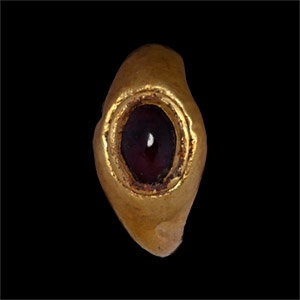
Roman Gold Ring with Garnet Cabochon
1st century A.D.Sold for (Inc. bp): £468
With a hollow-form D-section hoop widening at the shoulders, oval bezel set with a garnet cabochon. 0.95 grams, 18.42 mm overall, 15.61 mm internal diameter (approximate size British H, USA 3 3/4, Europe 6.18, Japan 6)
Acquired in the mid 1980s-1990s. Private collection, Switzerland, thence by descent. Private collection, since the late 1990s. -
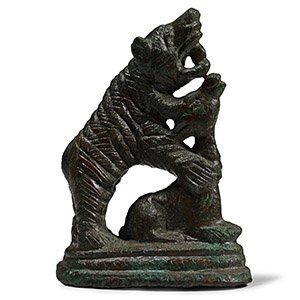
Roman Bronze Statue of a Bear Killing a Deer
1st-2nd century A.D.Estimate: £2,000 - 3,000 (+bp*)
Opening Bid: £600
On a stepped triangular base, bear with head raised, forepaws round the neck of a deer with legs folded beneath the body. 398 grams, 10 cm
Nicolas Koutoulakis (1910-1996). Private collection of Mr K.A. This lot has been checked against the Interpol Database of stolen works of art and is accompanied by a search certificate number no.12398-226600.
Combat between large animals was a popular theme in Roman art. The staging of such fights in the Flavian Amphitheatre in the heart of Rome is evidenced. Furthermore, the 3rd-4th century A.D. mosaic floor unearthed at Lod, Israel, in 1996 shows several scenes with ferocious wild animal - a lion and lioness, an elephant, a giraffe, a rhinoceros, a tiger, and a wild bull - all arranging themselves for a colossal fight to the death. The mosaic was lifted intact and is on display in the Metropolitan Museum of Art, New York.
