
Loading, please wait...
_900x900.jpg "Roman Bronze Head")
_200x200.jpg "Roman Bronze Head")
.jpg "Roman Bronze Head")
LOT 0163
Roman Bronze Head
2ND-4TH CENTURY A.D.
4 in. (440 grams, 10 cm).
Hollow-formed with long neck, abundant thick hair and beard, broad mouth; probably intended to represent an emperor.
ProvenanceAcquired by a Swiss family in the mid-1980s to late 1990s, thence by descent.
Private collection, Switzerland, since the late 1990s.
Cf. a bronze statue of Hadrian from the Camp of the Sixth Roman Legion in Tel Shalem, 117–138 AD, now in the Israel Museum, Jerusalem.
CONDITIONTimeLine Auctions follows a vetting process to ensure the authenticity and legality of all items, reinforcing our commitment to integrity and responsible trading. Each antiquity, antique, and coin lot undergoes thorough examination by a vetting committee of at least ten external specialists, professional trade association members, scientists, and archaeologists: Our Vetting Process
AUCTIONS:
TimeLine is a leading auction house specialising in antiquities, ancient art, collectables, natural history, coins, medals, and books. Our auctions offer museums, collectors, historians, and enthusiasts the opportunity to acquire unique and historically significant pieces.
LOT 0163
Roman Bronze Head
Estimate £1,000 - 1,400€1,160 - 1,620 (for guidance only)$1,350 - 1,890 (for guidance only)
-
.jpg)
'The Ceres Collection' Italic Agate Gemstone of a Boar in Silver Ring
2nd-1st century B.C.Sold for (Inc. bp): £572
Oval in plan and plano-convex in section, depicting a boar at bay from a hound; set in a later heavy silver mount with French maker's mark and French assay mark; supplied with a museum-quality impression. 12.35 grams, 25.62 mm overall, 18.51 mm internal diameter (approximate size British N 1/2, USA 6 3/4, Europe 14.35, Japan 13)
American family collection, New York, formed 1930s-1990s. with Bonhams, London, 17 September 2014, no.96. Private collection, England. -
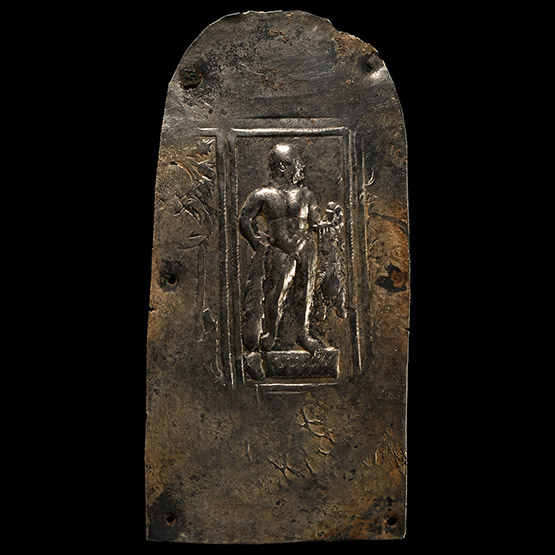
Roman Silver Votive Plaque with Hercules
2nd-4th century A.D.Sold for (Inc. bp): £780
Tongue-shaped with central repoussé motif of Hercules standing nude on a plinth supporting his club and with lionskin mantle draped over his bent forearm; rectangular frame surrounding; traces of similar frames to both sides; six holes for attachment. 30 grams, 99 mm
Acquired in the mid 1980s-1990s. Private collection, Switzerland, thence by descent. Private collection, since the late 1990s.
The panel has clearly been cut from a larger sheet of silver which was stamped with low-relief figures: to the left of Hercules is a frame with fronds at the top and the bent arms of a figure wearing a palla. -
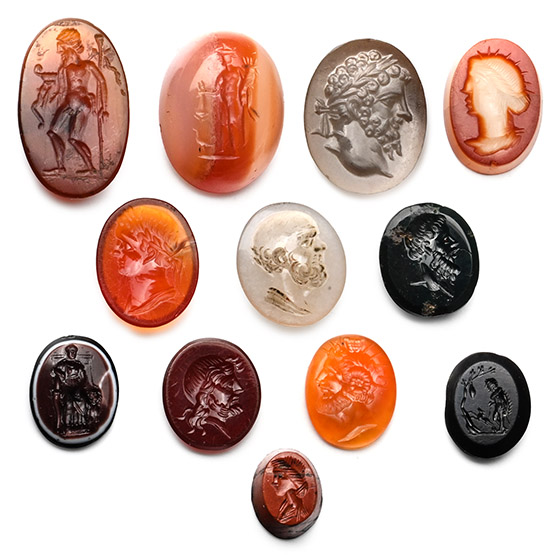
Roman and Later Hardstone Gemstone Collection
2nd century A.D. and laterSold for (Inc. bp): £2,080
Including profile bust, standing warrior and other types; supplied with a museum-quality impression. 13.02 grams total, 10-20 mm
Private collection, England.
