
Loading, please wait...
LOT 0710
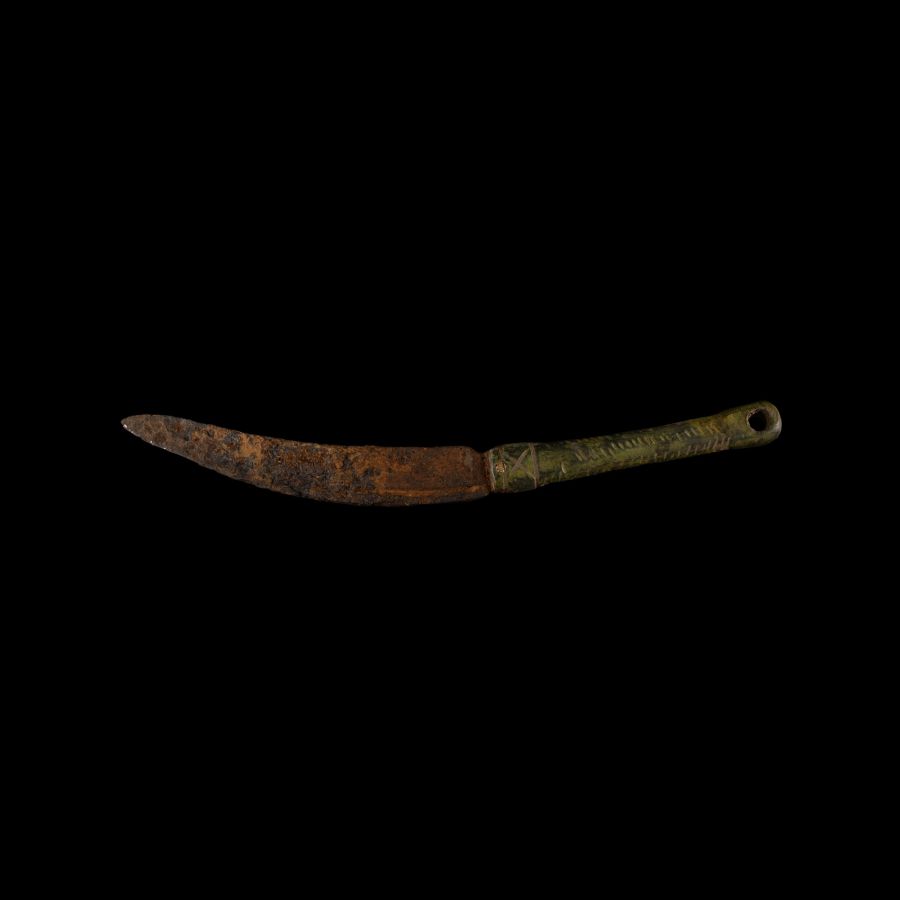
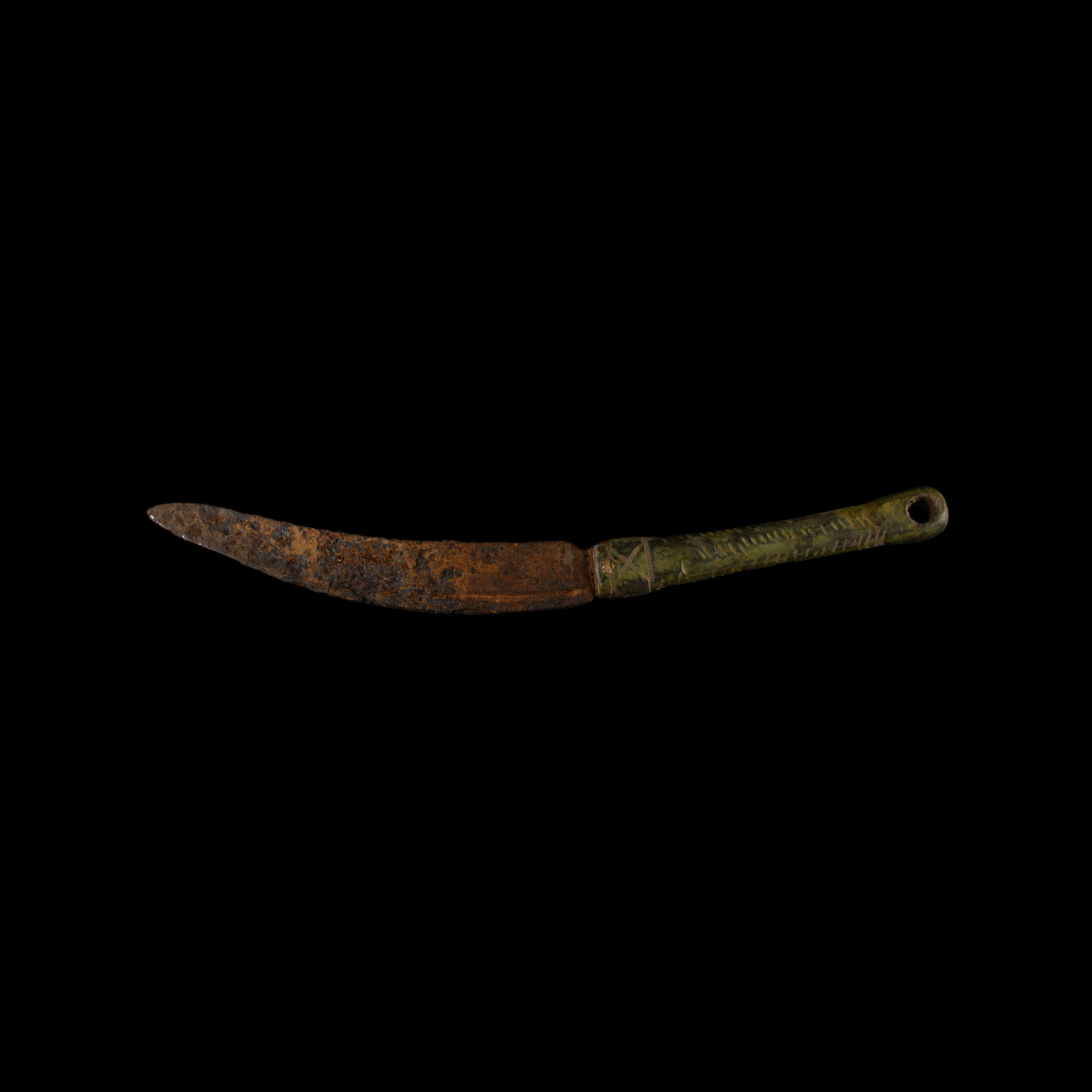
Roman Bronze Handled Knife
CIRCA 3RD CENTURY A.D.
6 3/4 in. (49 grams, 17 cm long).
An iron knife with curved blade and one cutting edge, with bronze handle decorated with incised X-motifs and dashes to both faces; pierced finial. [No Reserve]
ProvenanceAcquired before 2000.
From the collection of a European gentleman living in the UK.
TimeLine Auctions follows a vetting process to ensure the authenticity and legality of all items, reinforcing our commitment to integrity and responsible trading. Each antiquity, antique, and coin lot undergoes thorough examination by a vetting committee of at least ten external specialists, professional trade association members, scientists, and archaeologists: Our Vetting Process
AUCTIONS:
TimeLine is a leading auction house specialising in antiquities, ancient art, collectables, natural history, coins, medals, and books. Our auctions offer museums, collectors, historians, and enthusiasts the opportunity to acquire unique and historically significant pieces.
-
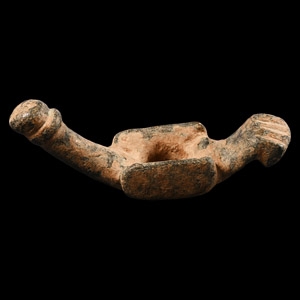
Roman Phallic Amulet
3rd-4th century A.D. or laterEstimate: £100 - 140 (+bp*)
Opening Bid: £50
A bronze phallic amulet composed of a hollowed truncated conical socket, with a curved arm to each side, one ending in a phallic shape, the other ending with a closed fist. 26.1 grams, 55 mm
Acquire in the 1990s. Ex Cambridgeshire, UK, collection.
Roman phallic amulets are represented by many examples preserved in museums and private collections, with a vast variety of types. This specimen belongs to category of double phallus, even if one of the male attributes is here represented as a fist. These amulets were worn as a wish for fertility and virile power, often hung on horses as harness pendants. -
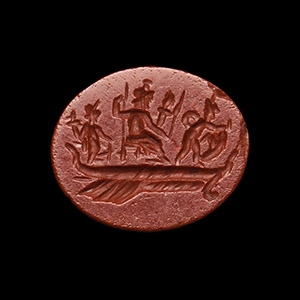
Roman Gemstone with Zeus Serapis and Isis
2nd-3rd century A.D. or laterSold for (Inc. bp): £442
A gem with a representation of Zeus Serapis enthroned, modius on his head, sceptre and eagle by his side, Isis Gubernatrix to his right and Isis sail-bearer to his left, all three figures riding a galley or cargo ship. 0.28 grams, 10 mm
Acquired before 1988. Ex family collection, by descent, Geneva.
This triad formed by Serapis and the two aspects of Isis (Gubernatrix and sail-bearer) aboard a ship, appears in several examples of Alexandrian coinage and gemstones. This imagery is linked to the image of Isis, goddess of the sea, and Serapis, god of vegetation and protector of the sailors. -
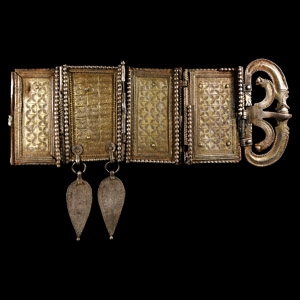
Roman Silver-Gilt Military Buckle of an Elite Imperial Officer
4th-5th century A.D.Estimate: £5,000 - 7,000 (+bp*)
Opening Bid: £2,500
A set of military belt elements comprising: a buckle with rectangular plate, richly decorated with embossed laurel leaves in a grid, framed with raised bosses, the buckle loop comprising opposing dragons with open mouths, holding a spherical tongue-rest, another pair of smaller dragon heads to base, the tongue with a smaller pair of punch-decorated dragon heads; three rectangular belt fittings, two with similar laurel leaf decoration and raised border, the central plaque with two foliate pendants with punched decoration. 390 grams total, 27.5 cm wide
Very fine, excellent condition
Acquired before the 1970s. Ex J.L. collection, Surrey, U.K., thence by decent. Accompanied by an academic report by Dr Raffaele D’Amato. This lot has been checked against the Interpol Database of stolen works of art and is accompanied by search certificate no.11588-199387.
Most precious military belts, like this one, were reserved to soldiers belonging to Legiones Palatinae, i.e. the legions forming part of the imperial Comitatus, accompanying the emperor in his military expeditions.
