
Loading, please wait...
LOT 0139
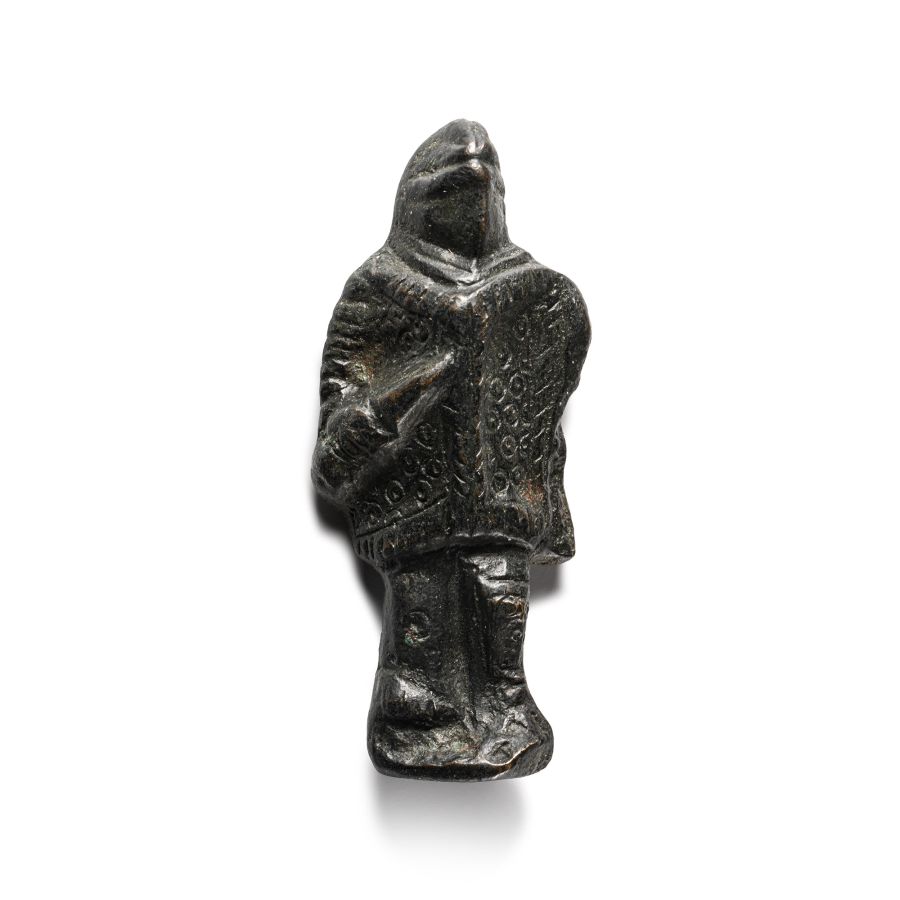
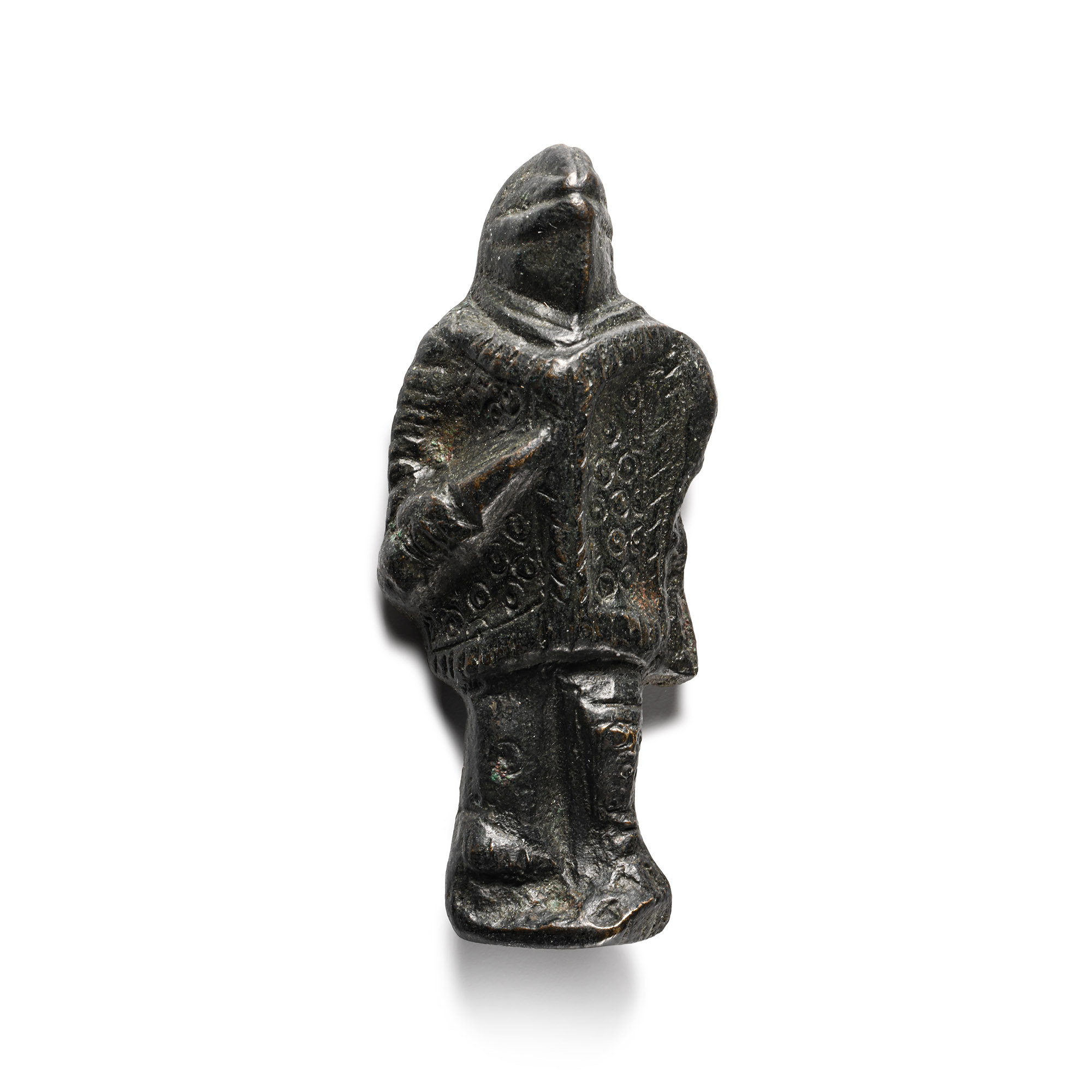
Roman Bronze Gladiator Mount
CIRCA 1ST-2ND CENTURY A.D.
2 1/2 in. (48 grams, 62 mm).
Modelled in the half-round with hollow reverse and fixing stud; gladiator advancing with a gladius short-sword drawn in right hand, holding a rectangular shield (scutum) and wearing greaves (ocreae); the arm protected by an armoured manica.
ProvenanceFrom the French collection of M Garcia, 1990s.
LiteratureCf. Heynowski, R., Bestimmungsbuch Archaeologie: Fibeln, Munich, 2012, item 3.27.5, for type; Gilbert, F., Gladiateurs, chasseurs et condamné á morte, La Capelle-Marival, 2013, pp.138-139.
FootnotesThe gladiator represented here belongs to the class of the scutarii (wearers of big shields) of the familia of the secutor or provocatores. The secutor was the chronological evolution of samnite gladiators. The title of secutor appears historically only in the imperial era and is closely linked to the title of contraretiarius, the retiarius being his true and only opponent. The secutor's armament consisted of the gladius and a large shield, a short ocrea on the left leg and a padded or armoured sleeve with chiroteca to protect his arm and hand.
CONDITIONTimeLine Auctions follows a vetting process to ensure the authenticity and legality of all items, reinforcing our commitment to integrity and responsible trading. Each antiquity, antique, and coin lot undergoes thorough examination by a vetting committee of at least ten external specialists, professional trade association members, scientists, and archaeologists: Our Vetting Process
AUCTIONS:
TimeLine is a leading auction house specialising in antiquities, ancient art, collectables, natural history, coins, medals, and books. Our auctions offer museums, collectors, historians, and enthusiasts the opportunity to acquire unique and historically significant pieces.
-
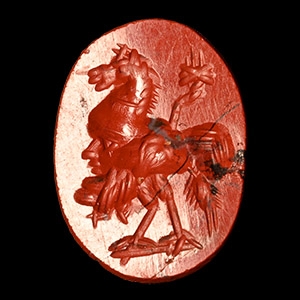
Roman Red Jasper Gemstone with Gryllos
2nd century A.D.Sold for (Inc. bp): £598
Oval in shape; the main subject of the gryllos a youth wearing a horse-head topped helmet, the body a ram's head holding an ear of corn in its mouth, the legs and tail that of a cockerel. 0.34 grams, 11 mm
Acquired 1980-2015. Ex Abelita family collection.
According to Plutarch, grylloi had apotropaic properties to ward off the evil eye. -
.jpg)
Late Roman Geometric Floor Mosaic
Circa 6th-8th century A.D.Sold for (Inc. bp): £3,250
Comprising three full and one partial octagon, each with two concentric rhombuses distinguished by different shades of yellow, white and light red, each with a central red dot; the border above with a band of red triangles; mounted on a reinforced backing board. 59 kg, 151 cm wide including frame
Acquired 1970s-1996. Property of a North American collector. London collection, 2016. Accompanied by an academic report by Dr Raffaele D'Amato. This lot has been checked against the Interpol Database of stolen works of art and is accompanied by search certificate number no.11920-207410.
The use of abstract and geometric motifs characterises the mosaic art of the Levant under the domination of Byzantium. Close ties can be identified between these rhomboidal figures with those of some of the famous Lebanese mosaics of Beit el Dine, or the mosaics of Tiberias and Hammat, which represent the last expression of Roman art in that area before the Islamic conquest. -
.jpg)
Roman Carnelian Composite Goddess Gemstone
Circa 2nd century A.D.Estimate: £500 - 700 (+bp*)
Opening Bid: £250
With a goddess with the attributes of Victory, Fortuna, Ceres and Iustitia standing wearing a crested helmet and holding a spear; supplied with a museum-quality impression. 1.11 grams, 17 mm
From the collection of a Swiss gentleman formed in Europe from 1970-1980s; thence by descent from the family in London.
