
Loading, please wait...
_900x900.jpg "Roman Bronze Furniture Applique")
_200x200.jpg "Roman Bronze Furniture Applique")
.jpg "Roman Bronze Furniture Applique")
LOT 0880
Roman Bronze Furniture Applique
1ST-2ND CENTURY A.D.
5/8 in. (4.75 grams, 16 mm).
Discoid in plan with low-relief facing bust.
ProvenanceAcquired 1980-2015.
Ex Abelita family collection.
TimeLine Auctions follows a vetting process to ensure the authenticity and legality of all items, reinforcing our commitment to integrity and responsible trading. Each antiquity, antique, and coin lot undergoes thorough examination by a vetting committee of at least ten external specialists, professional trade association members, scientists, and archaeologists: Our Vetting Process
AUCTIONS:
TimeLine is a leading auction house specialising in antiquities, ancient art, collectables, natural history, coins, medals, and books. Our auctions offer museums, collectors, historians, and enthusiasts the opportunity to acquire unique and historically significant pieces.
LOT 0880
Roman Bronze Furniture Applique
Estimate £150 - 200€170 - 230 (for guidance only)$200 - 270 (for guidance only)
-
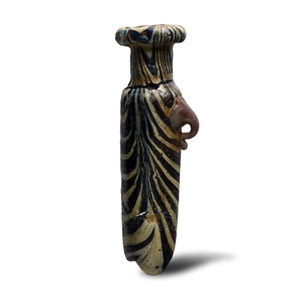
Eastern Roman Core-Formed Glass Alabastron Fragment
3rd-4th century A.D.Sold for (Inc. bp): £130
Modelled in blue and yellow glass with everted rim and loop handle to the shoulder; lower body and one handle absent. 20.29 grams, 64 mm
From the collection of a gentleman, acquired on the London art market in the 1990s. -
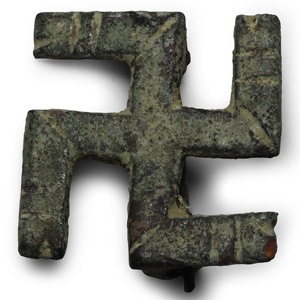
Roman Bronze Fylfot Brooch
3rd-4th century A.D.Sold for (Inc. bp): £117
With incised line decoration to the arms, pin-lugs, pin and catchplate to the reverse. 11.9 grams, 28 mm
Acquired in the mid 1980s-1990s. Private collection, Switzerland, thence by descent. Private collection, since the late 1990s. -
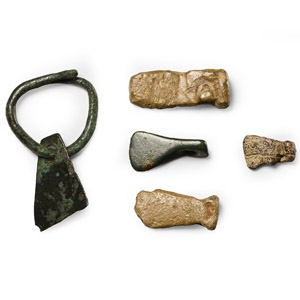
Roman Bronze and Lead Votive Axehead Collection
1st-4th century A.D.Sold for (Inc. bp): £65
Comprising: three lead axes; one bronze with rounded blade; one sheet-bronze with round-section loop. 15.8 grams total, 11-35 mm
Ex German art market, 2000s. Acquired from an EU collector living in London. From the collection of Surrey, UK, gentleman.
