
Loading, please wait...






LOT 0135
Roman Bronze Figure of Jupiter as Zeus Brontaios
1ST-2ND CENTURY A.D.
6 1/8 in. (384 grams total, 15.5 cm high including stand).
Depicted nude in contrapposto pose, his weight on his right leg, the left leg flexed and advancing; the hair and beard formed as a dense mass of curls; a full beard complementing his luxuriant curls; slender, muscular body with defined anatomical details; mounted on a custom-made display stand.
Provenancewith Münzen und Medaillen AG, Basel, 02.1976, lot 51.
Acquired in Europe in 2017.
Accompanied by copies of relevant pages of Münzen und Medaillen AG.
Accompanied by an academic report by Dr Raffaele D’Amato.
This lot has been checked against the Interpol Database of stolen works of art and is accompanied by search certificate number no.11792-206488.
See no.195a in Leventi, 'Zeus' in LIMC and nos.243-244 in Leventi and Machaira, 'Zeus' in LIMC; Christie's, Antiquities, New York, 4 June 2008, lot 255; the type is also visible in various statues of Zeus, for example an example in the Cabinet Des Medailles, published in Rolley, C.I., Monumenta Graeca et Romana; volume V : Les arts mineurs grecs; fascicule 1: Les Bronzes, Paris, 1967, pl.30; Rolland, H., Bronzes Antiques de Haute Provence, XVIII supplément à ‘Gallia’, Paris, 1965, no.15; Jongkees, J.H., Jongkees-Vos, M.F., in Varia Archaeologica, Ter Burg, 1971, pp.25ff.
FootnotesThe prototype of Zeus Brontaios, or Zeus the Thunderer, has been attributed to a Greek original by sculptor Leochares, c. 370-360 B.C. The statue was realised by Leochares to celebrate the founding of Megalopolis, in 371 B.C. The god would have held a sceptre in his left hand and cradled his thunderbolt in his right.
CONDITIONTimeLine Auctions follows a vetting process to ensure the authenticity and legality of all items, reinforcing our commitment to integrity and responsible trading. Each antiquity, antique, and coin lot undergoes thorough examination by a vetting committee of at least ten external specialists, professional trade association members, scientists, and archaeologists: Our Vetting Process
AUCTIONS:
TimeLine is a leading auction house specialising in antiquities, ancient art, collectables, natural history, coins, medals, and books. Our auctions offer museums, collectors, historians, and enthusiasts the opportunity to acquire unique and historically significant pieces.
-
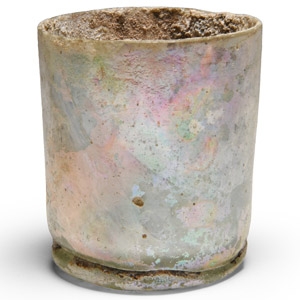
Roman Iridescent Glass Pyxis
1st-2nd century A.D.Estimate: £200 - 300 (+bp*)
Opening Bid: £100
Formed as a cylindrical body with flanged foot to base, straight rim, lid absent. 42.7 grams, 52 mm
Acquired 1980-2015. Ex Abelita family collection. -
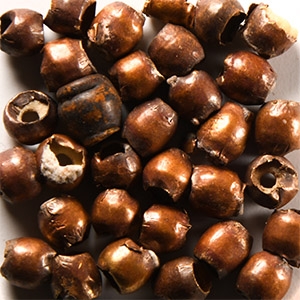
Roman Gold-Coloured Bead Group
1st century A.D. or laterSold for (Inc. bp): £39
Each bulbous-bodied sheet-gold bead with a slightly different profile and central hole for suspension. 5.18 grams total, 5-6 mm
UK gallery, early 2000s. -
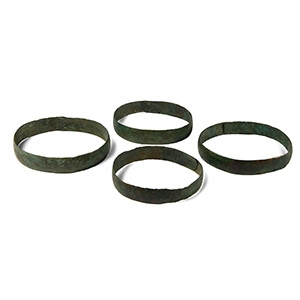
Roman Bronze Bracelet Group
1st-4th century A.D.Sold for (Inc. bp): £65
Comprising four flat-section bracelets with overlapping rounded terminals. 68 grams total, 61-71 mm
From the family collection of a Surrey gentleman since before 1960.
Bracelets were worn in Rome by ladies of rank, but it was considered a mark of effeminacy for civilian men to use such female ornaments (Suetonius, Caligula, 52; Nero, 30). The armillae (or psellia in Greek) were rings and bracelets worn by women in the Graeco-Roman world on both legs and arms. Homer mentions them (elikas) as being part of the hairstyle of the divine Aphrodite, thus giving an almost sacred character to these objects. There were different types, the most common consisting of a more or less thick metal wire, or a flat or cylindrical circle, like our examples.
