
Loading, please wait...
_900x900.jpg "Roman Bronze Figure of Hercules with Lion-Skin Headdress")
_200x200.jpg "Roman Bronze Figure of Hercules with Lion-Skin Headdress")
.jpg "Roman Bronze Figure of Hercules with Lion-Skin Headdress")
LOT 0118
Roman Bronze Figure of Hercules with Lion-Skin Headdress
2ND CENTURY B.C.
5 1/2 in. (443 grams total, 14 cm including stand).
Depicting Hercules in heroic nudity, standing with his legs slightly apart, the right leg set back and the left, slightly bent, advanced outward; his right arm raised, the forearm bent at a right angle, while the clenched hand originally held a club, now lost; the left arm extending forward and supporting the lion skin; the left hand, also clenched, probably held a further attribute; the stylised lion skin draped over the hero's head, terminating in two pointed flaps at either side, and fastened across the chest with the so-called 'Heracles knot', beneath which the forepaws of the lion are rendered with deeply incised claw; accompanied by a display stand.
ProvenanceAcquired in Germany before 2000s.
English private collection.
Bertolami Fine Art, London, Auction 85, 14 December 2020, no.11.
This lot has been checked against the Carabinieri Database of stolen works of art.
Cf. a closely comparable group of bronze figures is preserved in the Borghese Collection, Rome, these similarly fragmentary examples were restored in the eighteenth century by the goldsmith Luigi Valadier with additions in bronze and painted plaster and mounted on gilt wooden bases; see also Ciccarello, G., Statua di Ercole in assalto, Arte romana, inv. CCXCIX, Roma: Galleria Borghese, 2022, for the type.
FootnotesThe sculpture reproduces the iconographic type of the charging Hercules, a motif widely attested in ancient Italy, particularly in the Umbro-Sabellian region, and ultimately derived from the Magna Graecia artistic tradition. The widespread adoption of this iconographic scheme, repeated with only minor variations, reflects the development of local cults dedicated to the hero, who was at times assimilated to indigenous deities. It has also been suggested that this type ultimately derives from a bronze original identified as the Herakles Alexikakos, attributed to the Argive sculptor Hageladas, active between the late 6th and early 5th century B.C.
CONDITIONTimeLine Auctions follows a vetting process to ensure the authenticity and legality of all items, reinforcing our commitment to integrity and responsible trading. Each antiquity, antique, and coin lot undergoes thorough examination by a vetting committee of at least ten external specialists, professional trade association members, scientists, and archaeologists: Our Vetting Process
AUCTIONS:
TimeLine is a leading auction house specialising in antiquities, ancient art, collectables, natural history, coins, medals, and books. Our auctions offer museums, collectors, historians, and enthusiasts the opportunity to acquire unique and historically significant pieces.
LOT 0118
Roman Bronze Figure of Hercules with Lion-Skin Headdress
Sold for (Inc. bp): £780
-
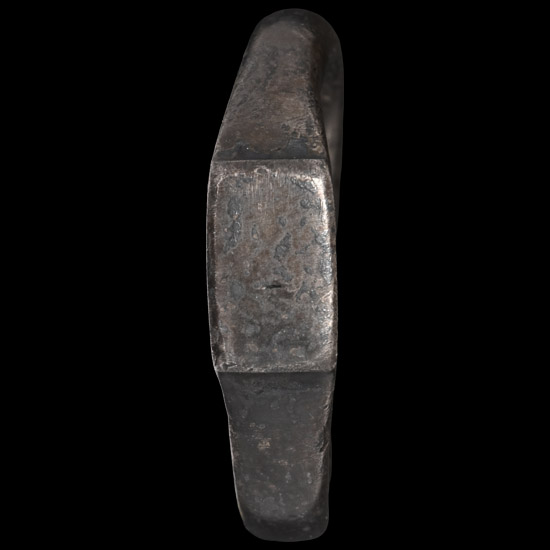
Roman Silver Ring with Rectangular Bezel
1st-4th century A.D.Sold for (Inc. bp): £111
Large ring with round-section hoop and a raised plain bezel. 8.29 grams, 26.69 mm overall, 21.01 x 18.98 mm internal diameter (approximate size British T 1/2, USA 9 3/4, Europe 21.89, Japan 21)
From the old family collection of a West Country, UK, lady; acquired by descent from her grandfather circa 2001. -
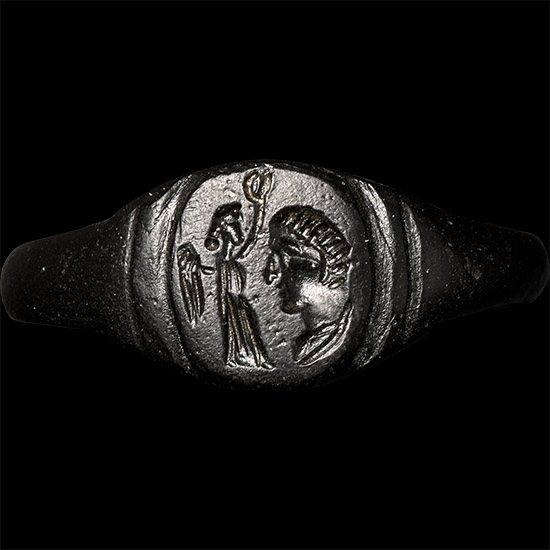
Late Roman Bronze Ring with Coronation of an Emperor
4th century A.D.Sold for (Inc. bp): £416
Large size ring with D-section hoop and an oval bezel with a profile bust of an emperor, standing Victory before him holding a wreath above his head. 3.03 grams, 24.96 mm overall, 22.06 mm internal diameter (approximate size British V, USA 10 1/2, Europe 23.77, Japan 22)
Ex German art market, 2000s. Acquired from an EU collector living in London. From the collection of a Surrey, UK, gentleman. -
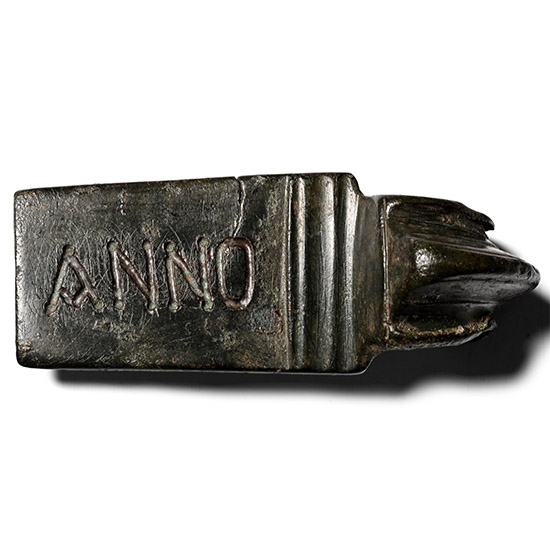
Roman Military Belt Clasp Engraved ANNO
Circa 3rd century A.D.Sold for (Inc. bp): £130
Comprising a rectangular plate with 'ANNO' in capital letters, and three rivets below, a large ribbed hook to one end. 23.2 grams, 58 mm
From a Wiltshire, UK, collection, 1990s.
