
Loading, please wait...
LOT 0661
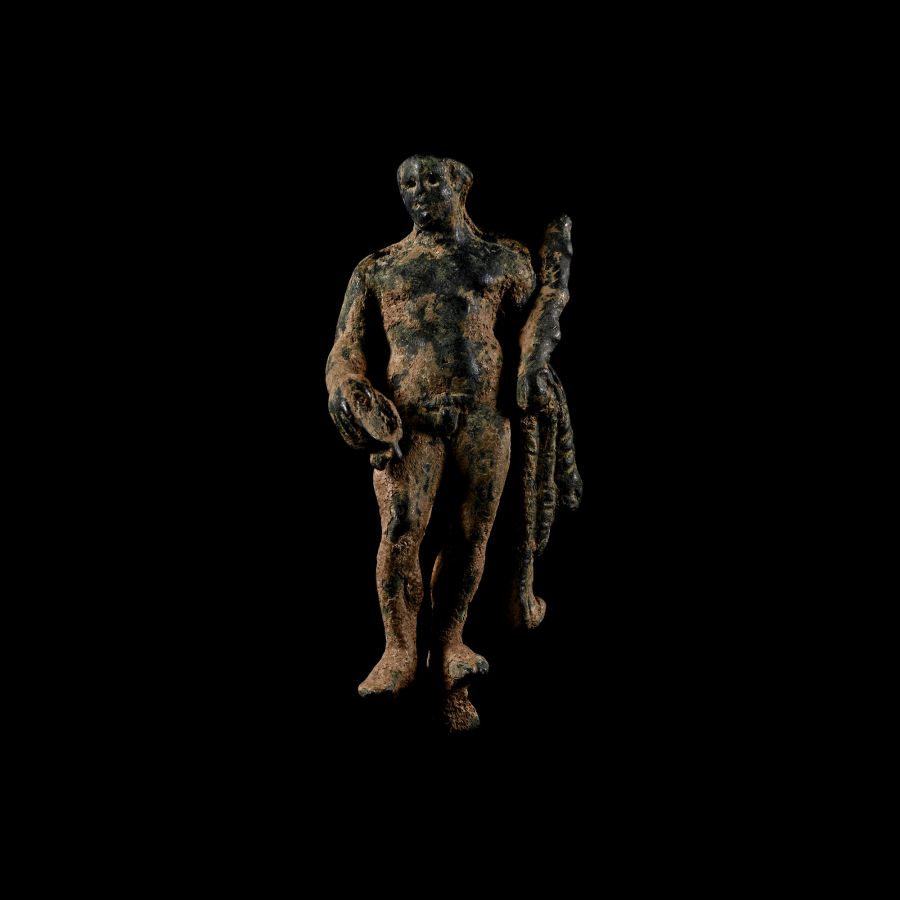
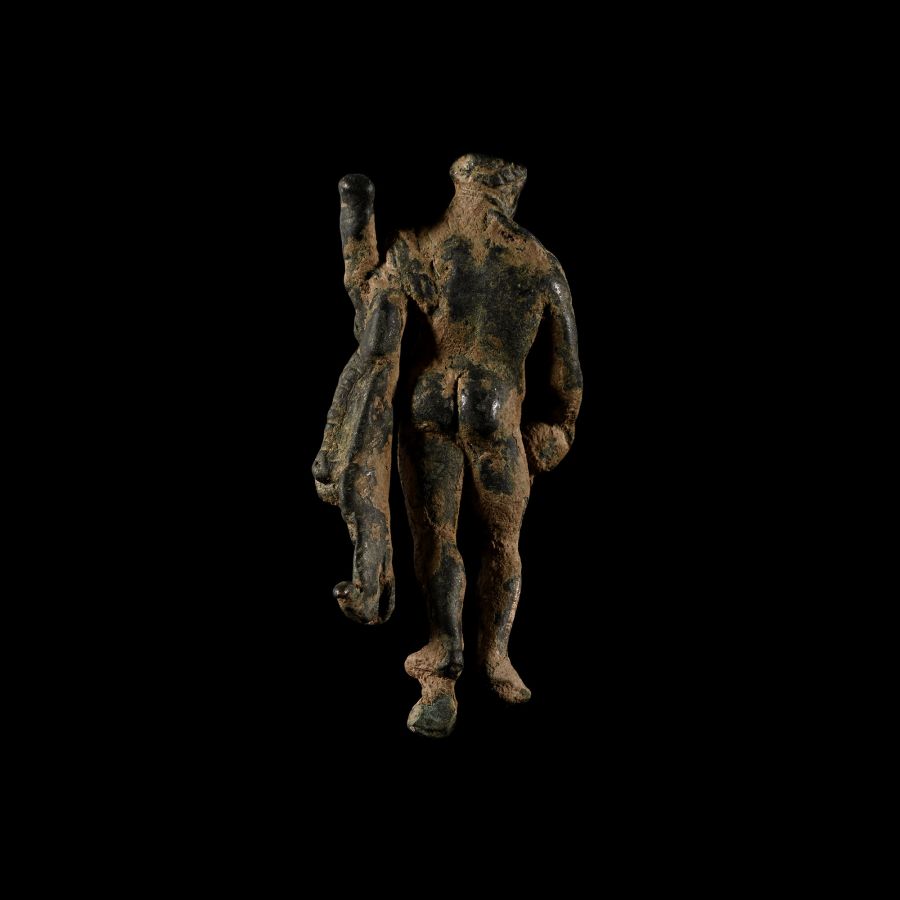
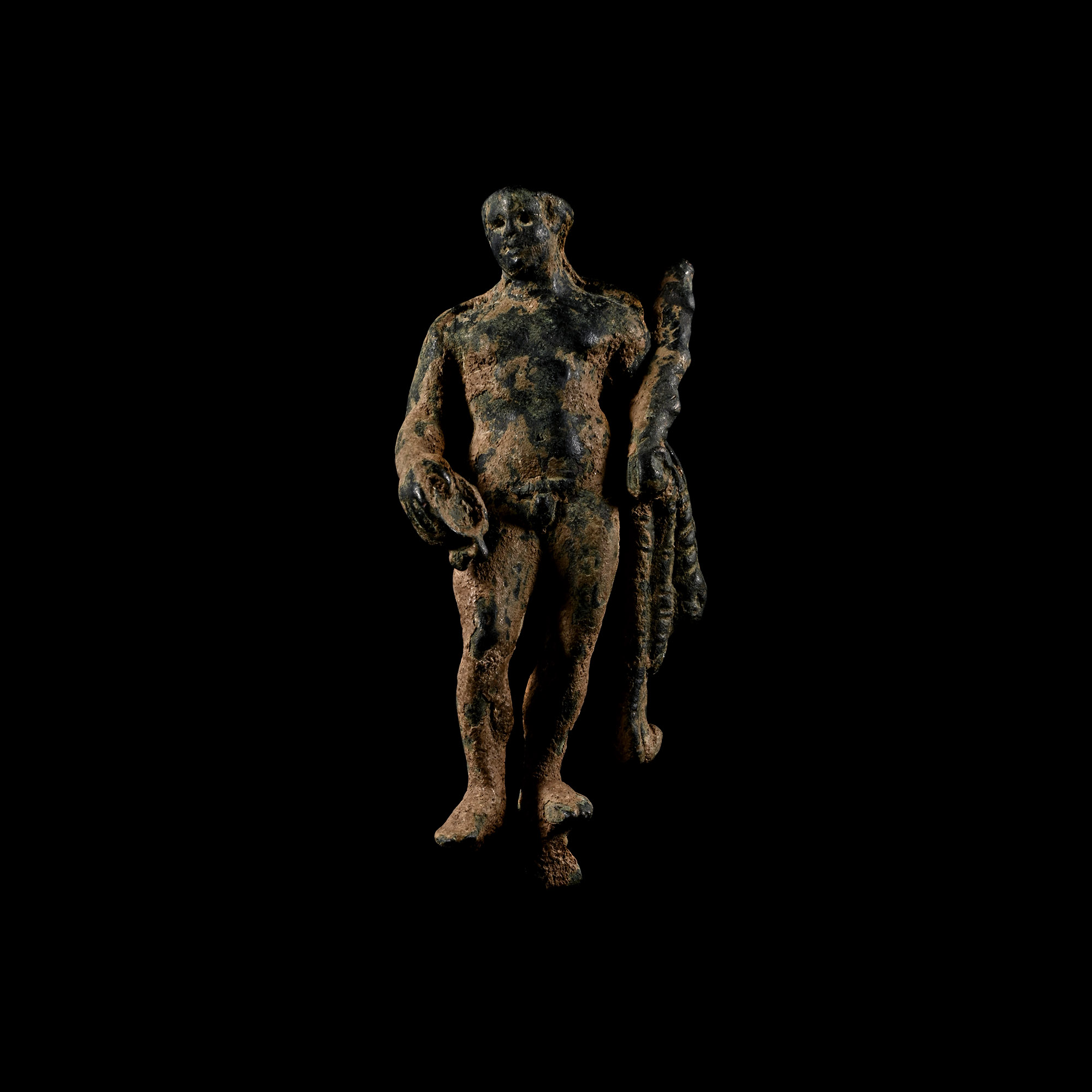
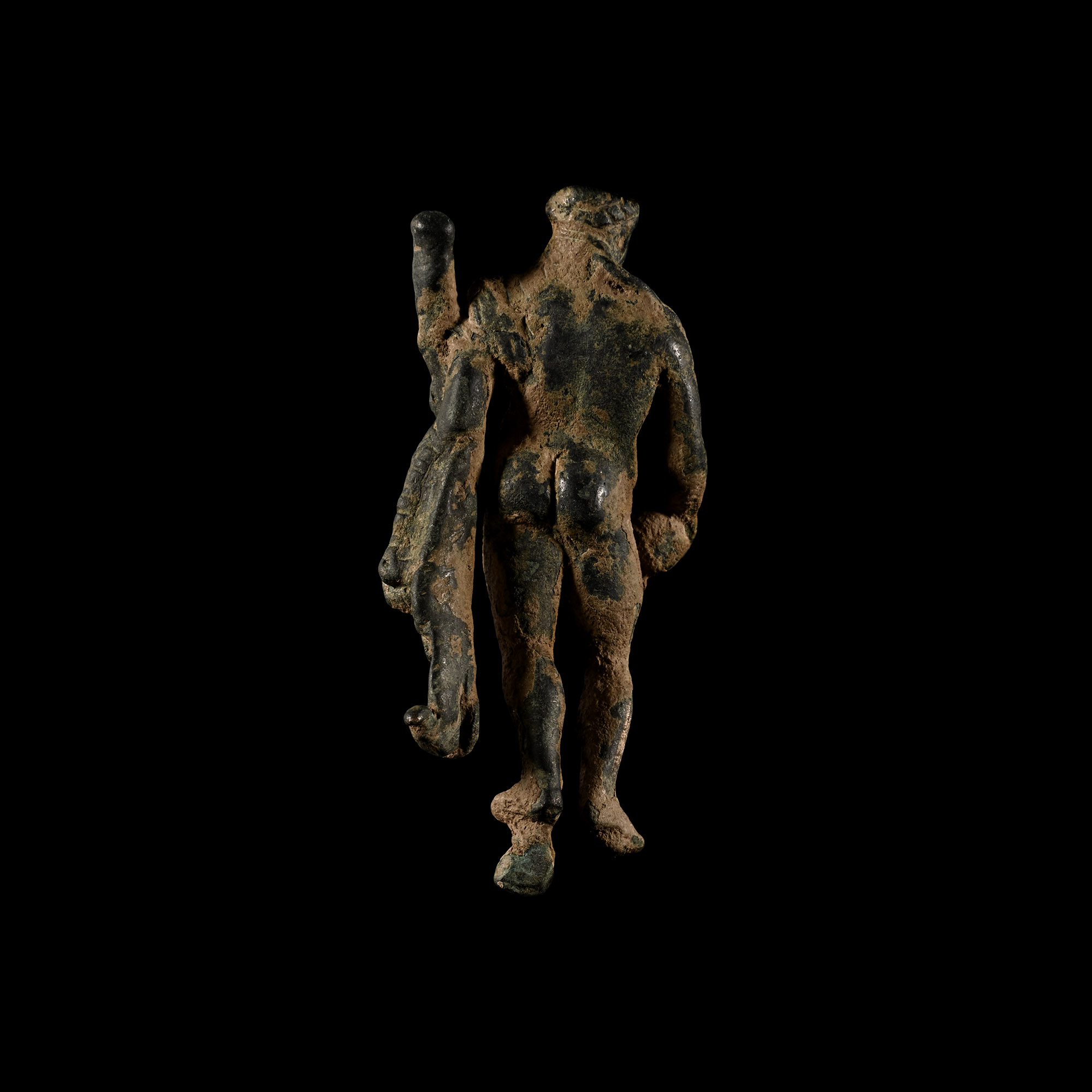
Roman Bronze Figure of Hercules Holding Club and Skyphos
2ND-3RD CENTURY A.D.
3 3/8 in. (115 grams, 86 mm).
Depicted nude in a contrapposto stance with the weight on his left leg, holding a club in the crook of his left hand with a lion-skin draped over the arm, and a cup in his right hand.
ProvenanceAcquired in the 1980s.
Private collection, Switzerland, thence by descent.
Private collection, since the late 1990s.
This lot has been checked against the Interpol Database of stolen works of art and is accompanied by search certificate number no.12615-234681.
Cf. Rolland, H., Bronzes Antiques de Haute Provence, Paris, 1965, item 105, for the type.
FootnotesThis well-proportioned bronze statuette, perhaps of Gallo-Roman origin, was likely made for a private lararium, the domestic shrine found in many Roman homes. Although provincial in style, it is carefully modelled and has a strong presence. Unlike many similar figures, Hercules is shown here without a beard, and the upper part of the head was probably once covered by a laurel crown. Known to the Greeks as Herakles, Hercules was one of the most admired heroic figures in the Roman world, celebrated for his strength, endurance, and ability to overcome immense challenges. His famous Twelve Labours made him a lasting symbol of perseverance and triumph, and small bronze figures such as this would have brought not only mythological meaning into the home, but also a sense of protection, resilience, and personal devotion.
CONDITIONTimeLine Auctions follows a vetting process to ensure the authenticity and legality of all items, reinforcing our commitment to integrity and responsible trading. Each antiquity, antique, and coin lot undergoes thorough examination by a vetting committee of at least ten external specialists, professional trade association members, scientists, and archaeologists: Our Vetting Process
AUCTIONS:
TimeLine is a leading auction house specialising in antiquities, ancient art, collectables, natural history, coins, medals, and books. Our auctions offer museums, collectors, historians, and enthusiasts the opportunity to acquire unique and historically significant pieces.
LOT 0661
Roman Bronze Figure of Hercules Holding Club and Skyphos
Sold for (Inc. bp): £1,235
-
Roman Gemstone with Minerva
2nd century A.D.Estimate: £150 - 200 (+bp*)
Opening Bid: £70
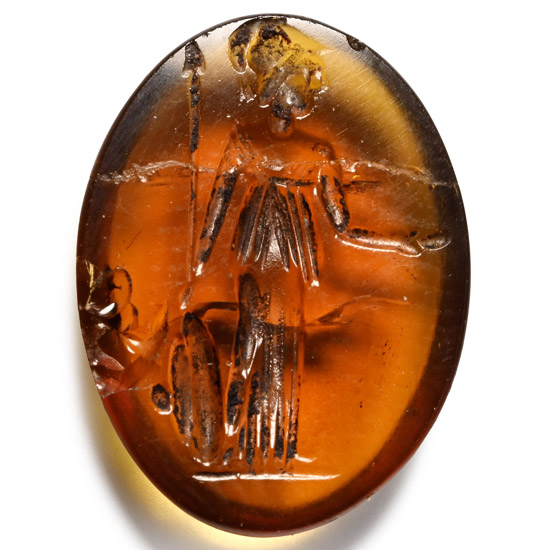
Plano-convex in section with incuse image of Minerva standing with one hand extended, holding her spear and shield. 1.18 grams, 17 mm
Acquired 1970s-1996. Property of a North American collector. London collection, 2016.
In Rome, the Athena Promachos type occurs on imperial silver medallions of Domitian (struck in 92 AD), since Minerva was his personal protector. On gems, it became very common from the end of the 1st century BC onwards, even on the magical gemstones. -

Very Large Roman Terracotta Flask
Circa 1st century A.D.Sold for (Inc. bp): £124
Piriform in profile with broad flared neck and everted rim at the mouth. 606 grams, 26 cm
From the private collection of Mr Brian Edwards, New Malden, Surrey, UK, formed from the late 1970s-early 1980s; thence by descent. Accompanied by the original collector's data sheet with reference no.A25. -
Roman Bronze Chariot Mount with Bust of Silenus
1st-2nd century A.D.Estimate: £15,000 - 20,000 (‡+bp*)
Opening Bid: £7,500
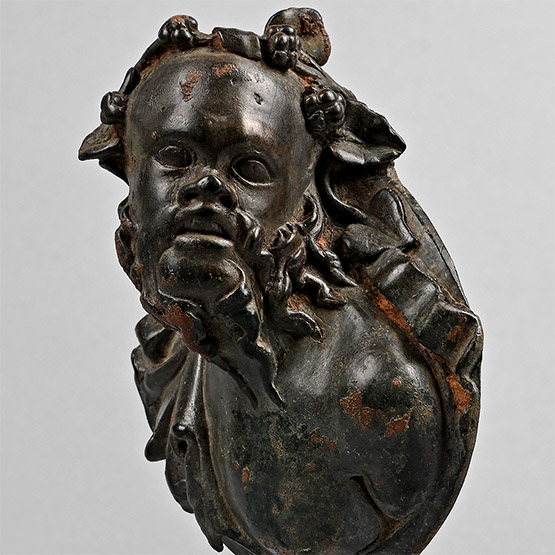
Ovoid in profile with hollow reverse, modelled in high-relief with pallium tied at his right shoulder and garland draped across his shoulders and wreath of ivy around his brow; mounted on a custom-made stand. 435 grams total, 13.5 cm including stand
Private Swiss collection, before 1976. with Bonhams Antiquities, London, 3rd October 2000, no.202. Private European collection. Accompanied by a copy of an Art Loss Register certificate, no.S00038120. Accompanied by copies of the relevant Bonhams catalogue pages. Accompanied by an academic report by Dr Raffaele D'Amato. This lot has been checked against the Interpol Database of stolen works of art and is accompanied by search certificate number no.13216-249243.
This type of mount was probably used as bridle holders and placed near the driver’s seat, on the wagon platform or as a central decoration on the back of the wagon.
