
Loading, please wait...
LOT 0146
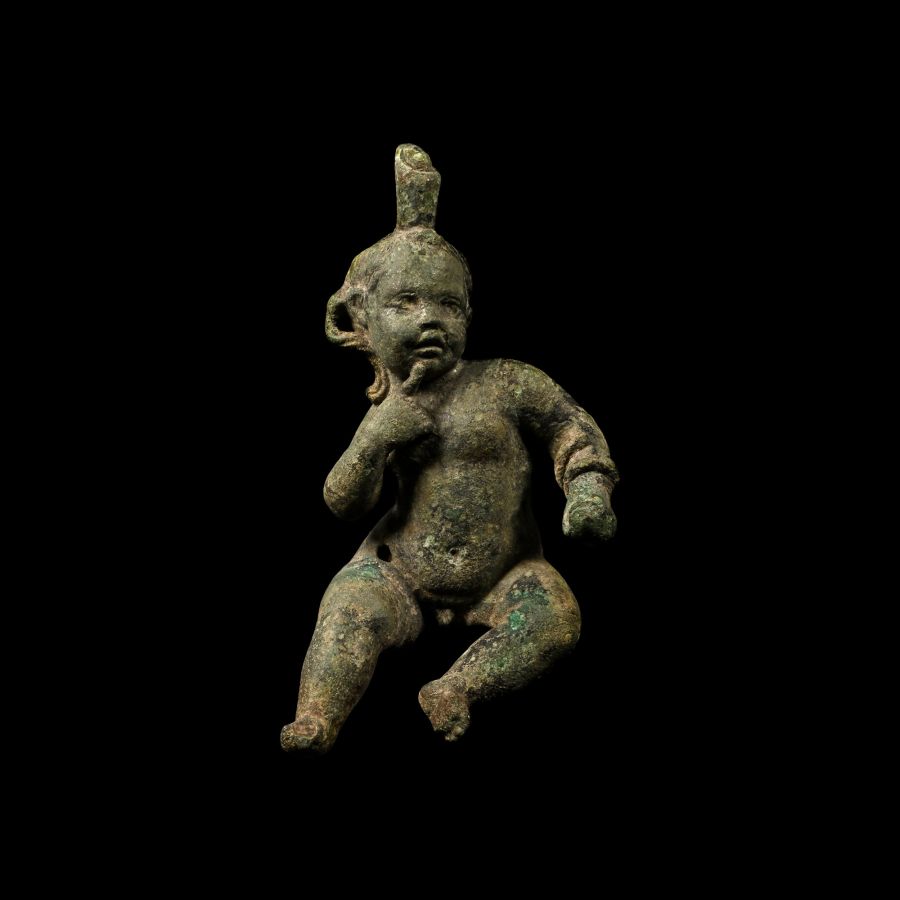
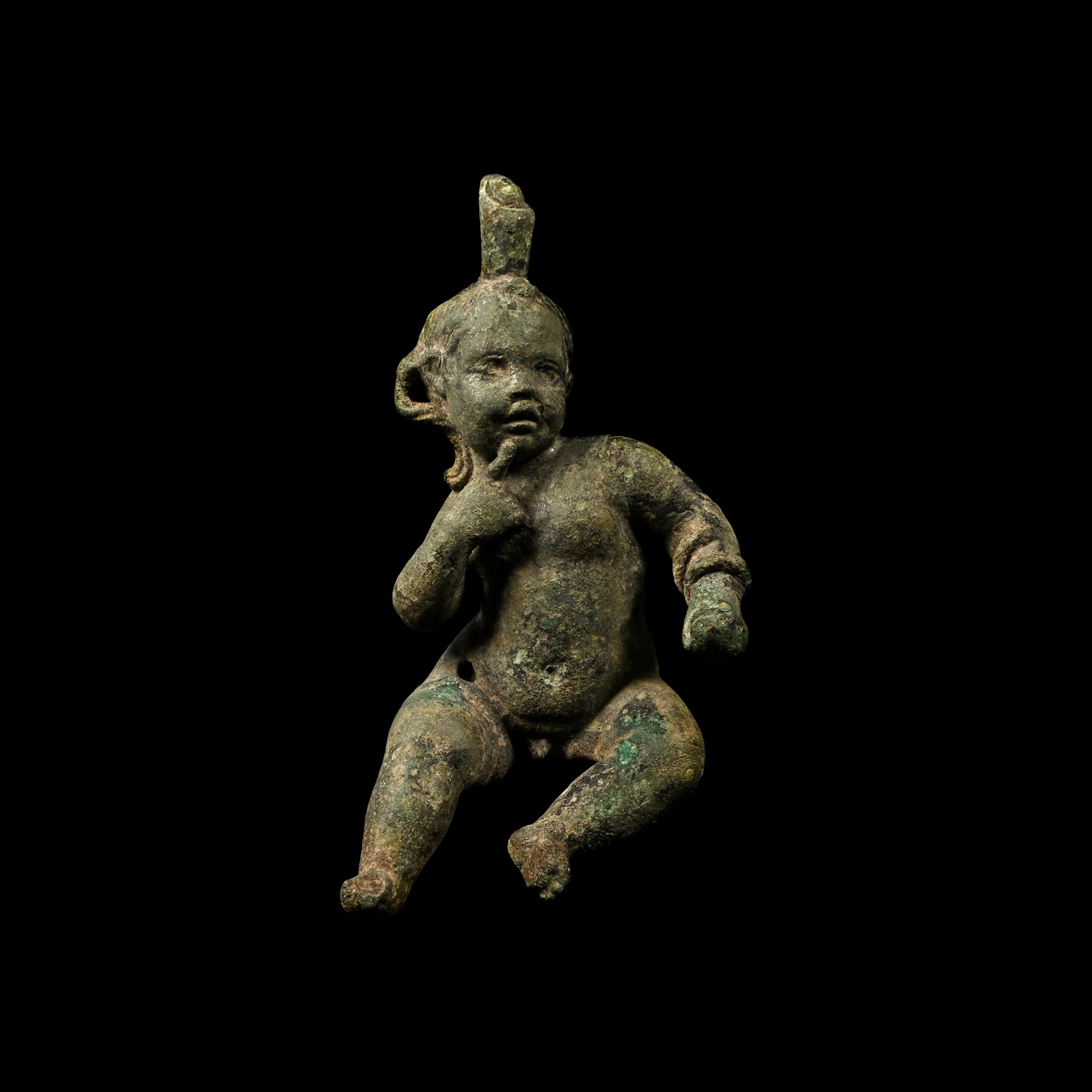
Roman Bronze Figure of Harpocrates, the God of Secrecy
1ST CENTURY A.D.
2 3/4 in. (145 grams, 72 mm).
Modelled in the round, sitting with miniature double-crown, serpent arm-ring on left wrist, sidelock; fixing socket to right thigh.
ProvenancePrivate collection, Me. A., Florida, USA, early 1990s.
European private collection, acquired in Germany, September 2000.
This lot has been checked against the Interpol Database of stolen works of art and is accompanied by a search certificate no.12683-234609.
See Swan Hall, E., 'Harpocrates and Other Child Deities in Ancient Egyptian Sculpture' in Journal of the American Research Center in Egypt, Vol. 14, 1977, pp.55-58, fig.1, pl.XXVII; fig.4, for full discussion.
CONDITIONTimeLine Auctions follows a vetting process to ensure the authenticity and legality of all items, reinforcing our commitment to integrity and responsible trading. Each antiquity, antique, and coin lot undergoes thorough examination by a vetting committee of at least ten external specialists, professional trade association members, scientists, and archaeologists: Our Vetting Process
AUCTIONS:
TimeLine is a leading auction house specialising in antiquities, ancient art, collectables, natural history, coins, medals, and books. Our auctions offer museums, collectors, historians, and enthusiasts the opportunity to acquire unique and historically significant pieces.
LOT 0146
Roman Bronze Figure of Harpocrates, the God of Secrecy
Estimate £1,500 - 2,000€1,740 - 2,320 (for guidance only)$2,030 - 2,700 (for guidance only)
Opening Bid
£833 (EUR 967; USD 1,125) ‡+BP*
-
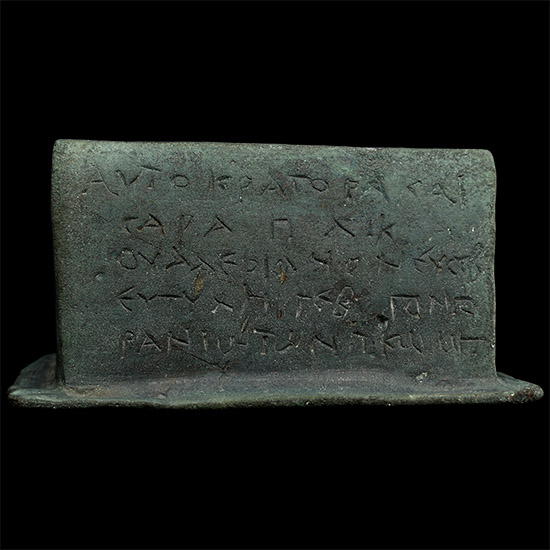
Roman Bronze Statue Plinth with Inscription for Publius Licinius Valerianus
2nd-3rd century A.D.Estimate: £2,000 - 3,000 (‡+bp*)
Opening Bid: £1,175
Hollow rectangular plinth with everted basal rim; hastily incised, five-line Greek inscription on one side: 'Αυτοκρατορα Και/σαρα Π Λικ/Ουαλεριανον ευσεβ/ευτυχη Σεβ 50-Ν-50 (?)/ρανιωτων η κωμ(ι)τ' (translated as 'To the Autokrator and Emperor P(ublius) Licinius Valerianus, pious and good-fortuned Augustus [? ...]'. 1.04 kg, 12.8 cm
with Hirsch Auction 246, 19-20 September 2006, no.838. This lot has been checked against the Interpol Database of stolen works of art and is accompanied by search certificate no.13547-263147.
Probably the base of a statuette of the Roman Emperor Publius Licinius Valerianus (r. 253–260 A.D.) presumably used by devotees of the imperial cult. Marks made by the standing statuette are still visible on top of the plinth. The number and last line incomprehensible. -
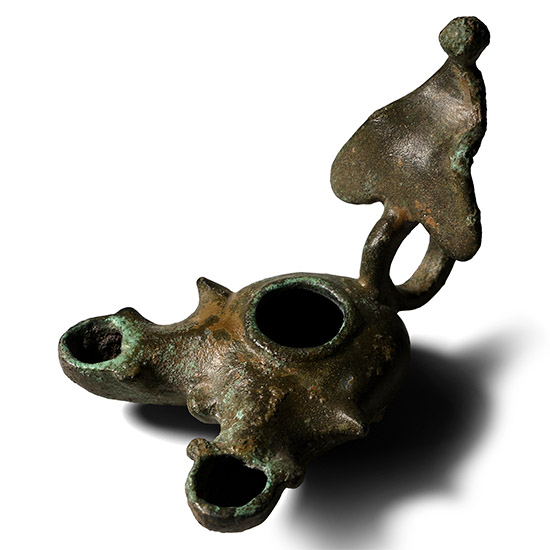
Roman Bronze Double-Spouted Oil Lamp
Circa 1st-2nd century A.D.Estimate: £300 - 400 (+bp*)
Opening Bid: £150
A hollow-formed bronze oil lamp with two scooped nozzles, a ring handle with a heart-shaped finial. 140 grams, 10.3 cm
London gentleman's collection, 1970-1990s, by descent. -
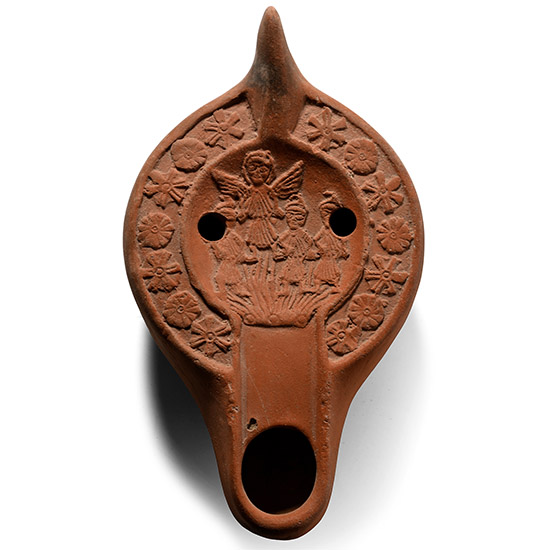
Late Roman Terracotta Oil Lamp with The Fiery Furnace
5th-6th century A.D.Estimate: £200 - 300 (+bp*)
Opening Bid: £5
With stub handle to the rear, wide rim with rosettes, the discus with an angel above three young men: Shadrach, Meshach, and Abednego with flames below; a low basal ring. 175 grams, 14 cm
From the private collection of Peter Clayton, FCILIP, Dip, Arch, FSA, FRNS, Hemel Hempstead, Hertfordshire, UK; formed since the late 1950s.
The scene is a depiction of the story from chapter three of the Book of Daniel. The three Jewish men, Hananiah, Mishael, and Azariah, were thrown into a fiery furnace by Nebuchadnezzar II, King of Babylon, for refusing to bow to the king's image. After having the three men thrown into the furnace, to his astonishment, Nebuchadnezzar saw four men walking unharmed amidst the fire, describing the fourth figure as being 'like the Son of God'.
