
Loading, please wait...


LOT 0721
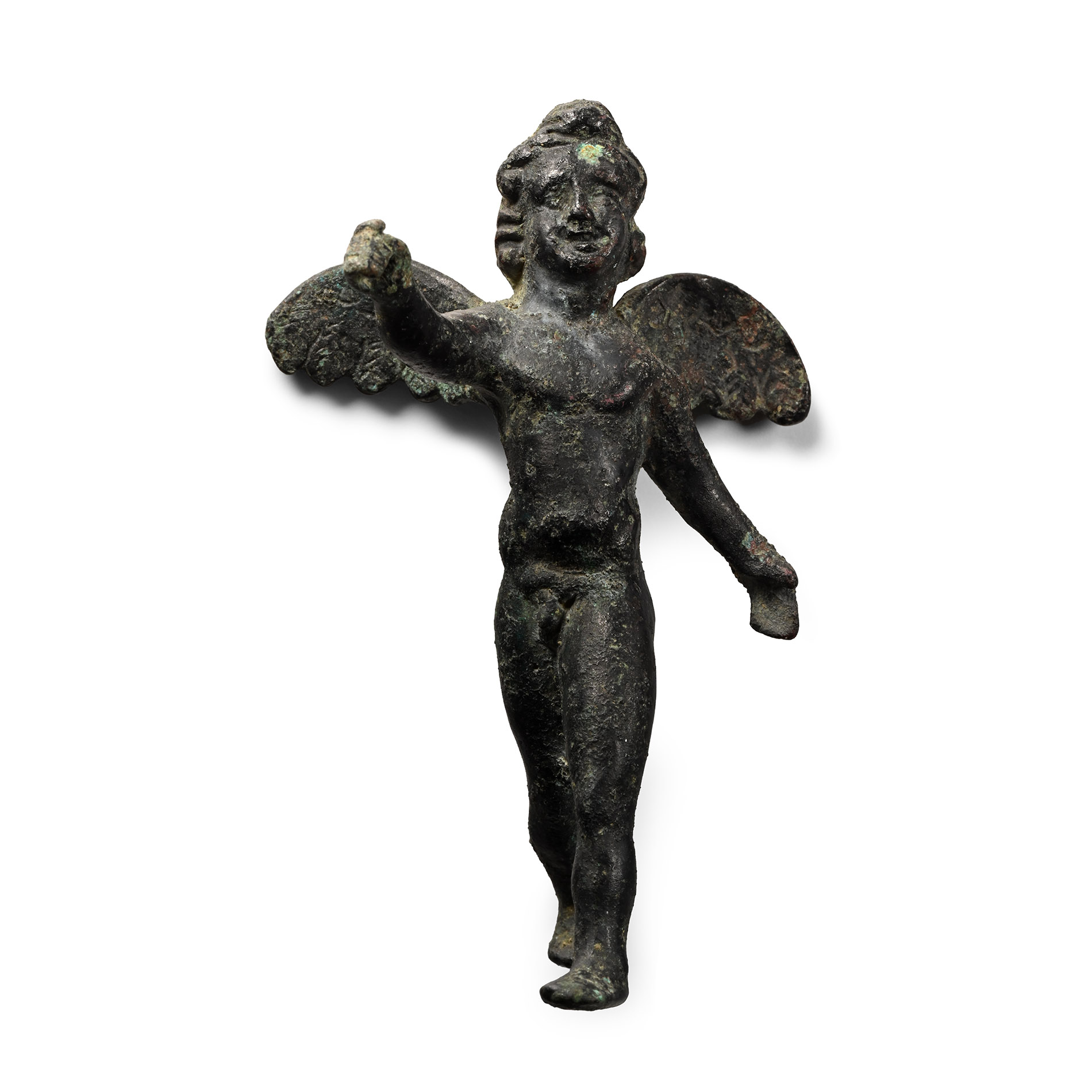
Roman Bronze Eros Statuette
2ND-3RD CENTURY A.D.
3 in. (76 grams, 76 mm).
Modelled in the round, nude, striding forwards with his wings spread, his right hand reaching out to grasp a bow (absent), and left hand extending to the rear; feather detailing to the wings, piled hairstyle. [No Reserve]
ProvenanceEx German art market, 2000s.
Acquired from an EU collector living in London.
From the collection of Surrey, UK, gentleman.
Cf. Rolland, H., Bronzes Antiques De Haute Provence, Paris, 1965, items 112-118, for type.
CONDITIONTimeLine Auctions follows a vetting process to ensure the authenticity and legality of all items, reinforcing our commitment to integrity and responsible trading. Each antiquity, antique, and coin lot undergoes thorough examination by a vetting committee of at least ten external specialists, professional trade association members, scientists, and archaeologists: Our Vetting Process
AUCTIONS:
TimeLine is a leading auction house specialising in antiquities, ancient art, collectables, natural history, coins, medals, and books. Our auctions offer museums, collectors, historians, and enthusiasts the opportunity to acquire unique and historically significant pieces.
-
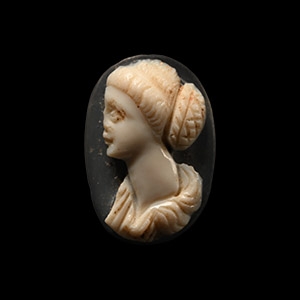
Roman Carved Cameo of a Female
Late 2nd century A.D.Sold for (Inc. bp): £234
Ellipsoid in plan with reserved female profile portrait bust, the hair dressed in a chignon. 0.64 grams, 13 mm
Acquired in the mid 1980s-1990s. From the family collection of Mr S.A., Switzerland, thence by descent. Private collection since the late 1990s. -
Roman Bronze Head-Shaped Weight
3rd century A.D.Sold for (Inc. bp): £143
Formed as youthful head with curly hair framing the face, loop to the top with ferrous remains. 55.1 grams, 50 mm
Acquired in the mid 1980s-1990s. Private collection, Switzerland, thence by descent. Private collection, since the late 1990s. -
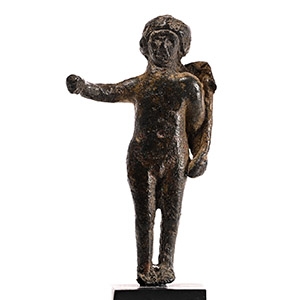
Roman Bronze Statuette of Mercury
3rd century A.D.Sold for (Inc. bp): £221
Standing erect with right hand extended sideways, left arm hanging at his side supporting a caduceus; mounted on a custom-made stand. 48 grams total, 89 mm including stand
From a collection acquired on the UK art market from various auction houses and collections mostly before 2000. From an important Cambridgeshire estate; thence by descent.
Although the statuette seems have been realised in a provincial Gallo-Roman workshop, as demonstrated by the inequality of the treatment of the anatomical dimensions, the movement of the body and head positioned to the right, derive from models of the Alexandrian type.
