
Loading, please wait...
_900x900.jpg "Roman Bronze Eagle Statuette")
_200x200.jpg "Roman Bronze Eagle Statuette")
.jpg "Roman Bronze Eagle Statuette")
LOT 0828
Roman Bronze Eagle Statuette
EASTERN EMPIRE, 3RD-4TH CENTURY A.D.
2 in. (46 grams, 52 mm).
Modelled in the round with a short tail and exaggerated beak; sockets to the eyes to accept glass inserts. [No Reserve]
ProvenanceFrom the collection of a gentleman, acquired on the London art market in the 1990s.
LiteratureCf. Durham, E., The Silchester Bronze Eagle and Eagles in Roman Britain in Archaeological Journal, 170, 2013, pp.78-105.
CONDITIONTimeLine Auctions follows a vetting process to ensure the authenticity and legality of all items, reinforcing our commitment to integrity and responsible trading. Each antiquity, antique, and coin lot undergoes thorough examination by a vetting committee of at least ten external specialists, professional trade association members, scientists, and archaeologists: Our Vetting Process
AUCTIONS:
TimeLine is a leading auction house specialising in antiquities, ancient art, collectables, natural history, coins, medals, and books. Our auctions offer museums, collectors, historians, and enthusiasts the opportunity to acquire unique and historically significant pieces.
-
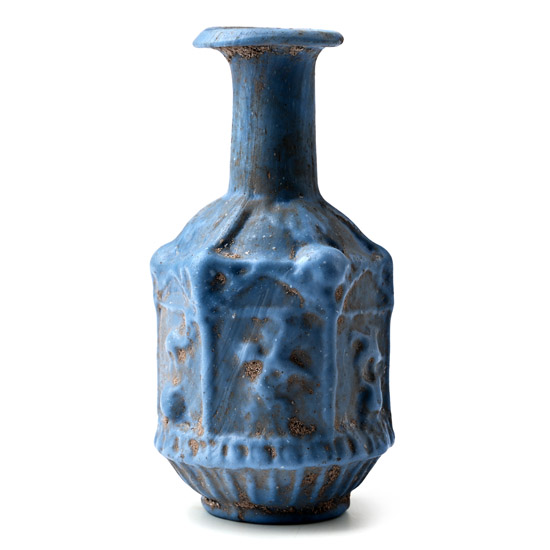
Roman Sidonian Opaque Light Blue Glass Flask
1st century A.D.Sold for (Inc. bp): £3,640
Hexagonal in plan with tall tubular neck and flared and folded rim, disc base with moulding seams; broad sloping shoulder above a sidewall of panels each with a low-relief avian image (bird in flight, bird perching on a branch, etc.). 31 grams, 80 mm
Ex private collection, Israel. Acquired from Archaeological Center, Auction 60, no.204. Private collection. Accompanied by a copy of the relevant Archaeological Center online catalogue page. This lot has been checked against the Interpol Database of stolen works of art and is accompanied by a search certificate number no.12530-232177.
Roman opaque glass attributed to the Sidonian workshops represents one of the most technically sophisticated achievements of early Imperial glassmaking. Produced in the Levant, long a centre of innovation, the workshops at Sidon were renowned for their mastery of colour chemistry, using controlled additions of antimony-and-tin-based opacifiers to create surfaces resembling fine stone or enamel. These vessels were not merely utilitarian objects but markers of status, admired in antiquity for their vibrant hues and precision of manufacture. Examples such as the present piece illustrate the transition of glass from a luxury comparable to carved hardstone to an art form that could be shaped, coloured, and refined with unprecedented freedom, underscoring the pivotal role of Sidon in the evolution of Roman glass technology. -
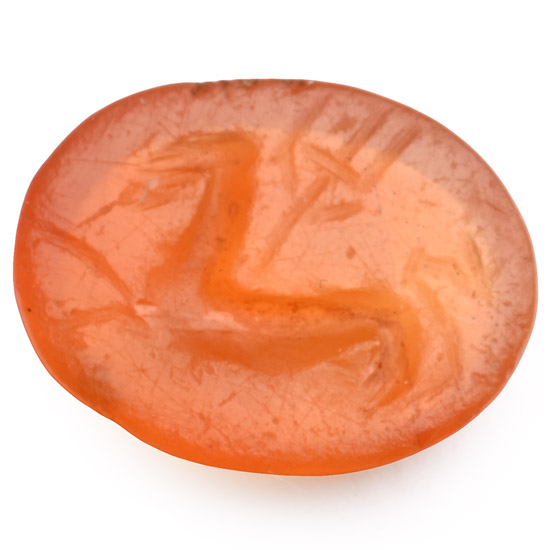
Roman Carnelian Gemstone with Hippocamp
2nd-3rd century A.D.Sold for (Inc. bp): £104
With intaglio hippocamp supporting a trident; supplied with a museum-quality impression. 0.23 grams, 9.68 mm
From the private collection of a European gentleman (1942-2024), formed since the 1970s. -
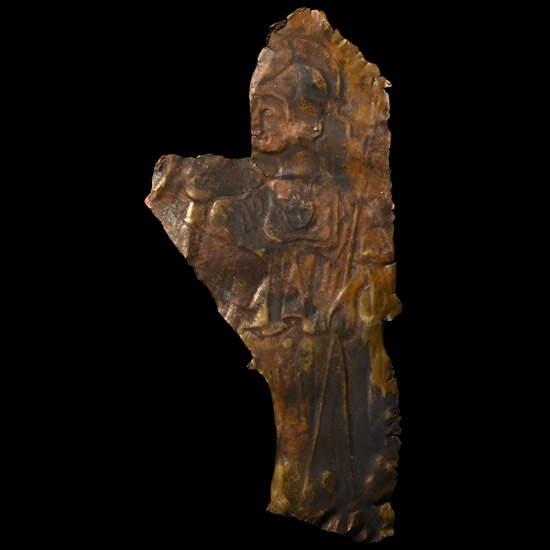
Roman Bronze Appliqué with Athena and Gorgon
Circa 4th century A.D.Sold for (Inc. bp): £130
Irregular sheet-bronze fragment with repoussé figure of Athena standing wearing a long robe and gripping the shaft of a spear, wearing a Corinthian-style crested helmet and sporting a gorgoneion at the chest. 1.67 grams, 83 mm
From the collection of a Buckinghamshire, UK, collector established from the earlier 1960s.
