
Loading, please wait...
_900x900.jpg "Roman Bronze Eagle-Handled Knife")
_200x200.jpg "Roman Bronze Eagle-Handled Knife")
.jpg "Roman Bronze Eagle-Handled Knife")
LOT 1053
Roman Bronze Eagle-Handled Knife
1ST-4TH CENTURY A.D.
5 3/4 in. (37 grams, 14.5 cm).
Comprising a curved single-edged iron blade; openwork bronze handle with a standing eagle finial; an open groove to the back of the eagle and handle to accept the folding blade. [No Reserve]
ProvenanceEx California, USA, collection formed since the late 1960s.
European art market before the late 1990s.
TimeLine Auctions follows a vetting process to ensure the authenticity and legality of all items, reinforcing our commitment to integrity and responsible trading. Each antiquity, antique, and coin lot undergoes thorough examination by a vetting committee of at least ten external specialists, professional trade association members, scientists, and archaeologists: Our Vetting Process
AUCTIONS:
TimeLine is a leading auction house specialising in antiquities, ancient art, collectables, natural history, coins, medals, and books. Our auctions offer museums, collectors, historians, and enthusiasts the opportunity to acquire unique and historically significant pieces.
-
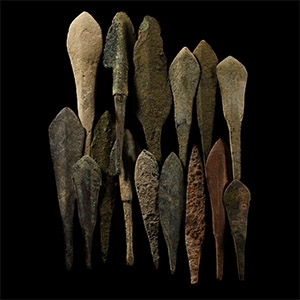
Western Asiatic Bronze Arrowhead Group
2nd-1st millennium B.C.Estimate: £100 - 140 (+bp*)
Opening Bid: £50
Comprising fifteen tanged examples, including one slender arrowhead in iron. 112 grams total, 44-75 mm
Acquired 1980-2015. Ex Abelita family collection. -
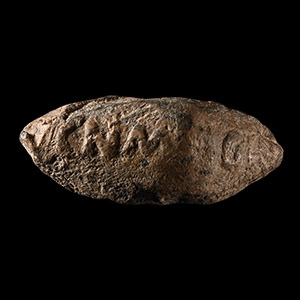
Roman 'Pompey the Great' Lead Slingshot
1st century B.C.Sold for (Inc. bp): £286
Biconical lead slingshot (glans) with inscription in Latin letters 'CN' (Cneius) 'MAG' (Magnus) on one side, and 'IMP' for 'IMPERATOR' (victorious general) to the other side, i.e Gnaeus Pompeius Magnus Imperator (Pompey the Great the victorious general). 47 grams, 39 mm
Ex M.Cummings, UK, 1990s.
The shot (Völling type 1C) is marked with the abbreviated name of Gnaeus Pompey; it was used in quantity at the Battle of Monda (or Munda) against Julius Caesar, 17th March 45 BC. The projectiles were made of different materials: lead (glandes) or in pottery or stone (lapides missiles). Sometimes they were signed with the name of the general, like our specimen. -
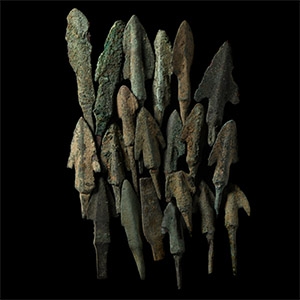
Western Asiatic Bronze Arrowhead Group
10th-9th century B.C.Sold for (Inc. bp): £117
Comprising mainly tanged arrowheads, the most of them having large elongated triangular blades and raised midrib, sharp central groove, cylindrical or squared stem for the shaft, barbed shoulders and convex sides; others with lanceolate head and rounded shoulders with long tang and foliate-section. 103 grams total, 29-68 mm
Acquired 1980-2015. Ex Abelita family collection.
The most of these arrowheads, having a lozenge-section midrib with thin blades filed sharp at the edges, are typical of the early Iron Age in Luristan. These arrowheads seem to belong to the type V, subcategory types A, C and D according to the classification of Khorasani and Negahban. In the four categories of triangular bronze arrowheads from Luristan, Marlik, and Northern Iran individuated by Negahban, subtypes C and D of type V are larger arrow or javelin heads, C with barbed shoulders and D with round shoulders. Subtype A is substantially similar to C, but smaller. Similar arrowheads are also visible in the Western Iberian and Balkan cultures in the Early Iron Age.
