
Loading, please wait...


LOT 0821
Roman Bronze Double Horse Brooch
3RD-4TH CENTURY A.D.
1 5/8 in. (10.4 grams, 40 mm).
Formed with two curving horse heads at each end, the legs forming the catchplate and pin lug. [No Reserve]
ProvenanceEx German art market, 2000s.
Acquired from an EU collector living in London.
From the collection of a Surrey, UK, gentleman.
TimeLine Auctions follows a vetting process to ensure the authenticity and legality of all items, reinforcing our commitment to integrity and responsible trading. Each antiquity, antique, and coin lot undergoes thorough examination by a vetting committee of at least ten external specialists, professional trade association members, scientists, and archaeologists: Our Vetting Process
AUCTIONS:
TimeLine is a leading auction house specialising in antiquities, ancient art, collectables, natural history, coins, medals, and books. Our auctions offer museums, collectors, historians, and enthusiasts the opportunity to acquire unique and historically significant pieces.
-
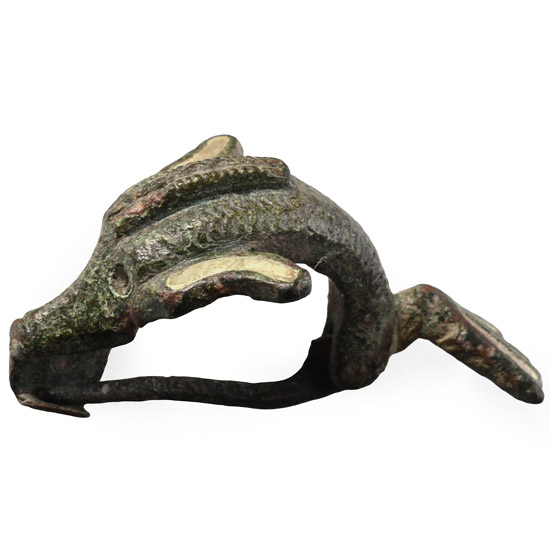
Roman Enamelled Bronze Dolphin Brooch
2nd century A.D.Sold for (Inc. bp): £312
Bow brooch formed as a leaping dolphin with notched dorsal fin and splayed pectoral fins with enamel, the body with notched decoration, fanned tail with red enamel, recessed eyes and a catchplate beneath the nose. 13.4 grams, 42 mm
From the private coin collection of a West London, UK, gentleman, formed since the mid 1980s. -

Roman Fresco Wall Plaster Collection
1st century A.D.Sold for (Inc. bp): £416
Fragments of wall plaster with rendered surface painted with mainly Pompeii red, pale blue and white detailing; some with impression of timber laths to the reverse. 475 grams total, 59-95 mm
Acquired in the 19th century. Ex Jeger collection, Switzerland. UK gallery, early 2000s.
These small fragments, for analogies with the fragments of Pompeii, seem to belong to the second style of Roman painting, red panels representing highlight and shadow, decorated with vegetal interlaces. Some panels were probably framed by a red grenade fillet. A fragment shows alternate blue and red colour over a cream background, maybe pertinent to a socle. -
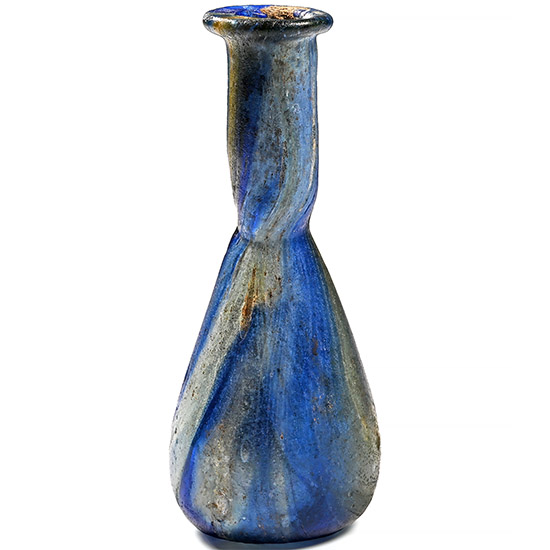
Roman Marbled Blue Glass Toilet Bottle
1st-2nd century A.D.Sold for (Inc. bp): £1,820
An iridescent unguentarium with piriform body, tubular neck with everted rolled rim. 19.7 grams, 83 mm
Acquired on the European art market in 2001.
This typology was produced mainly in Egypt (Karanis class XIII.B). They were characteristic of the Eastern Mediterranean as well, and characterised by the irregular curved depression on the underside of the base and by the narrow cylindrical neck with slight constriction at the bottom.
