
Loading, please wait...
_900x900.jpg "Roman Bronze Dancing Sol Statuette")
_200x200.jpg "Roman Bronze Dancing Sol Statuette")
.jpg "Roman Bronze Dancing Sol Statuette")
LOT 0123
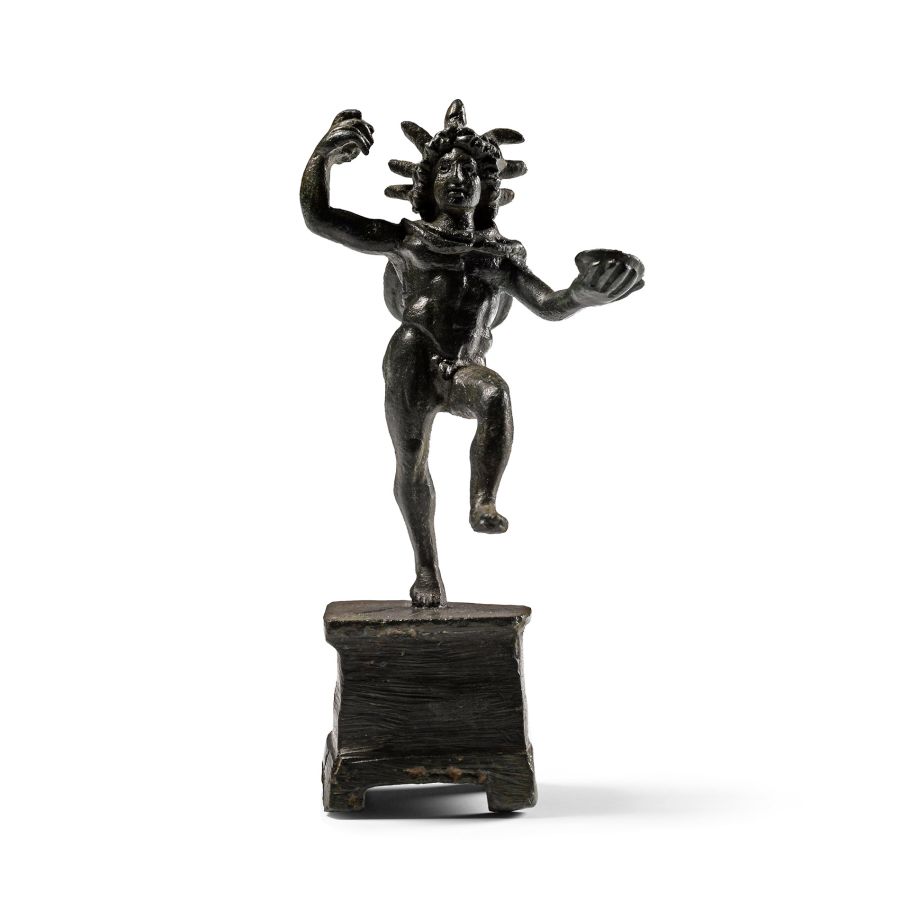
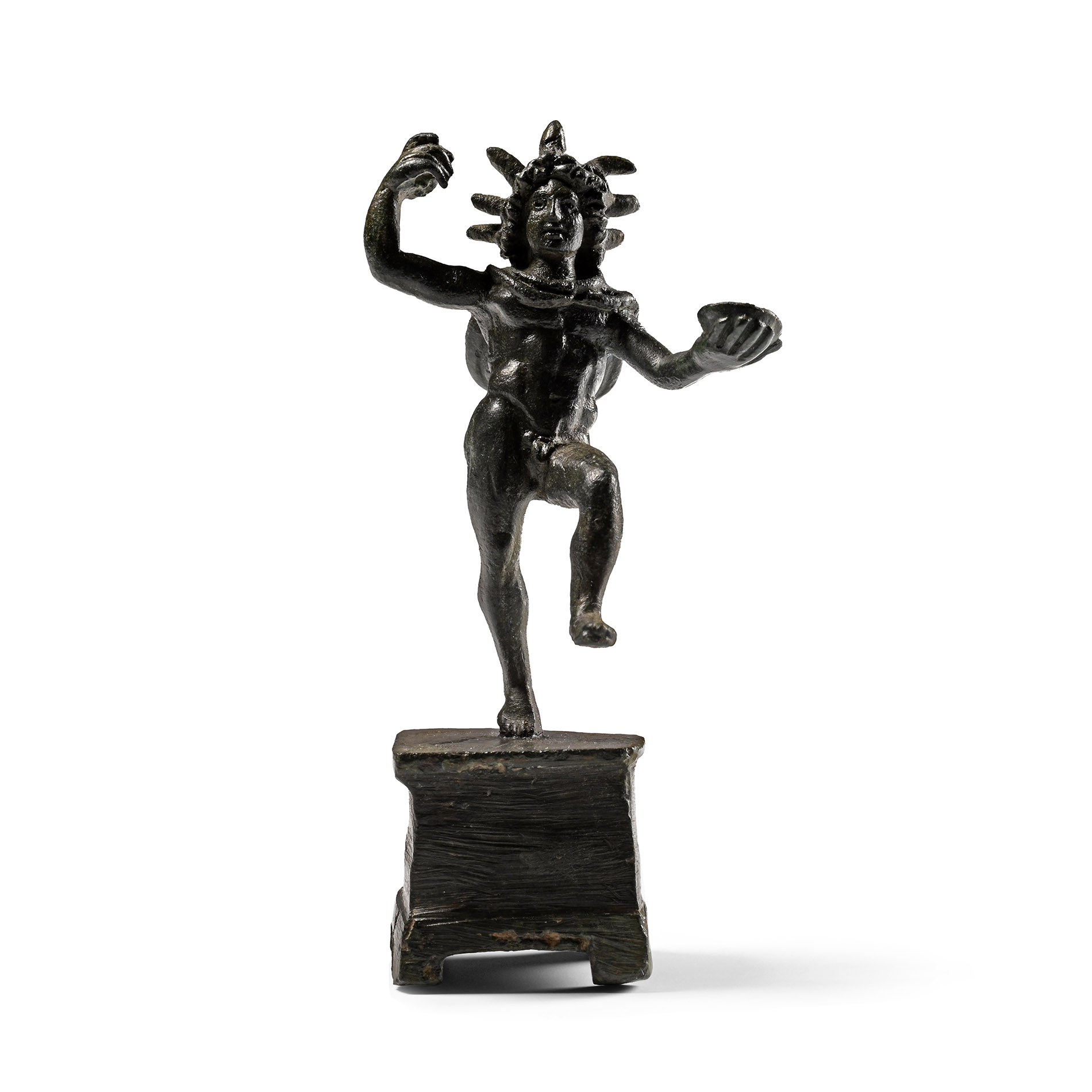
Roman Bronze Dancing Sol Statuette
CIRCA 1ST-2ND CENTURY A.D.
2 3/4 in. (57 grams, 72 mm including stand).
Standing nude on one leg on a cuboid socle base, the other leg raised and extended, right arm raised and bent, hand open to accept a sceptre, left arm extended with patera in the open hand, short mantle to the shoulders, hair and rays framing the face.
ProvenanceAcquired on the German art market before 2000.
From an EU collection before 2020.
Cf. similar in the British Museum under accession number 1865,0712.17.
CONDITIONTimeLine Auctions follows a vetting process to ensure the authenticity and legality of all items, reinforcing our commitment to integrity and responsible trading. Each antiquity, antique, and coin lot undergoes thorough examination by a vetting committee of at least ten external specialists, professional trade association members, scientists, and archaeologists: Our Vetting Process
AUCTIONS:
TimeLine is a leading auction house specialising in antiquities, ancient art, collectables, natural history, coins, medals, and books. Our auctions offer museums, collectors, historians, and enthusiasts the opportunity to acquire unique and historically significant pieces.
-
.jpg)
Roman Redware Fragment with Diana
4th-5th century A.D.Sold for (Inc. bp): £143
Curved ceramic fragment with high-relief image to the inner face, female in short-sleeved undergarment and outer stola draped over her head as a hood, holding a rod in her left hand and extending her right arm across her body. 19.6 grams, 63 mm
Acquired 1960s-1990s. From the late Alison Barker collection, a retired London barrister. -
.jpg)
Late Roman Geometric Floor Mosaic
Circa 6th-8th century A.D.Sold for (Inc. bp): £3,250
Comprising three full and one partial octagon, each with two concentric rhombuses distinguished by different shades of yellow, white and light red, each with a central red dot; the border above with a band of red triangles; mounted on a reinforced backing board. 59 kg, 151 cm wide including frame
Acquired 1970s-1996. Property of a North American collector. London collection, 2016. Accompanied by an academic report by Dr Raffaele D'Amato. This lot has been checked against the Interpol Database of stolen works of art and is accompanied by search certificate number no.11920-207410.
The use of abstract and geometric motifs characterises the mosaic art of the Levant under the domination of Byzantium. Close ties can be identified between these rhomboidal figures with those of some of the famous Lebanese mosaics of Beit el Dine, or the mosaics of Tiberias and Hammat, which represent the last expression of Roman art in that area before the Islamic conquest. -
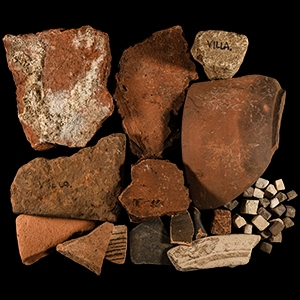
Roman 'St Albans' Pottery Sherd and Mosaic Tesserae Group
1st-4th century A.D.Sold for (Inc. bp): £26
Comprising large tile and vessel fragments, some with inked notes; and a group of white and grey tesserae, including one large redware tessera. 2.3 kg total, 1-17 cm
Found St Albans, Hertfordshire, UK. Acquired from the finder in 2008. Property of a Nottinghamshire gentleman.
The great monuments of Verulamium were efficiently destroyed by the medieval builders of Saxon and Norman abbeys. They sought Roman bricks and, above all, limestone which could be burnt for mortar. Most of the ancient Roman town stone monuments were broken up and thrown into lime kilns. These surviving fragments give a hint of what was once there. For the monuments and buildings Romans used Northamptonshire limestone, but the more delicate, finely carved inscriptions were realised in Purbeck marble from Dorset.
