
Loading, please wait...

LOT 0863
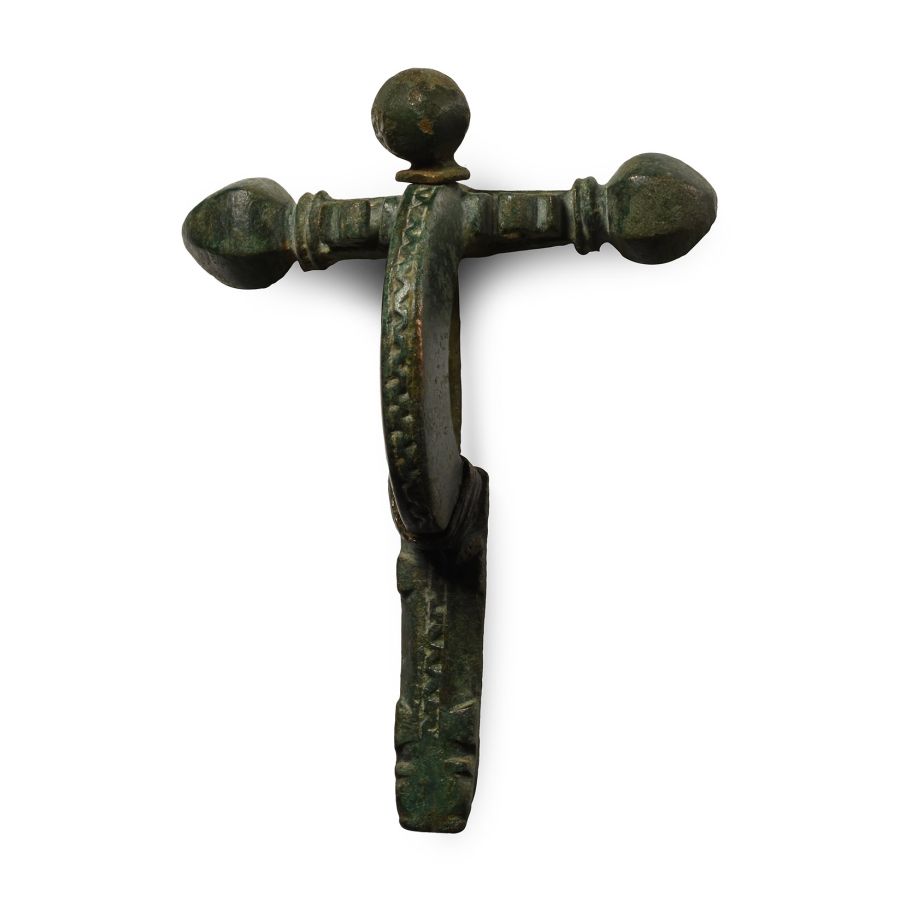
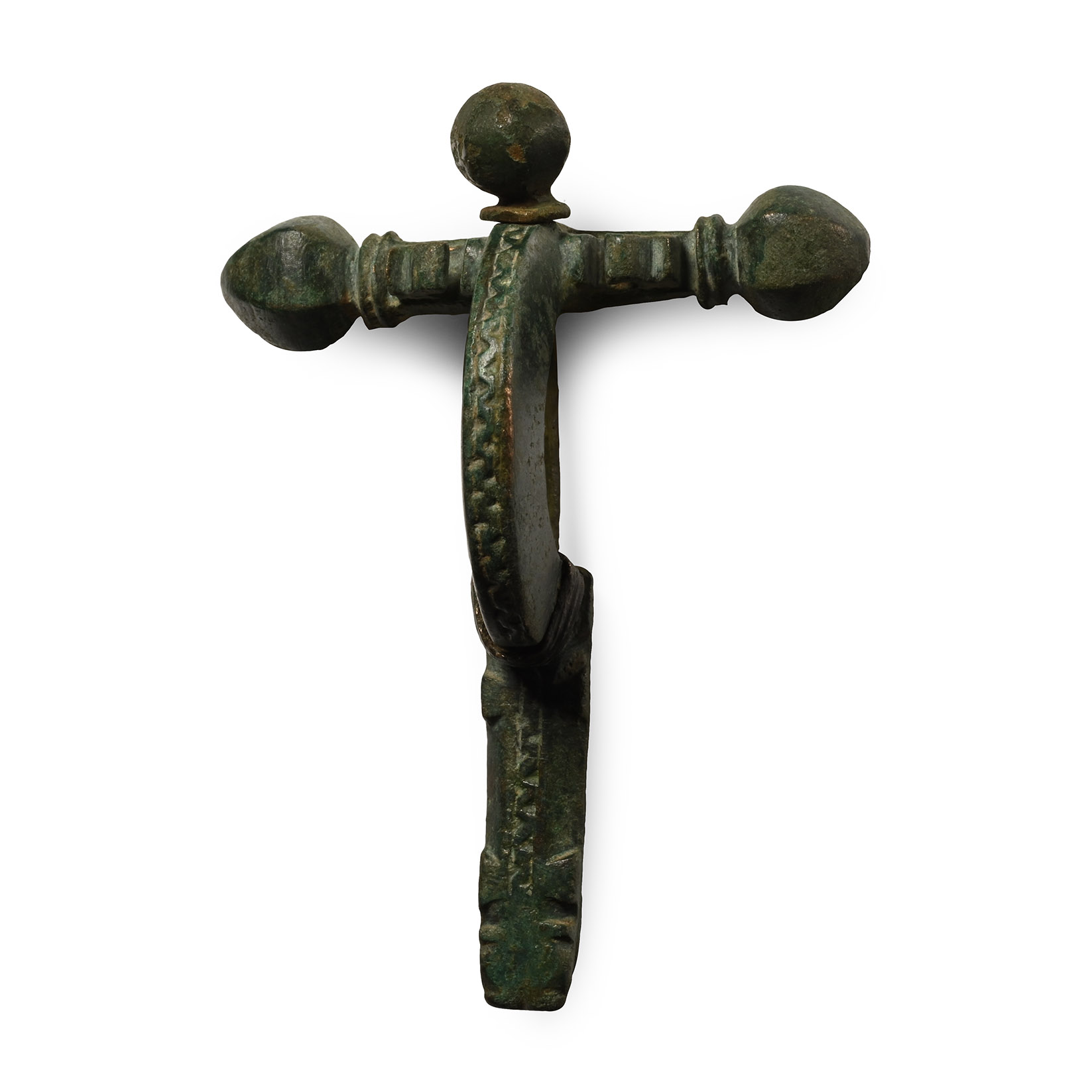
Roman Bronze Crossbow Brooch
4TH CENTURY A.D.
2 5/8 in. (41 grams, 68 mm).
With facetted onion-knop finials, keeled bow with a central decorative panel extending to the footplate, separately made ribbed collar to the bow. [No Reserve]
ProvenanceEx German art market, 2000s.
Acquired from an EU collector living in London.
From the collection of Surrey, UK, gentleman.
TimeLine Auctions follows a vetting process to ensure the authenticity and legality of all items, reinforcing our commitment to integrity and responsible trading. Each antiquity, antique, and coin lot undergoes thorough examination by a vetting committee of at least ten external specialists, professional trade association members, scientists, and archaeologists: Our Vetting Process
AUCTIONS:
TimeLine is a leading auction house specialising in antiquities, ancient art, collectables, natural history, coins, medals, and books. Our auctions offer museums, collectors, historians, and enthusiasts the opportunity to acquire unique and historically significant pieces.
-
Roman Bronze Grotesque Silenus on Dolphin Handle
Circa 2nd century A.D.Sold for (Inc. bp): £390
Formed as a dolphin with hollow-formed curved body attached at the mouth to the base; standing on the dolphin's lower back, a grotesque bearded figure of Silenus with a furry body, and with a rope tied around his waist, his arms spread holding a cymbal in each hand; stub to the rear where the dolphin's tail joined to form a loop; mounted on a custom-made stand. 370 grams total, 17.5 cm including stand
From a collection acquired on the UK art market from various auction houses and collections mostly before 2000. From an important Cambridgeshire estate; thence by descent.
Silenus is here represented as Papposilenus, a representation of Silenus that emphasises his old age, particularly as a stock character in satyr play or comedy. His costuming includes a body stocking tufted with hair (mallōtos chitōn) that seems to have come into use in the mid-5th century B.C. -

Roman Marble Relief of a Woman
1st century B.C.Sold for (Inc. bp): £520
Featuring a female face shown in three-quarter view with short locks framing her face, full lips and wide nose. 1.7 kg, 16 cm
Acquired in the mid 1980s-1990s. Private collection, Switzerland, thence by descent. Private collection, since the late 1990s. -

Large Roman Bronze Chariot Fitting with Imago Clipeata of a Priest of Mithras
Late 3rd-early 4th century A.D.Estimate: £25,000 - 35,000 (+bp*)
Opening Bid: £12,500
Representing a facing bust of a mature man with his head turned slightly to the right; short hair and a full, neatly trimmed beard, furrowed brow and strong eyebrows, deep-set eyes with heavy eyelids, eyes marked with pupils; dressed in a short-sleeved tunic draped around the neck and wearing a conical cap, holding an egg in his left hand; pierced through the surrounding roundel; mounted on a custom-made display stand. 1.8 kg total, 24.5 cm including stand
J.J. Klejman, New York, 1963. with Gallery Six, New York, 1991. with Christie's, New York, 11 December 2014, no.156 ($50,000-$70,000). Private collection, London. Accompanied by an academic report by Dr Raffaele D'Amato. This lot has been checked against the Interpol Database of stolen works of art and is accompanied by search certificate number no.12361-226874.
In the Mithraic cult the egg is a symbol of eternal time, and associated with the birth of god Mithras. The cult of Mithras, the god of the legions, whose symbol was the Sol Invictus, was popular during the 3rd century and in Tetrarchic Age. The chariot which this fitting adorned possibly wouldn't have been used in war, but in triumphal and religious processions, or simply for transport of priests.
