
Loading, please wait...
_900x900.jpg "Roman Bronze Candelabrum Base with Dolphins")
_200x200.jpg "Roman Bronze Candelabrum Base with Dolphins")
.jpg "Roman Bronze Candelabrum Base with Dolphins")
LOT 0128
Roman Bronze Candelabrum Base with Dolphins
1ST-2ND CENTURY A.D.
7 3/4 in. (980 grams, 19.5 cm).
Tripod form with splayed legs, feet formed as scallops and legs as sinuous dolphins, scallops between the tails; central column with fixing spike.
ProvenanceEx old English collection.
London art market, 1980s.
This lot has been checked against the Interpol Database of stolen works of art and is accompanied by search certificate number no.11890-207744.
Cf. similar in the collection of the British Museum under accession no.OA.873.
CONDITIONTimeLine Auctions follows a vetting process to ensure the authenticity and legality of all items, reinforcing our commitment to integrity and responsible trading. Each antiquity, antique, and coin lot undergoes thorough examination by a vetting committee of at least ten external specialists, professional trade association members, scientists, and archaeologists: Our Vetting Process
AUCTIONS:
TimeLine is a leading auction house specialising in antiquities, ancient art, collectables, natural history, coins, medals, and books. Our auctions offer museums, collectors, historians, and enthusiasts the opportunity to acquire unique and historically significant pieces.
-
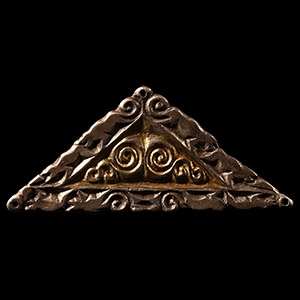
Late Roman Silver-Gilt Triangular Belt Mount with Lions
4th-5th century A.D.Estimate: £500 - 700 (+bp*)
Opening Bid: £200
The borders with spiral motifs and running lions, a hole in each corner for fastening pins. 8.97 grams, 60 mm
Acquired early 1990s. From an East Anglian private collection.
By the second half of the 4th century, broad Roman military belts were decorated with chip-carved mounts and plates. The fittings were realised by punching or by chip carving different patterns and motifs. -
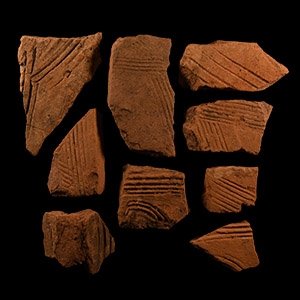
Roman Roof Tile Fragment Group
Circa 1st-3rd century A.D.Sold for (Inc. bp): £33
Mainly amorphous, including examples displaying combing or attachment lips. 1.26 kg total, 5.6-13.1 cm
Found Somerset/Devon, UK. -
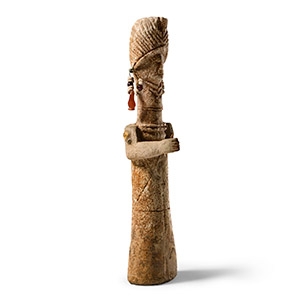
Roman Bone Child's Doll
1st century B.C.-1st century A.D.Sold for (Inc. bp): £364
The free-standing human figure carved with a long neck and voluminous hairstyle, with a stylised face and suggestions of necklaces; remains of a previously articulate arm held at a right angle to the body, hoop earrings with bead ornament to both ears. 133 grams, 18.5 cm
London, UK, gallery, 1971-early 2000s.
