
Loading, please wait...
LOT 0570
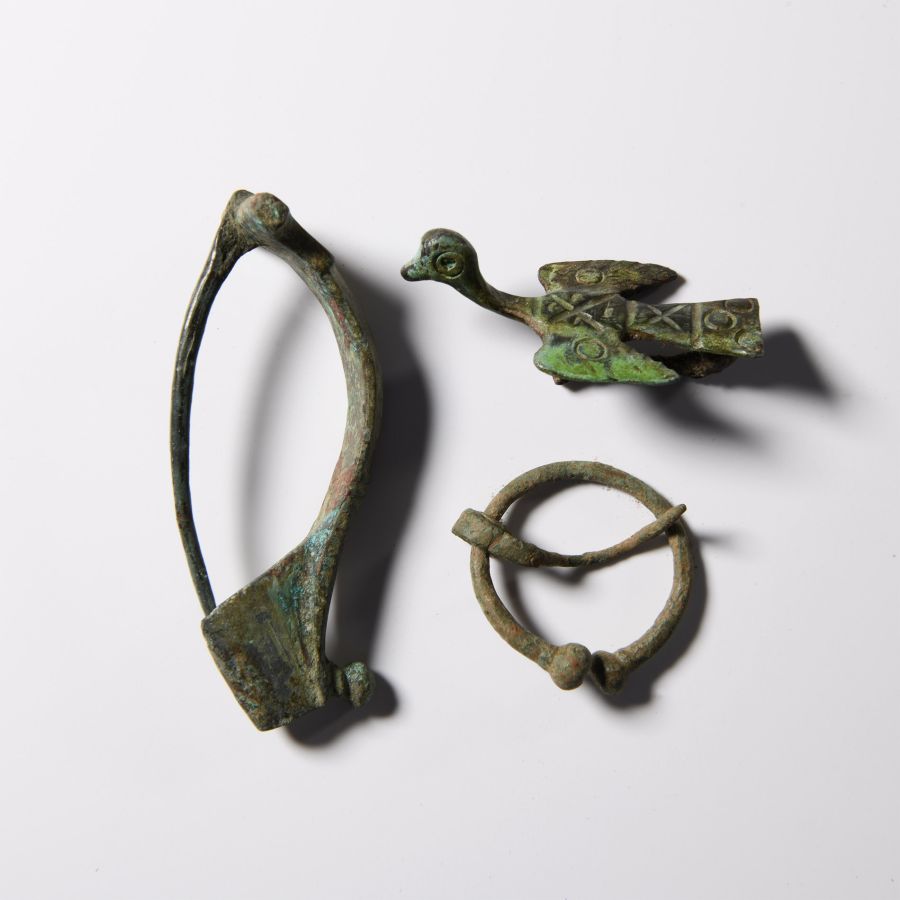
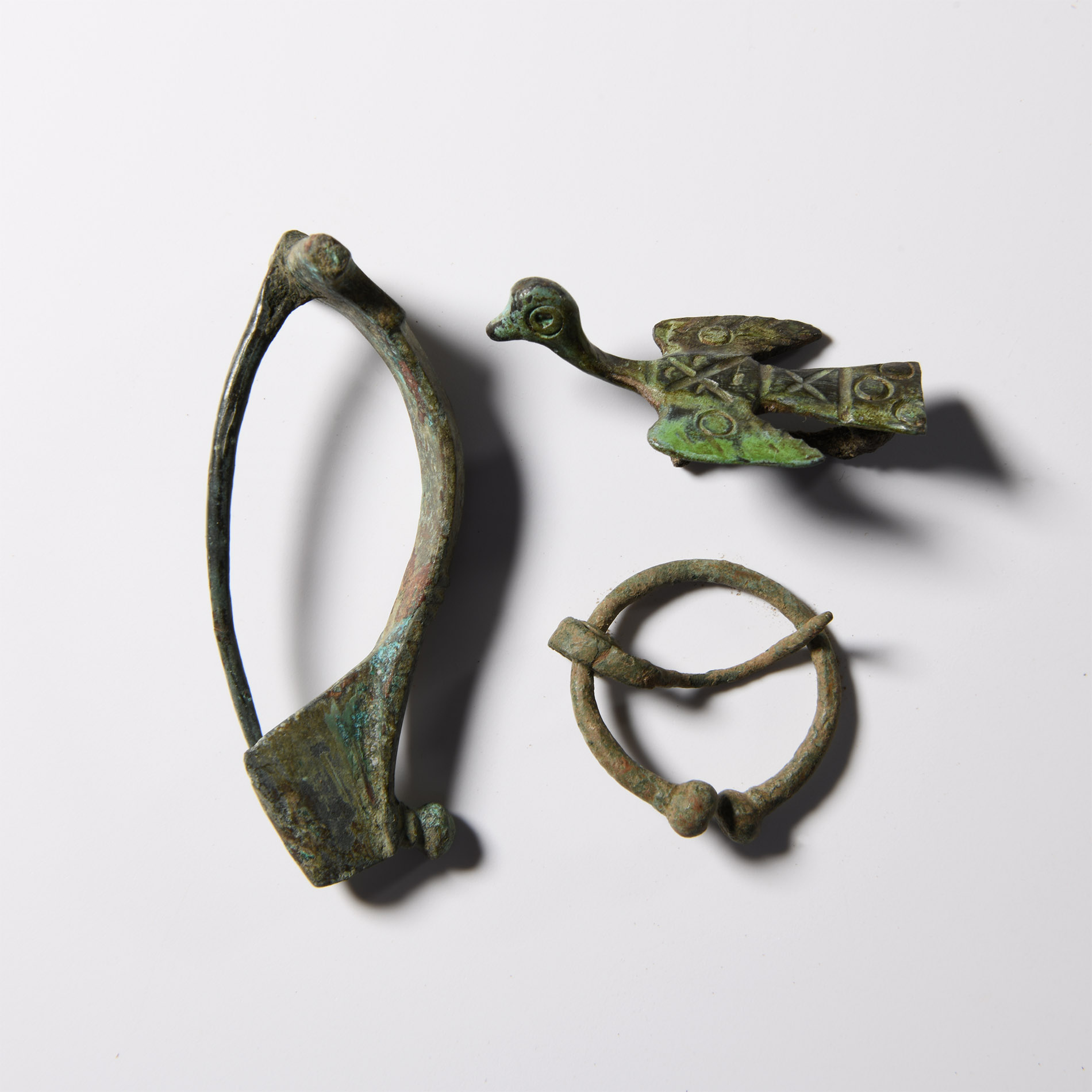
Roman Bronze Brooch Group
1ST-4TH CENTURY A.D.
1 1/4 - 2 1/2 in. (31 grams total, 31-63 mm).
Comprising: a bird-in-flight with incised annulets and X-motifs to the body, accompanied by a typed ticket 'Roman bronze brooch of bird in flight, beautifully incised decoration, iron pin intact, 2nd century AD, authenticated by British Museum, 30/5/2006'; a penannular brooch with clubbed terminals; a bow brooch with carinated bow. [3, No Reserve]
ProvenanceAcquired in the 1980s-1990s.
Property of a Nottinghamshire gentleman.
TimeLine Auctions follows a vetting process to ensure the authenticity and legality of all items, reinforcing our commitment to integrity and responsible trading. Each antiquity, antique, and coin lot undergoes thorough examination by a vetting committee of at least ten external specialists, professional trade association members, scientists, and archaeologists: Our Vetting Process
AUCTIONS:
TimeLine is a leading auction house specialising in antiquities, ancient art, collectables, natural history, coins, medals, and books. Our auctions offer museums, collectors, historians, and enthusiasts the opportunity to acquire unique and historically significant pieces.
-
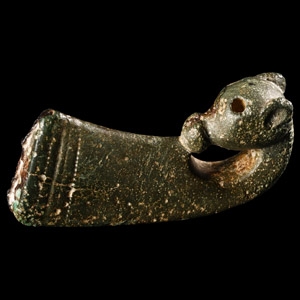
Romano-British 'Essex' Bronze Dragon Knife Handle
Circa 1st century A.D.Sold for (Inc. bp): £208
With a series of pointillé bands at the base, terminal in the form of a stylised beast with neck curling to form a loop and the head facing back towards the blade; ferrous remains to the broad end. 40.7 grams, 46 mm
Found Essex, UK. Property of an East Sussex, UK, private collector. Recorded with the British Museum's Portable Antiquities Scheme (PAS) with record no.ESS-AC745B. -
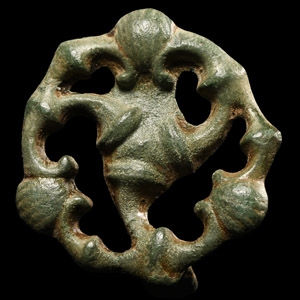
British Roman Military Bronze Plate Brooch with Scallop Shells and Trumpets
2nd-3rd century A.D.Sold for (Inc. bp): £111
The face moulded with a central motif of three trumpet heads all meeting at a triangular central point, in-between each outer trumpet motif is a scallop-shell like element; the reverse carry's a single rectangular lug for the spring and pin, and a single transverse rectangular tab to act as a catchplate, but appears to be unfinished. 10.8 grams, 35 mm
Found whilst searching with a metal detector near Kettlewell with Starbotton, North Yorkshire, UK, early 2022. The evidence of the manufacturing process makes this find a 'Find of Note', and has been designated by the British Museum's Portable Antiquities Scheme to be of Regional importance. Accompanied by a copy of the British Museum's Portable Antiquities Scheme (PAS) report no.SWYOR-A1B317.
Mackreth notes that this brooch is uncommon in Britain. This brooch directly parallels LIN-B8C6EB and no.11664 (Mackreth 2011, p.172-173, Type 7c, no.11664, p.115). -
.jpg)
Roman Bronze Plaque with Eros on Lion
Circa 2nd-4th century A.D.Sold for (Inc. bp): £1,430
Modelled in relief with openwork elements, stylised detailing to both figures; hollow reverse. 182 grams, 10.2 cm high
Acquired 1990s-early 2000s. East Anglian private collection.
Hollow cast bronze images of Eros riding a lion are linked to the Eastern Levant and have been found for example in Tamna, probably a Roman import. The importance of long-distance contacts within the Eastern Mediterranean areas was rapidly reflected in provincial artistic styles, probably as soon as in Hellenistic times, at the beginning of the third century B.C., possibly even earlier. The unquestionable Greek influence led a number of scholars to define three main styles for the bronzes discovered in the eastern Roman provinces: a local type and iconography locally produced, Greek or Roman imports, and Oriental, Hellenistic, or Roman style, locally produced.
